Feeds:
Posts
Comments

Archive for the ‘Quote’ Category

Edible Sendak

***********************

Once a little boy sent me a charming card with a little drawing on it. I loved it. I answer all my children’s letters — sometimes very hastily — but this one I lingered over. I sent him a card and I drew a picture of a Wild Thing on it. I wrote, “Dear Jim: I loved your card.” Then I got a letter back from his mother and she said, “Jim loved your card so much he ate it.” That to me was one of the highest compliments I’ve ever received. He didn’t care that it was an original Maurice Sendak drawing or anything. He saw it, he loved it, he ate it.

–Maurice Sendak

**********************

He saw it, he loved it, he ate it.

I love this little episode from Maurice Sendak. Reinforces my own faith in the judgement of children when it comes to art. Their reactions are pure and unadulterated– with the emphasis on the adult portion of that word. Kids look at things without pretensions and preconceived notions of what art is or is not. I am happiest when a kid reacts strongly to my work.

If only I could paint something that some kid would love enough to eat…


Read Full Post »

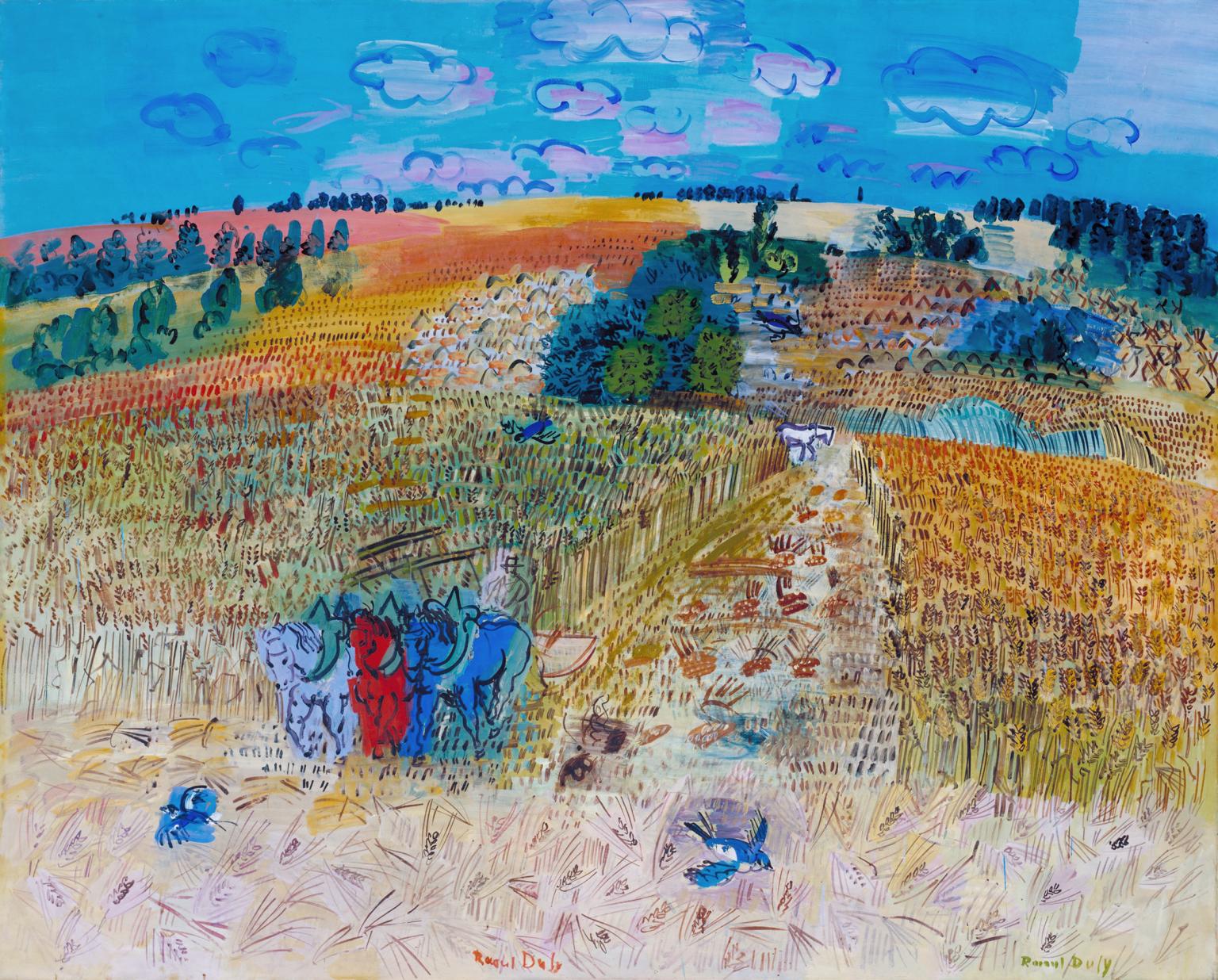
The Wheatfield -1929- Raoul Dufy

************************

I don’t follow any system. All the laws you can lay down are only so many props to be cast aside when the hour of creation arrives.

Raoul Dufy (1877-1953)


**********************

I can’t say I am the biggest fan of the paintings of Raoul Dufy or his younger brother, Jean Dufy (1888-1964) , French painters who were popular in the first half of the 20th century. It’s not that I don’t find them attractive and pleasant. While I particularly like the painting at the top , The Wheatfield, from 1929, they just don’t speak to me deeply.

But I like and agree with Raoul’s words above. Rules and systems may be fine and necessary up to a point. The trick comes in knowing when to blow past the limitations that they set on your work. When it comes down to making a piece work and come to life, rules and systems are often set aside. Whatever it takes to create rhythm, energy, and harmony within the painting becomes acceptable.

Casting aside rules is often the beginning of a new artistic freedom. It’s like taking off the training wheels and feeling the fear and freedom of being out there on your own.

Got to go try to break some rules right now. Have a great day.

Read Full Post »

************************

It seems at times I should be a composer of sounds, not only of rhythms and colors. Walking under the trees, I felt as if the color made sound.

Charles E. Burchfield

************************

I have featured the work of one of my favorite painters, Charles Burchfield, here a number of times. He is one of those artists whose work attracts me in a very big way yet I never feel that I am able to pull anything from it that will end up in my own work. It’s that distinct in its voice.

My affinity for his work also extends to his thoughts on his work, including the words above. Like Burchfield, I often equate color and form with sound and vice versa. What I might consider my best work has, for me, the quality of music. I don’t know if it’s apparent to anyone but me but I often see some of my paintings as songs with rhythm and lines of melody. I am pretty sure Burchfield felt the same.

Much to do this morning getting work ready for my Principle Gallery show so I am cutting this short. But please take a stroll though some of Burchfield’s work. Listen well because there is music to be heard.


Read Full Post »

******************

The mantra becomes one’s staff of life, and carries one through every ordeal. It is no empty repetition. For each repetition has a new meaning, carrying you nearer and nearer to God.”

–Mahatma Gandhi

*****************

I wanted part of my upcoming June show at the Principle Gallery to feature not only new growth, as the show’s title implies, but a few nods of acknowledgement back to my older work. The new painting above, one that I finished just yesterday and am calling Mantra, is such a nod.

I have periodically used multiple images in my work through the years. Some were quite large back in my earlier days, some having as many as 60+ images making up the piece. I am attracted by the look of these piece but also by the mindset required when painting them, one with a blank concentration, one that produces a repetition of thought and form.

This repetition of thought and form produces small incremental changes in each cell. Each is the same but slightly different.

That could be the mantra for my work.

Over the past twenty years of these shows, the work has always changed in small increments. Changes in colors and tones. Changes in strokes and textures. Additions and subtractions in elements and forms. Each is the same but slightly different.

Again, the mantra.

I guess that is why I chose that word mantra for the title. As Gandhi points out above, it is no empty repetition.

Each repetition is new and has its own meaning even though it is seemingly the same. Each is its own moment in time, its own coordinate on the grid of time and space.

Whether this repetition takes one closer to god, as Gandhi adds, I cannot say. I don’t know what that even means. But if it means that it brings one closer to understanding and a sense of unity with this world, then I agree heartily and this painting, this mantra, says everything I need to know.

***********************

My new solo exhibit at the Principle Gallery , my 20th annual show there, is titled Red Tree: New Growth and opens June 7, 2019 at their Alexandria, VA gallery.  The painting above, Mantra, will be included in this show.

Read Full Post »

****************

Do not try to paint the grandiose thing. Paint the commonplace so that it will be distinguished.

William Merritt Chase (1849-1916)

****************

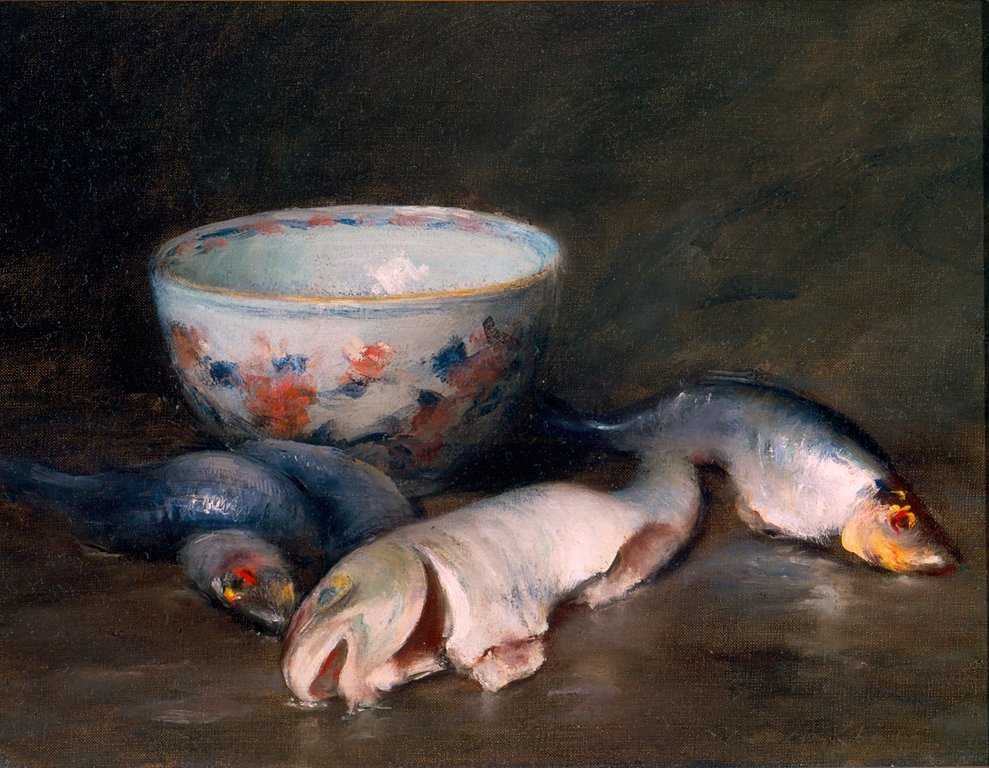
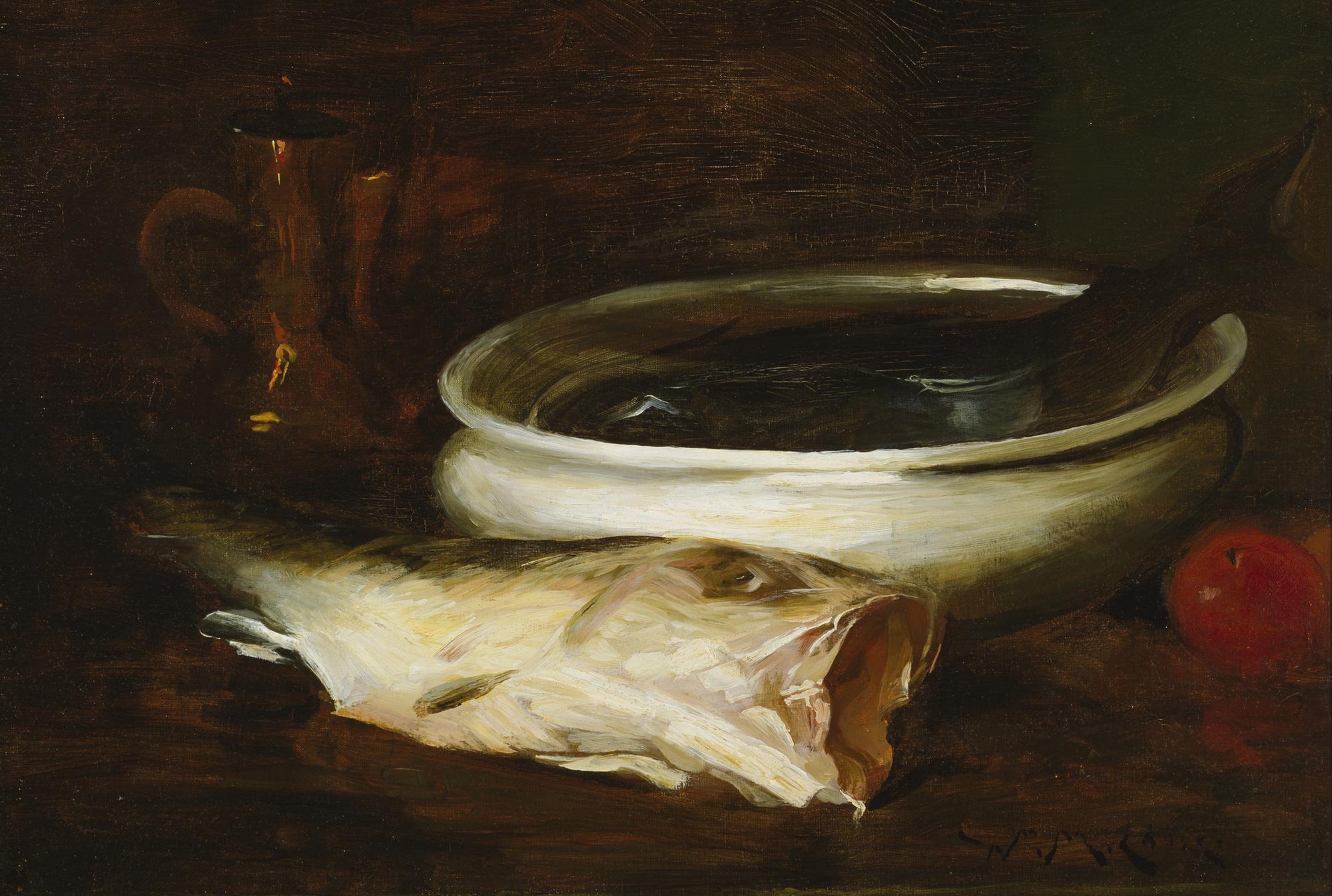
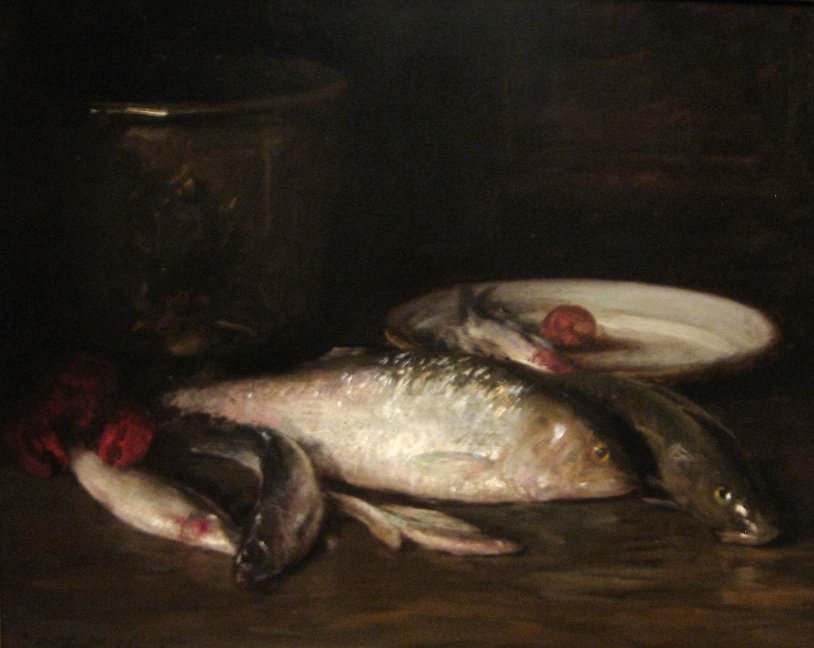
Love these words from the great American painter William Merritt Chase. I echo the sentiment whenever I get a chance to speak with art students, telling them to focus less on subject and more on how they render whatever they choose to depict. Most of the greatest paintings are of very common things, people and places. It is how they are painted that lifts and distinguishes them.

Chase was one of the dominant figures of American art in the late 1800’s. He was a prolific and renowned painter and among the first American Impressionists as well as an influential teacher who established a progressive art academy in NYC, The Chase School, that today is the Parsons School of Design.

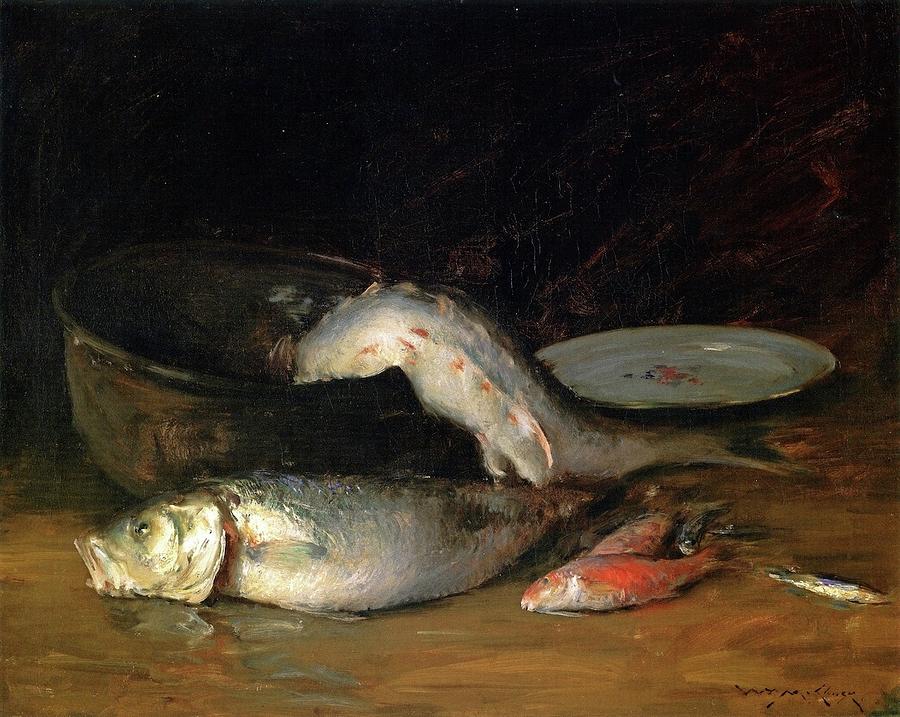
Some of Chase’s best known work is a great example of his words above. He painted the gamut of subjects– landscapes, portraits and still lifes– and is well known for each of these fields. His still life paintings with fish were among his favorite subjects, one that he often employed for painting demonstrations for his students. These pieces were done in a fast, wet into wet technique that relied on extreme contrasts of dark and light , setting aside detail for gesture and impression.

I don’t know how many of these fish pieces Chase painted but it appears to be quite a large figure. A number of years back, the Principle Gallery had one of his fish pieces in the gallery for sale and I remember being very impressed because whenever I thought of Chase his fish paintings always came to my mind.

Here are just a few examples.

Read Full Post »

********************

“There is a pleasure in the pathless woods,

There is a rapture on the lonely shore,

There is society, where none intrudes,

By the deep sea, and music in its roar:

I love not man the less, but Nature more”

Lord Byron, Childe Harold’s Pilgrimage

********************

This another new painting, coming in at 24″ by 24″ on canvas, that is headed to the Principle Gallery for my annual solo show there. The show,my 20th solo effort at the Alexandria gallery, is titled Redtree: New Growth and opens on June 7. This painting is titled Solitude’s Rapture.

I don’t know if solitude is for everybody. Some people might look at this painting with a little discomfort, seeing in it isolation and loneliness. But for myself, it represents a total freedom of the self, one that allows one’s absolute truth to emerge. A freedom that allows one to experience clear glimpses of our connection with all being.

The lines above from Byron’s Childe Harold’s Pilgrimage express this feeling well. Alone on a shore, one can begin to hear and converse with nature. The lap and roar of the sea becomes language as does the light of the sun and moon as it sifts through clouds above. It is in these conversations that we come to better understand that we are both small and large, insignificant yet integral.

Of  course, this is not a practical matter for most of us. I have my own little island of solitude here in my studio but I am not isolated. My regular life has me out in the world, interacting with people on a regular basis. But knowing that I will soon be back on my island where the only conversation taking place is in myself.

Hermann Hesse put it well in the excerpt below from his book, Reflections. He mentions it as being a way of bitter suffering. I suppose initially, for those who have been always in the society of others and seldom alone, this may be the case when faced with solitude. But, as he points out, when you get past that discomfort, the rewards of solitude are rapturous.

*********************

“We must become so alone, so utterly alone, that we withdraw into our innermost self. It is a way of bitter suffering. But then our solitude is overcome, we are no longer alone, for we find that our innermost self is the spirit, that it is God, the indivisible. And suddenly we find ourselves in the midst of the world, yet undisturbed by its multiplicity, for our innermost soul we know ourselves to be one with all being.”

Hermann Hesse, Reflections

**********************

Read Full Post »

******************

To appreciate a work of art, is it okay to like what you like, and the heck with the art critics and experts? Absolutely.

–Thomas Hoving

*******************

I came across this quote from the late Thomas Hoving and thought it would be a good opportunity to show off an illustration of him done by the late David Levine, the famed illustrator/artist whose distinct caricatures adorned the New York Review of Books for many years, along with many other publications. The original drawing now hangs in a corner of my studio, obtained from the estate of Thomas Buechner who was friend to both Levine and Hoving.

Hoving was primarily a museum director. Now that sounds pretty blasé on its surface but among his peers he was a rock star,writing bestselling books and ushering the Metropolitan Museum into a renaissance of sorts as its director. He was big personality in what is often a low key position.

His words above definitely ring true as good advice to anyone who has ever felt anxious about purchasing or even sharing their opinion on a piece of art. Feel free to buy and admire work that speaks to you, regardless of what critics might say. Art is based on an emotional elicitation and nobody can dictate how anyone should respond to any one piece of work. A critic may have a response to a work of art and write effusively about that work, perhaps even making cogent points about the validity of the work. But if I don’t feel that same emotional response, all the eloquence in the world telling me why I should like it cannot make me suddenly adore that work.

In short, we like what we like.

I’ve seen people in high powered positions, people who normally ooze confidence, suddenly turn to jelly when trying to decide whether they should buy a piece of art. Art is such a nebulous and subjective thing that many of these folks feel a bit lost and out of their depth. They are afraid of making a mistake and lose all trust in their own opinion. They forget that they should simply like what they like and trust that feeling.

So, if you see something you like sometime, don’t be shy about showing your admiration for it. Maybe that means purchasing it or maybe it’s just letting the artist know that it moves you somehow.

Both are appreciated by every artist I have ever known.

Read Full Post »
*******************

“I learned this, at least, by my experiment: that if one advances confidently in the direction of his dreams, and endeavors to live the life which he has imagined, he will meet with a success unexpected in common hours.”

― Henry David Thoreau, Walden: Or, Life in the Woods

*******************

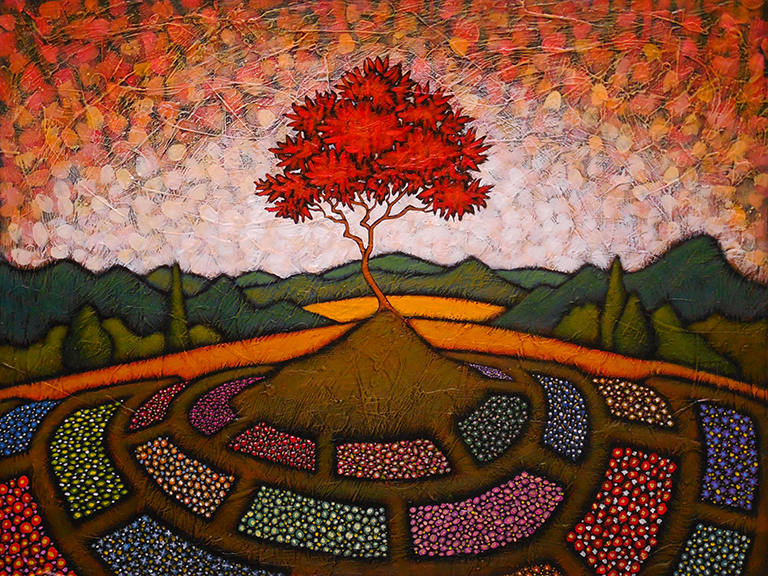
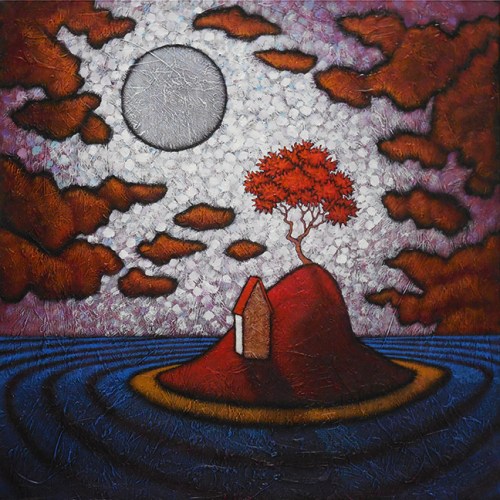
This is a new painting, 18″ by 24″ on panel, that is headed to the Principle Gallery for my upcoming show, Redtree: New Growth, that opens June 7. It’s been one of those pieces that keeps drawing my eye in its direction here in the studio. Maybe it’s the rings of colorful flowers– part of the New Growth from the show’s title–that encircle the Red Tree that attract my eye. They have a gem-like quality in the landscape.

I have mentioned in the past how I view many of my Red Tree paintings as being portraiture as much as they are landscapes, with the Red Tree and the foreground landscape often serving as the head and shoulders of a portrayed figure.  That certainly holds true for this piece, which I have titled  The Pharaoh’s Necklace.

In this piece, I see the Red Tree as a head held high with the colorful bands around the mound– the neck here– transforming from beds of flowers into a sort of necklace like those seen of the pharaohs of ancient Egypt. By the way, for your daily dose of useless facts, that type of necklace is called a usekh or wesekh.

Seeing this painting as a portrait, I see it as a portrayal of the strength and pride of someone who has, as Thoreau describes above, endeavored to live the life they have imagined in their dreams and have met with unexpected success.

More than that, it’s a painting of possibility, one that points out that we all have the potential to realize our hopes and aspirations, That is, if we can first formulate a dream. I sometimes get the feeling that many people have never given their dreams much thought.

As to those who have, I often wonder if many people actually maintain the dreams of their youth into their adulthood. If not, have they convinced themselves that these dreams were foolish and unattainable then finally ceased all pursuit? Or perhaps they had aspirations that didn’t match up with their actual strengths and abilities?

For example, I knew at an early age that my dream of being the ace of the St. Louis Cardinals pitching staff was off the table. And I never had the nerve to be a master thief. I knew my dreams had to focus on the few qualities I possessed and prized if they were ever going to come to fruition, if I was ever going to wear my own pharaoh’s necklace.

And, thankfully, there are some days when I do feel that I am sporting my own gem encrusted usekh. Those are the good days of this life and this painting is how those certain days feel to me.


Read Full Post »
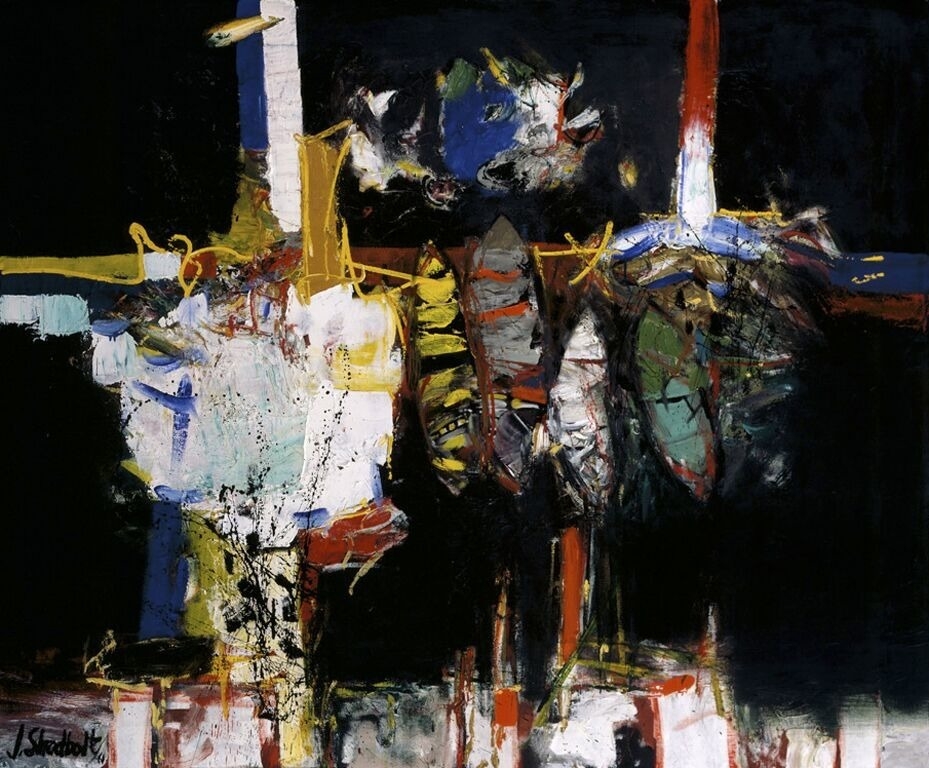
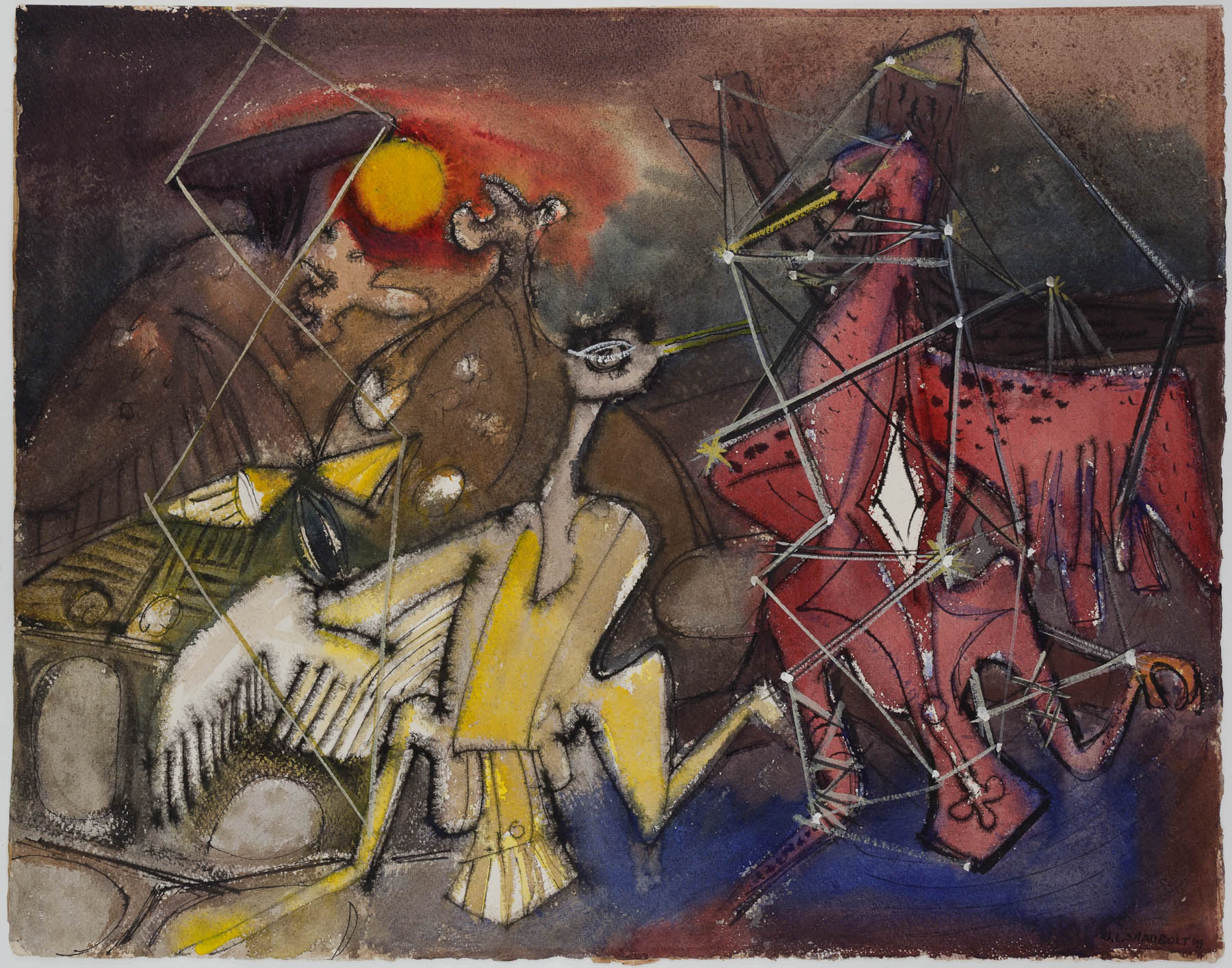
Jack Shadbolt- Presence After Fire – 1950

***********************

An artist is no bigger than the size of his mind.

–Jack Shadbolt (1909-1998)

***********************

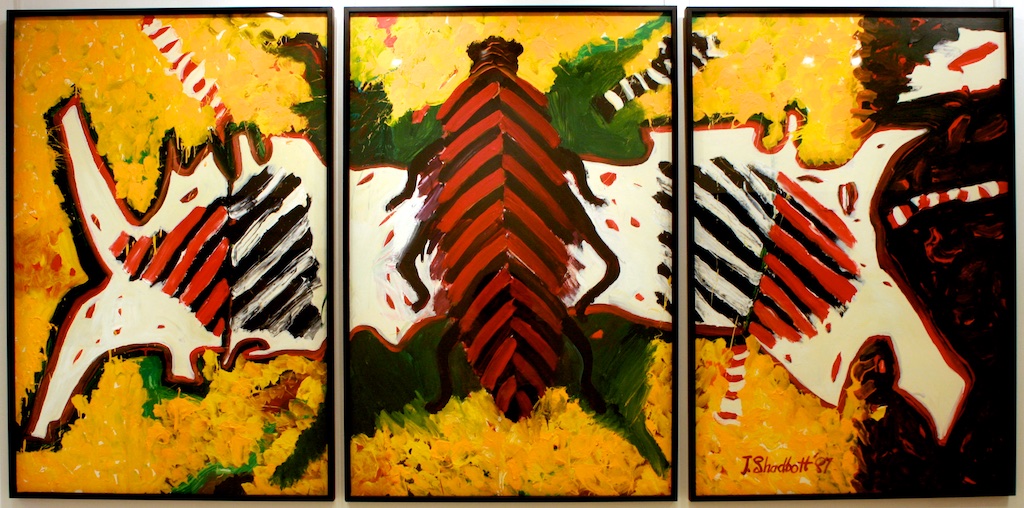
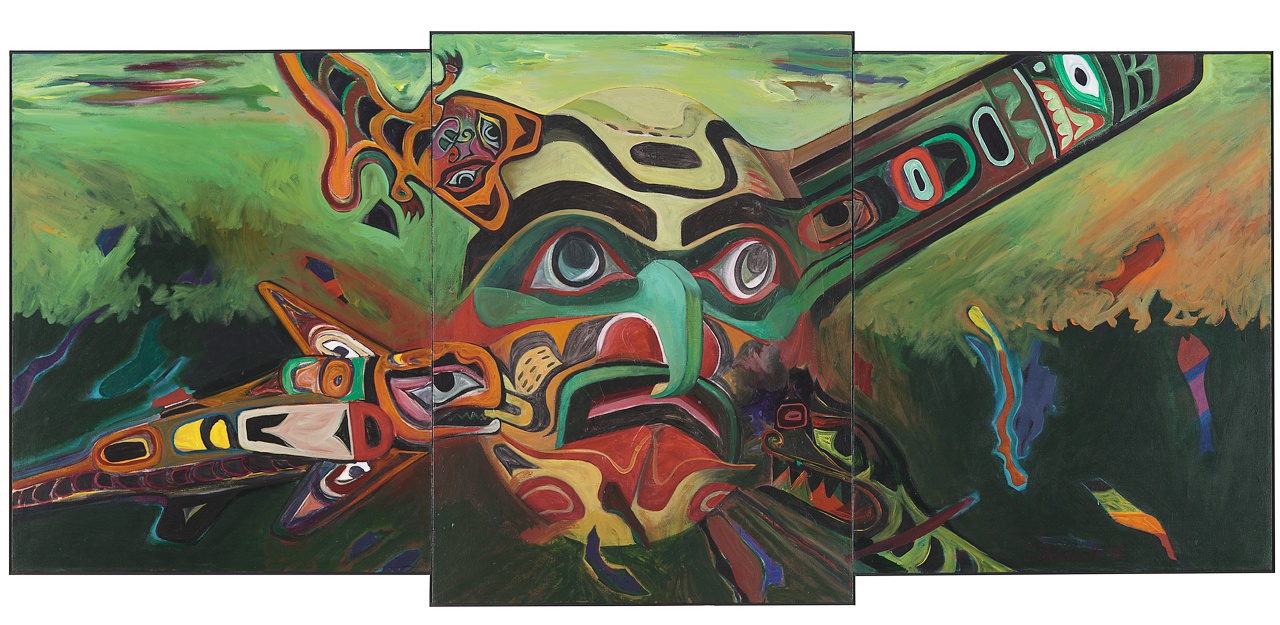
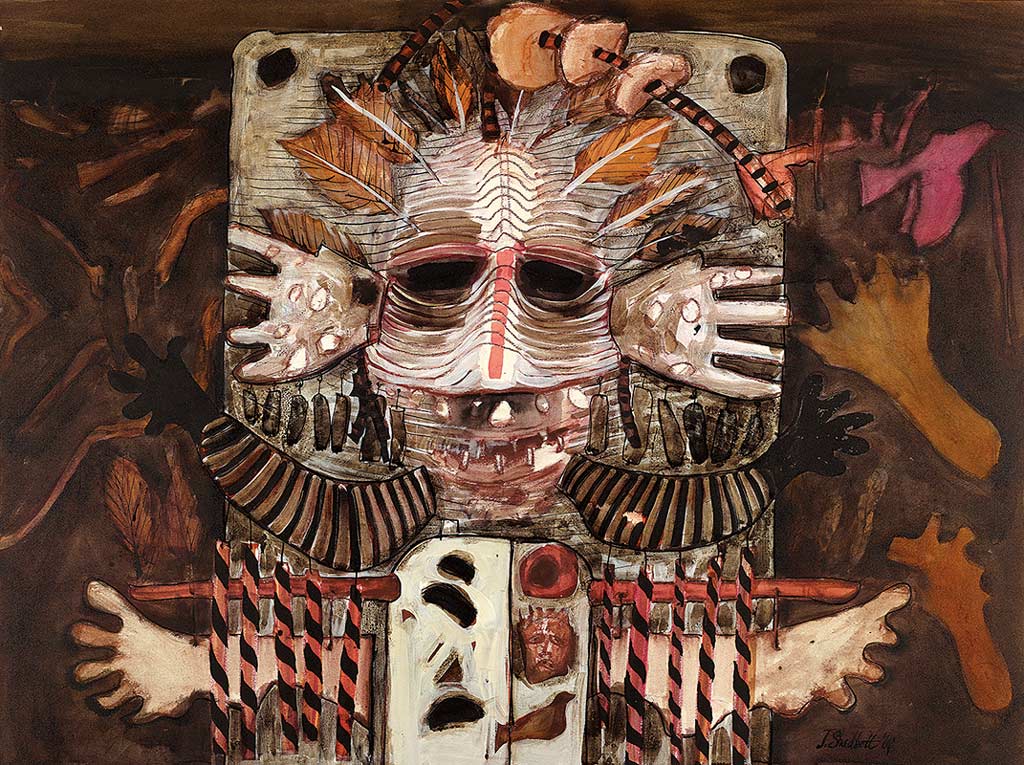
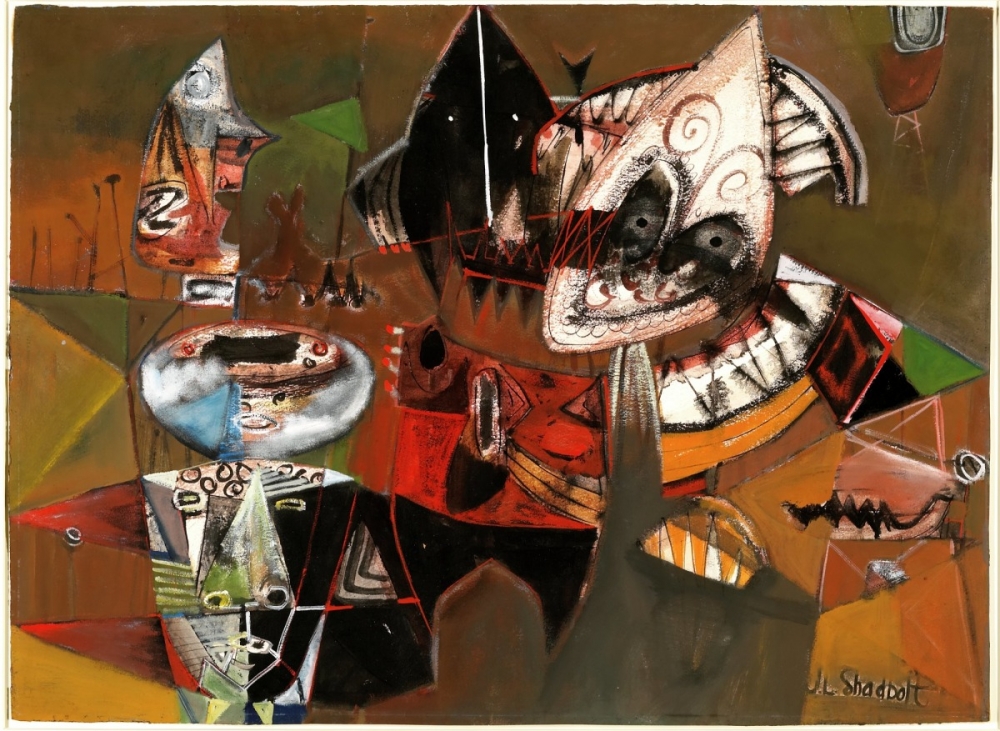
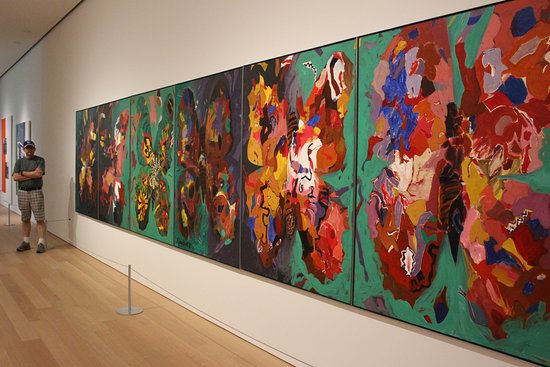
I have to admit that I knew little of the Canadian painter Jack Shadbolt before this morning. But I was immediately taken by his use of bold colors and forms along with an interesting use of symbolism depicted in a blend of representation and abstraction. I was also impressed with the scale of his many triptychs, their size giving the work greater weight. Just interesting work to put it simply.

There is a good short bio of Jack Shadbolt that you can read by clicking on this link. It gives you an idea of the forces, such as his World War II experiences, and people–his friendship with iconic Canadian painter Emily Carr, for example– that shaped his work. It also makes clear the influence his work has in his homeland.

One thing I discovered was that as Shadbolt was suffering at the age of 89 from congestive heart failure, his wife brought him home from the hospital. She set up a hospital bed in the center of his studio in British Columbia so that he might be surrounded by his paintings and be in that place where he had spent most of his time at his life’s work. He died there in his studio several days later.

I thought to myself that would not be a bad way to go. That is, if for some reason I decide to die someday.

But the focus today is on the short quote above, one with which I heartily agree. Whenever speaking to students I try to stress the need to grow their mind, to become an interesting person with something to say. To read more. To watch and listen more. To simply think and continue to learn.

Technique without an active mind behind it bears lifeless work.

At least, that’s my opinion. And Shadbolt said that beautifully and succinctly.

Now, take a look at some of the work of Jack Shadbolt.

Read Full Post »
*****************

There is always hope, as long as the canvasses are empty.

–Gustav Klimt

*****************

This quote from Klimt made me smile this morning, a little knowing smile. When I am getting ready for a show, such as I am now, the studio is initially filled with prepared empty canvasses of a wide variety of sizes, coated with layers of gesso and topped with a thick layer of black paint. They are everywhere, all propped up against any available surface that will support them.

Having them around is comforting, representing possibility. It is the hope of which Klimt speaks. Each blank canvas has the possibility of being a whole new world, a new experience, a new revelation. There is almost a hum of potential life coming from them.

But as the weeks and months pass and many of the canvasses are painted, taking on their new identities, the supply of blank surfaces dwindles down to the point where there is now only a smattering of blank canvasses scattered around the studio. It is at this point when I get anxious, most likely from no longer being surrounded by those empty surfaces that have come to symbolize hope and potential for me.

It is at this point that I can begin to see the end of this painting session, that soon I will have to stop for a bit to ready the work, to photograph, to stain frames and varnish paintings to make them presentable for the show. This makes makes me a little glum because I am usually very hyped up and wanting to do even more, to further explore all the new avenues that are opening up before me in the paintings in which I am working.

Looking around now and seeing just a few empty canvasses is a reminder of that coming point. It makes me pause in for a moment, anticipating that coming shift of gears, and for that moment I am a bit down. But reading Klimt’s words makes me smile, knowing that I just received a new shipment of canvas the other day which is waiting patiently downstairs to be prepped so that it soon can carry all my hopes and possibilities.

And the glumness fades.


Read Full Post »
« Newer Posts - Older Posts »