Feeds:
Posts
Comments

Singularity

singularity4


I had other things on my mind about what I would write here this morning. I was going to question how a law that makes giving a drink of water to someone in line at the polls a crime is supposed to prevent voter fraud. I was also going to question the motive for other such suppressive provisions in legislation being moved into law around much of this country.

But before I could start, I came across this short animation of a poem from poet Marie Howe and I decided that maybe this was the better way to go this morning.

Her poem is titled Singularity and refers to the theory Stephen Hawking (among others) set forth that the universe and all that it is was once a single thing before the Big Bang created all that we know the universe to be now.

We were all part of one thing.

No, we were that one thing.

That is as simple as I can put it and still understand it. I am not even sure that simple explanation is correct. Much as Howe explains to her audience, my own grasp of advanced physics and most other great scientific theoretical concepts is limited. But the idea that we were once one and that we may all at some point become one again is somehow appealing to something inside me.

I don’t know. My eternal refrain.

Take a look. The Marie Howe poem is below the video.


SINGULARITY
by Marie Howe

          (after Stephen Hawking)

Do you sometimes want to wake up to the singularity
we once were?

so compact nobody
needed a bed, or food or money —

nobody hiding in the school bathroom
or home alone

pulling open the drawer
where the pills are kept.

For every atom belonging to me as good
Belongs to you.
   Remember?

There was no   Nature.    No
 them.   No tests

to determine if the elephant
grieves her calf    or if

the coral reef feels pain.    Trashed
oceans don’t speak English or Farsi or French;

would that we could wake up   to what we were
— when we were ocean    and before that

to when sky was earth, and animal was energy, and rock was
liquid and stars were space and space was not

at all — nothing

before we came to believe humans were so important
before this awful loneliness.

Can molecules recall it?
what once was?    before anything happened?

No I, no We, no one. No was
No verb      no noun
only a tiny tiny dot brimming with

is is is is is

All   everything   home

Folk Blues- LeRon's Yellow Guitar -GC Myers 1994


This morning, I thought I would combine another old piece with this week’s Sunday morning musical selection. The painting above is one of my earliest pieces, completed in early 1994.

It was at a point before I had what I considered then and now to be a breakthrough with my work. I was still working with watercolors solely and using them in as close to a traditional manner as someone who is self-taught can. I still find the qualities of that medium really appealing and use many of them– in a manner that is adjusted to fit the way I think– in much of what I call my transparent work with inks.

This piece was titled which meant that I saw something in it that deserved a name. That’s one way I judge some of this earliest work. There are some pieces in my files that don’t have titles which means that while I may like the piece or see something of value in it, I don’t feel it is complete and whole.

I think I saw this piece as being whole even though at the time I didn’t feel it was good enough to exhibit. Maybe it wasn’t that I didn’t think it was good enough, maybe it was more that by the time I was showing my work a year after this my work had changed, moved away from this style.

It’s titled Folk Blues/ LeRon’s Yellow Guitar. It certainly has flaws but there is much in it that I like.

Anyway, thought this would pair up with an old blues tune written and first recorded in the 1920’s, Nobody Knows You When You’re Down and Out. This version is from early blues artist Scrapper Blackwell who is an interesting case.

Blackwell was born in South Carolina in 1903 and moved to Indianapolis, Indiana as a child. He built a cigar box guitar and taught himself to play, becoming a performer in the Indy/ Chicago areas as a teenager. Around this time he met and partnered with pianist Leroy Carr. In the late 1920’s until around 1935, the two were very successful as songwriting and recording artists. One of their best known songs was Kokomo Blues which was later transformed into the song most of us know as Sweet Home Chicago.

The duo lived pretty large at that time with lots of drink and partying. However, Carr died from physical complications from this lifestyle in 1935. Blackwell floundered for a couple of years before dropping out of the musical scene altogether. He settled into an obscure life in Indianapolis as a manual laborer in an asphalt plant for the next 20 years. In the late 1950’s he reemerged as a musician, recording several albums of his early blues over the next few years. The song below was recorded during this period and is pretty poignant in that at that time he truly knew the highs of stardom and the lows of poverty and obscurity.

His renewed career was taking hold at a time when the blues were undergoing a revival in the early 1960’s when he was shot and killed while being mugged in an Indy alley in 1962. He was 59. As a result, his influence in the blues revival never really extended out to the wider audiences that other blues artists were able to tap into in the mid 1960’s. Most of you have most likely never heard of Scrapper Blackwell.

This is a really nice recording of an old blues song. The kind of song LeRon at the top would feel right at home with. Give a listen to Nobody Knows You When You’re Down and Out.


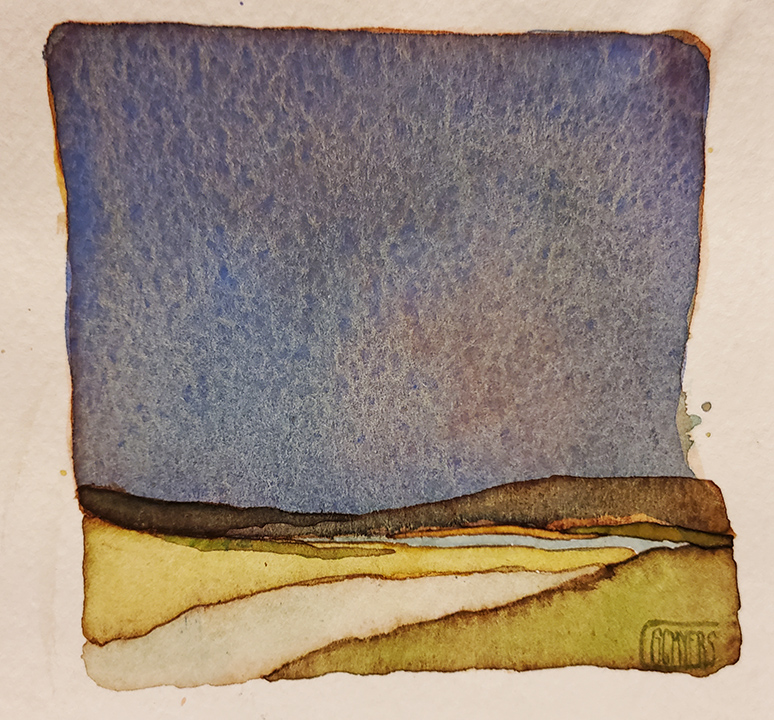
The Sky Is…

GC Myers- The Sky Is Always the Sky 1995 sm


There is one spectacle grander than the sea, that is the sky; there is one spectacle grander than the sky, that is the interior of the soul.

Victor Hugo, Les Misérables


Thought I’d share another older piece, one that also never found its way out of the studio. Some times the reason they stay with me is obvious and other times not so much. This small piece falls in the not so much category.

It’s from mid 1995, not long after I first started showing my work publicly. Across the bottom of the piece of watercolor paper on which it is painted is the title The Sky Is Always the Sky along with the date it was painted in 1995.

Looking at it now, I can’t figure out why I felt it wasn’t worthy to show at that time. I am actually pretty pleased to be able to show it now. It has much in it that I wish would show up in my work now, twenty five years later.

For example, its utter simplicity and the gracefulness of its linework. Well, my definition of gracefulness, anyway. There’s also the way the layers of color go together so well with the grainy pigments of the cobalt blue settling into the shallow pits of the paper above a sepia underlayer.

Looking at it, I realize that many of the changes that took place in the following years in my work were material related. A few years after this I went from employing traditional watercolors in my work to acrylic inks. The difference is that the inks have a more and finer pigments which make their colors more explosive, more impactful. There is a difference in the more subtle aspects of the watercolors that is hard to replicate with the inks. This piece is an example, at least by my analysis.

Another difference was that I also began using a gessoed surface a few years later which also brought dramatic changes to the work. The positives of using gesso outweigh not using it for me but the beauty of cotton watercolor paper and its tactile appearance is undeniable.

The other difference was that the brushes I was using at the time were  wonderful Winsor & Newton round brushes that have long since been discontinued. These round brushes had a different brush profile than almost any other round brush I have been able to find since that time. I use a round brush almost all the time in my wet work even when a flat brush might sometimes be a more obvious choice. I like the organic quality it gives the work and the linework it produces. Brush choice has a big impact on how the work appears and I am still trying to find brushes that have the same qualities as those old W&N brushes.

Anyway, looking at this old piece again so closely gives me inspiration, makes me want to revisit those elements that make it work so well for me. We’ll see

Here’s an old Chris Isaak song, a favorite that is centered around a particular blue sky. It’s the tone I would like for this piece. Here’s Blue Spanish Sky.


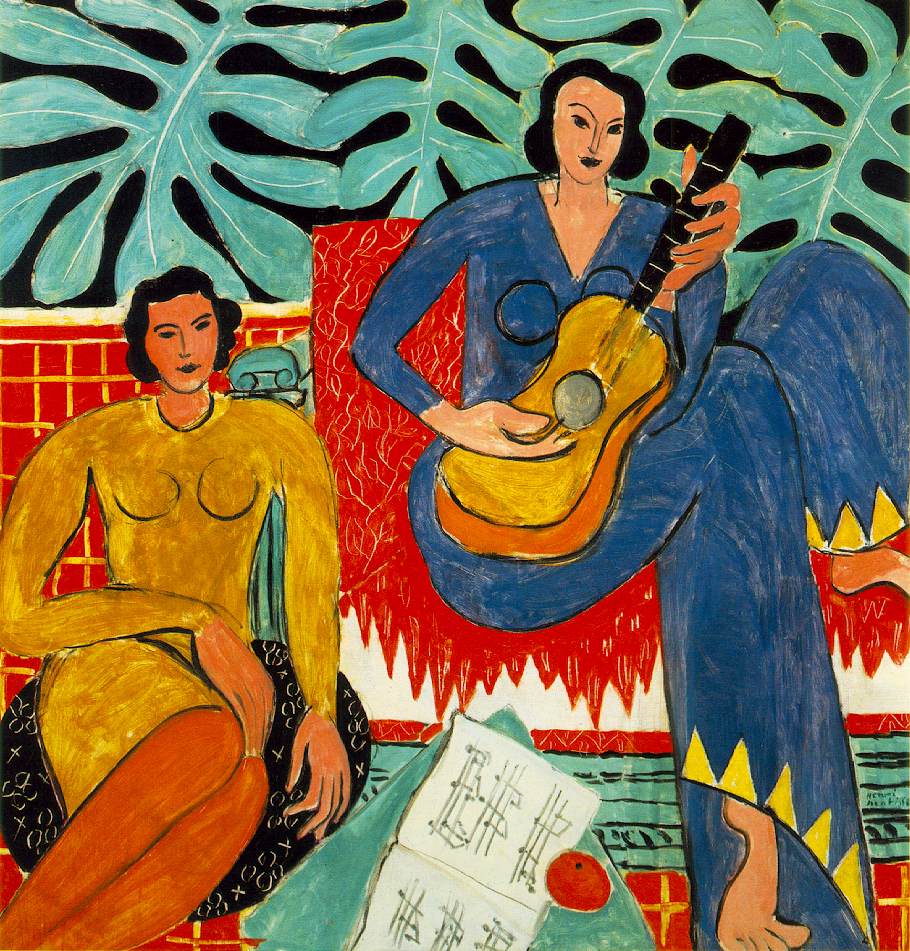
matisse.la musique


I want to reach the state of condensation of sensations which constitutes a picture. Perhaps I might be satisfied momentarily with a work finished at one sitting, but I would soon get bored looking at it; therefore, I prefer to continue working on it so that later I may recognize it as a work of my mind…Nowadays, I try to infuse some calm into my pictures and I keep working at them until I have succeeded in doing so.

–-Henri Matisse, 1908


It seems like every artist has a different answer for the question of when a painting is done. Whistler and several others said it was when all traces of its creation have been concealed on the surface. Some say it is when the artist achieves their aim, what they envisioned in their mind’s eye. Edward Munch (The Scream) said that a piece is done after it has had time to mature, weathered a few showers and endured the elements, including nail scratches.

Others say they are never finished. 

I tend to go with the never finished group although Munch’s definition appeals to my love of weathering and patina and Matisse’s infusion of calm is something I also aspire to in my work. Ultimately, my goal is to have the paintings complete enough that they can exist on their own, to be alive in the outer world.

In that respect, because they are human creations, I view them very much as I view other humans– never quite complete and always imperfect. That’s just how we are and I am certainly no different.

I am a collage of imperfections that is still a work-in-progress. If I saw myself hanging on the wall I might want to take a brush and soften an edge here or there and add color in certain parts of my composition. But I probably would not do it because those imperfections actually become part of the composition, create the contrasts that give us, as a painting, life. And that , even with the flaws and weathering exposed, pleases me.

None of us is perfectly painted. Nor should we be.


Very busy this morning and wasn’t willing to distract from the attention needed. But here’s a post from several years ago that I like. Hope you do as well.

theodore rousseau-underthebirches1842-43

Theodore Rousseau- Under The Birches 1842


It is better in art to be honest than clever.

–Theodore Rousseau


Theodore Rousseau (1812-1867) was part of the Barbizon school of painters, an art movement in 19th century France that was instrumental in moving away from from the traditional formalism that was prevalent in art up to that point and towards naturalism and artistic expression of emotion. It was very influential on many of the painters who later created the Impressionist movement.

Rousseau and Jean-Francois Millet, best known for his peasant scenes, were the two artists from this school whose work really spoke to me, seeming to have honest emotional content in them. Perhaps that is why his short quote resonated so strongly with me. That and the fact that I have found myself less impressed with cleverness than honest expression through the years. I have always believed that art comes from tapping into the subconscious, something other than the part of our brain that produces conscious thought.

I guess I just don’t think we are that smart. Or clever.

I know I am not.

My work is at its best when it comes from a place of honesty and real emotion, when it is made with more intuition than forethought. When it is too thought out and directed it begins to feel stilted and contrived, losing its naturalness and rhythm and becoming heavy-handed.

That is probably the reason I tell young or beginning painters to focus not so much on the actual idea or subject of a painting but more on things like paint handling and color quality, those things that make up the surface of a painting and convey the real meaning of the painting.

And I think that is what Rousseau was probably getting at in his terse quote.

But maybe not. Like I said, I am not that clever.


This post ran about six years ago and like they say, some things never change. I certainly haven’t gained any cleverness and I still believe that honest emotion is the basis of all impactful art. But what do I know?

Lester’s Place


I was looking at some more old small paintings, stuff from before I ever showed my work in public. This piece from late 1994 always jumps out at me. It has a title written below the image (cropped out in the photo above) that says Lester’s Place. I don’t really know why I called it Lester’s or to who or what the name might refer. 

There’s something about this little piece that I really like. Maybe it’s as simple as its colors. Maybe it’s the sense of place it evokes for me. Or the mystery of its narrative.

I don’t know. 

And I don’t think I need to really know. I just like it for whatever reason. The funny thing is that I often think of this old John Lee Hooker song, Rock House Boogie, from the mid 1950’s when I look at this piece. This shack has the same sort of roughness and emotional coloration of this song. I can imagine someone in 1954 stumbling upon this after hearing years of music from groups like the Four Freshmen and the Modernaires on the radio. 

It’s hard driving beat and sharp snapping guitar riffs would most likely create a sense of revelation or one of bewilderment and maybe even terror.

For me, even twenty years later, it was revelation.

Now, that beat has me wanting to get to it for the day. Give a listen and get to your own day.


Sometimes the horizon is defined by a wall behind which rises the noise of a disappearing train. The whole nostalgia of the infinite is revealed to us behind the geometrical precision of the square. We experience the most unforgettable movements when certain aspects of the world, whose existence we completely ignore, suddenly confront us with the revelation of mysteries lying all the time within our reach and which we cannot see because we are too short-sighted, and cannot feel because our senses are inadequately developed.  Their dead voices speak to us from nearby, but they sound like voices from another planet.

–Giorgio de Chirico

***************

I am busy this morning but wanted to share a post from several years ago about painter Giorgio de Chirico. I thought I’d run it again today with the addition at the bottom of one of his more famous paintings and a short MoMA video about it. The idea that is presented about the metaphysics contained in dealing not with “perceived reality” but a “reality imagined” and of creating “a plausible representation of a believable and negotiable space” rang a bell for me as that is the space where I try to operate. Take a look.


de chirico_mysteryA turning point for me when I was first stumbling around with my own painting was when I encountered the work of Giorgio de Chirico, an Italian painter of darkly toned metaphorical works. He lived from 1888 until 1978 but was primarily known for his early work from 1909-1919 which is called his Metaphysical PeriodMetaphysics is  devoted to the exploration of what is behind visible reality without relying on measurable data.

His work from this defining ten year period is very mystical.

De Chirico’s work after 1919 became much more based in reality and far more traditional. This later work was less colorful, less symbolic, less powerful and way more mundane. It is definitely the work from the earlier Metaphysical period that defines him as the artist as we know him today.

I was immediately drawn to that early work. It was full of high contrast, with sharp light and dark. The colors were bold, bright and vibrant, yet there was darknessde-chirico-the-great-tower implied in them. The compositions were full of interesting juxtapositions of forms and perspectives, all evoking a sense of mystery. It was a visual feast for me.

At that time in my own painting, I was still painting in a fairly traditional manner, especially with watercolors. That is to say that I was achieving light through the transparency of my paint, letting the underlying paper show through. It was pretty clean which was fine. But it wasn’t what I was looking for in my work.

Seeing de Chirico’s paintings made me realize what I wanted.  It was that underlying darkness that his work possessed. It was a grittiness, a dark dose of the reality of our existence. I immediately began to experiment with different methods that would introduce a base of darkness that the light and color could play off.  Plus, his ability to create a reality that seemed possible and recognizable but seemed filled with mystery  was something aspired for in my own pieces.

Working with this in mind, my work began to change in short order and strides forward came much quicker as a result of simply sensing something in de Chirico’s work that wasn’t there in my own.

Perhaps that is what is meant by metaphysical…


de-chirico


After Party


GC Myers- After PartyTurn out the lights, the party’s over
They say that, ‘All good things must end’
Let’s call it a night, the party’s over
And tomorrow starts the same old thing again

–Willie Nelson, The Party’s Over


This is a new small painting that is going to be part of my annual solo show at the Principle Gallery in  Alexandria, VA. This year’s show is called Between Here and There and opens Friday, June 4th.

This might be an odd choice to be the first piece shown from this year’s show. It’s called After Party and is one of those pieces I often do mainly for myself. Actually, most of the work I do is for myself first.

But this and others like it might be even more so. They just really satisfy some need inside of me, something that wants to come out.

Plus, they usually make me smile or sigh. I know that this one did both.

I am not going to get into what I see in this for myself. I would rather you have your own interpretation on this one.

I will say that I immediately thought of the old Willie Nelson song, The Party’s Over, that he wrote way back in the 1950’s. A lot of us remember Dandy Don Meredith wailing it during the early years of Monday Night Football ( with Howard Cosell) when the game’s results seemed inevitable. I have been listening to a remake of this old classic as done by the Atlanta-based group Manchester Orchestra. They employ the basic structure and chorus of the song but add a bit to the song. Some may not like the idea of toying with another’s song but I think it works well here and I kind of like it for this painting.

Give a listen, if you like.


If you can’t dig this, you got a hole in your soul– and that ain’t good.

–John Lee Hooker


On some Sunday mornings, the day I always choose a song to feature, it’s a struggle trying to find what i consider is the right song for that morning. I want it to reflect how I am feeling and maybe set the tone for the rest of the day. 

This morning I was in the studio at 5:30, wanting to get an early jump on my day of painting. I began looking for a song that I though might match with the painting above, River Angel. I thought of a couple of other songs with river in their titles but when this song clicked in my head, I knew it was the one.

River Deep, Mountain High as sung by Tina Turner in 1966, produced by Phil Spector. He was crazy and dangerously despicable but, man, he made some great records. Immortal recordings.

This is one of those.

It only takes about 30 seconds for Tina to reach full emotional intensity. And she never lets down from point on. It just roars and soars above the high mountaintops.

I just love this recording. My day feels like it off to the races already. Like the late great John Lee Hooker says at the top– If you can’t dig this, you got a hole in your soul– and that ain’t good.

Hope you dig it.


Gershom

 Stranger (In a Strange Land) -GC Myers, 2002


And she bare him a son, and he called his name Gershom: for he said, I have been a stranger in a strange land.

Exodus 2:22


I was looking at the piece above early this morning. It’s been with me for a long time, since 2002. I sometimes take it for granted and don’t take the time to engage with it. But this morning I looked at it longer than I had in some time, reconnecting with what it has meant to me. Maybe it was because it’s near that time of the year when I get to indulge a guilty pleasure with my annual viewing of The Ten Commandments, the campy biblical epic from Cecil B. DeMille that always runs on ABC during the week before Easter. Or maybe it’s that the pronunciation of the Hebrew word ger which means stranger sounds the same as the shortened version of my name that my family often used for me growing up. I don’t really know but thought that it would be appropriate to share a post about it that has ran a couple of times during the many years this blog has been around.


I have been writing recently about some of the orphans, those paintings that make the rounds of the galleries and finally come back to me. The piece above is one of these orphans but it really isn’t. It’s mine alone, one of the rare pieces that I don’t think I would ever give up. Like many parents when looking at their children, I see much of myself in this painting.

Over the years I have periodically written about a group of paintings that were considered my Dark Work that were painted in the year or so after 9/11. The piece shown above is one of these paintings, painted sometime in early 2002. I very seldom consider a painting being for myself only but this one has always felt, from the very minute it was completed, as though it should stay with me.

It is titled  Stranger (In a Strange Land) which is derived from the title of Robert Heinlein’s famous sci-fi novel which in turn was derived from the words of Moses in Exodus 2:22, shown here at the top. The name Gershom is derived from the Hebrew words ger which means stranger or temporary resident and sham which means there. Together Gershom means a stranger there. It is defined now as either exile or sojourner.

The landscape in this piece has an eerie, alien feel to it under that ominous sky. When I look at it I am instantly reminded of the feeling of that sense of not belonging that I have often felt throughout my life, as though I was that stranger in that strange land. The rolling field rows in the foreground remind me just a bit of the Levite cloth that adorned Moses when he was discovered in the Nile as an infant, a symbol of origin and heritage that acts as a comforting element here, almost like a swaddling blanket for the stranger as he views the landscape before him.

As I said, it is one of those rare pieces that I feel is for me alone, that has only personal meaning, even though I am sure there are others who will recognize that same feeling in this. For me  this painting symbolizes so much that feeling of alienation that I have experienced for much of my life, that same feeling from which my other more optimistic and hopeful work sprung as a reaction to it. Perhaps this is where I saw myself as being and the more hopeful work was where I aspired to be.

Anyway, that’s enough for my five-cent psychology  lesson for today.  In short, this is a piece that I see as elemental to who I am and where I am going. This one stays put.

Here’s a little of the great (and I think underappreciated) Leon Russell from way back in 1971 singing, appropriately, Stranger in a Stranger Land