Feeds:
Posts
Comments

I met a traveller from an antique land,
Who said—“Two vast and trunkless legs of stone
Stand in the desert. . . . Near them, on the sand,
Half sunk a shattered visage lies, whose frown,
And wrinkled lip, and sneer of cold command,
Tell that its sculptor well those passions read
Which yet survive, stamped on these lifeless things,
The hand that mocked them, and the heart that fed;
And on the pedestal, these words appear:
My name is Ozymandias, King of Kings;
Look on my Works, ye Mighty, and despair!
Nothing beside remains. Round the decay
Of that colossal Wreck, boundless and bare
The lone and level sands stretch far away.
–Ozymandias, PB Shelley
*******************

If you have ever been to the Museum of Fine Arts in Boston, you have no doubt seen the painting above. I’ve only been there once and the image of this painting and its strong presence in the space really sticks in my mind. It was painted in 1863 by artist Elihu Vedder, an American expatriate who lived and worked in Italy for over 60 years.

Its title is The Questioner of the Sphinx and it shows a man listening intently at the lips of the ancient monument with the hope, no doubt, of hearing some eternal truth. The skull in the sand makes clear that the Sphinx will not easily relinquish its secrets. The kneeling listener is said to represent man’s futile desire to find immortality.

With the still sand covered Sphinx and the scattered toppled columns, the painting presents us with echoes from ancient history of once mighty empires that are long fallen and forgotten. It is reminiscent of Shelley’s great poem, Ozymandias, shown above, that speaks to the hubris and folly of those who think they can lord over this world.

This was painted at a time when the US was in the midst of the Civil War and there was great doubt as to whether the county would be able to endure the struggle. The US was not an empire at that point. It was still young and finding its way but we still represented a great triumph of democracy, a country ruled by its people and  not kings or dictators or despots– a rarity in the whole of history. But in that civil war we found ourselves in an existential crisis, a tipping point, that put us in peril of being consigned to the dustbin of history before we even grew into any form of our potential.

I write about this painting this morning because it feels to me that we are again at a tipping point, divided in many ways as a country. It feels like there is going to soon be some sort of revelation that is either going to set us on a course that will either allow us to continue to grow our American experiment or will cause us to plummet into a darker and much more dangerous future.

It all hinges on people who are ethical and principled standing up and doing what is right and exposing the truths of our time.

But in the meantime, I find myself feeling like that man with his ear anxiously pressed to the lips of Sphinx.


Blues Twilight

 I was looking for something to play this morning and put on this album, Blues Twilight, from jazz trumpet player Richard Boulger. I’ve played a couple of tracks from this album here over the years.

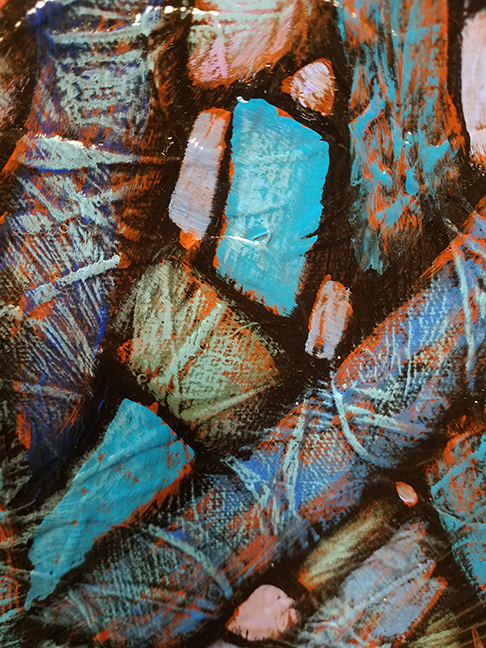
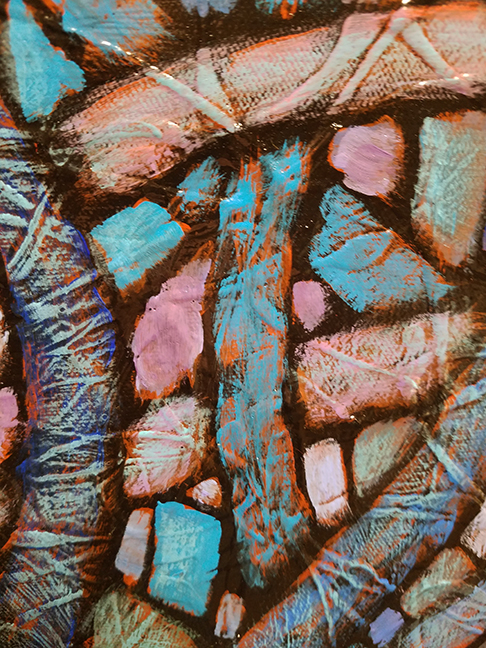
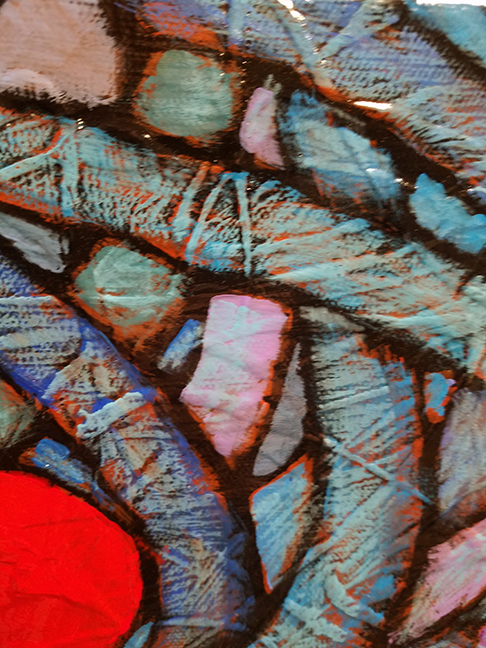
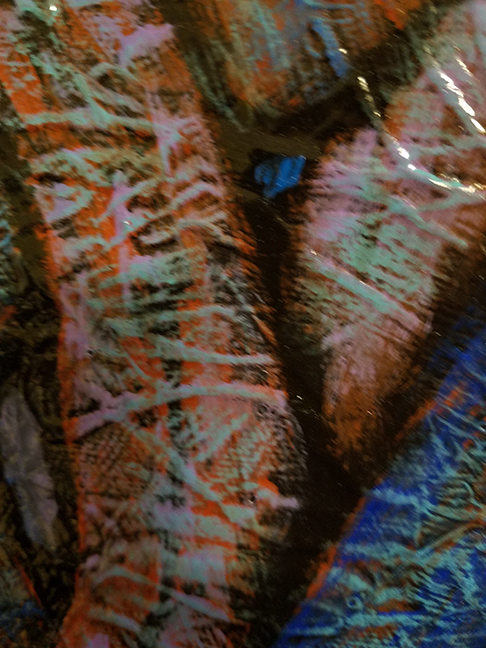
While the title track was playing I went over to over to a painting that hangs in my studio, the one shown above. It’s an experiment titled October Sky from a few years back that is a real favorite of mine. I showed it for only a short time before deciding that I wanted it hanging in the studio. I never really worked any further in the direction this piece was taking me. Part of that decision to not go further was purely selfish, wanting to keep something solely for myself, something that wasn’t subject to other people’s opinions.

A strictly personal piece. A part of the prism that doesn’t show.

I look at it every day but generally it is from a distance, taking it in as a whole. But his morning, while the album’s title track played I went  and really looked hard at it, up close so that every bump and smear was obvious. And I liked what I was seeing, so much so that I grabbed my phone and began snapping little up close chunks of it.

It all very much felt like the music, like captured phrases or verses.  Each had their own nuance, color and texture and they somehow blended into a harmonic coherence that made the piece feel complete.

It’s funny but sometimes when I am working hard and in a groove that takes over from conscious thought, I almost forget about those things that I myself like in my work because I don’t have to think about them in the process of creating the work. Looking at this painting this close made me appreciate the painting even more, made me think about it in a different way than the manner in which I now used to seeing it.

Guess it’s a good thing to stop every now and then and look at what you’ve done, up close and personal.

Here’s Blues Twilight from Richard Boulger. Enjoy the music and take a look at the snips, if you so wish. But definitely have a good day.


GC Myers- October Sky detail
GC Myers- October Sky detail GC Myers- October Sky detail GC Myers- October Sky detail GC Myers- October Sky detail GC Myers- October Sky detailGC Myers- October Sky detail

Aurae

++++++++++++++++++

It is better to have your head in the clouds, and know where you are, if indeed you cannot get it above them, than to breathe the clearer atmosphere below them, and think that you are in paradise.

–Henry David Thoreau

++++++++++++++++++

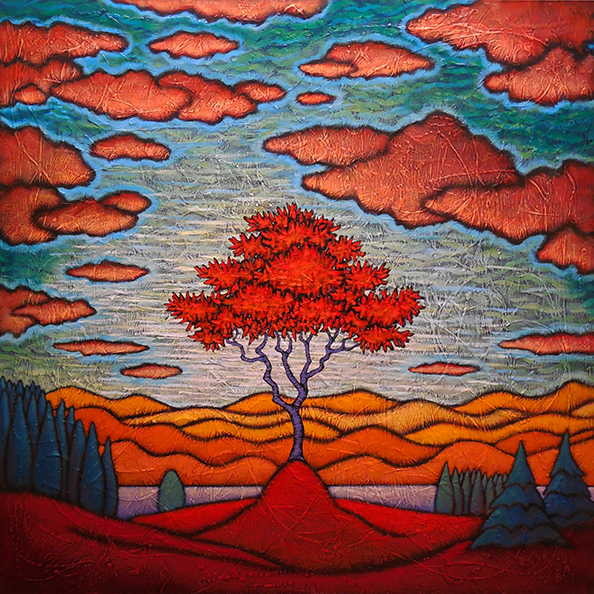
This is a new painting, titled Aurae, that is part of my upcoming June show at the Principle Gallery. It has a real presence in a space, mainly to its strong colors and its sheer size, 36″ by 36″. I know that it’s a piece that my eyes keep coming back to during the day as I am working in the studio and with each look comes a deep and satisfying pang.

Pang.

I don’t know what that even means except that it feels good.

I guess it also means that it feels right and true.

Core. Essential.

I just feel a pang inside, in that area between my head and my heart, when I look at it.

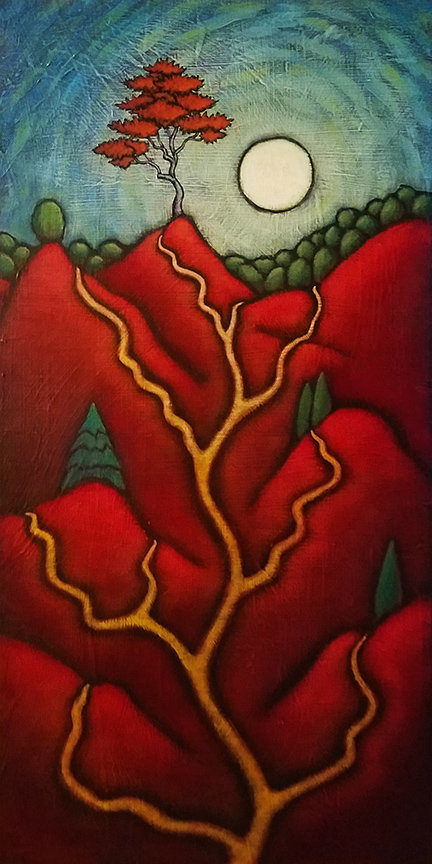
Aurae is the plural of aura and it refers to the pale blue aurae that runs around each cloud. These blue aurae were actually never meant to be so visible. They were meant to be a step to another upcoming layer (or layers) that would have undoubtedly altered the final painting from what you are seeing. But once they were in place, they suddenly made the piece jump to life. The whole piece seemed to speak at that point and I knew I couldn’t cover these aurae with more paint.

But aurae also refers to the general atmosphere that surrounds the central Red Tree here. It’s an atmosphere of completeness, of self-knowledge.  Or as Thoreau said in the words at the top, of knowing where you truly are as a human.

I am going to stop talking about it. The more I write, the less I seem to be saying.

Let’s just go with pang.


The Loser

Ah, this little bit of  Shel Silverstein feels just about right on a Friday the 13th morning.

There’s certainly some truth in there somewhere. Maybe it’s that we are all looking for something we feel is missing and all the time, it’s there in plain sight. Or it would be if we weren’t sitting on our heads.

Keep your heads on today, folks.

When you think of painting as painting it is rather absurd. The real world is before us – glorious sunlight and activity and fresh air, and high speed motor cars and television, all the animation – a world apart from a little square of canvas that you smear paint on.

–Wayne Thiebaud

+++++++++++++++++++

These words from the great contemporary painter Wayne Thiebaud ring completely true for me. I have talked and written many times before about those moments in the studio when I suddenly find the whole idea of painting, of smearing paint on some surface, completely absurd. The whole idea of making these two-dimensional things that represent inner feelings about the outer world seems suddenly abstract and, to be honest, a little ridiculous.

It’s a little like waking up one day to find yourself standing in your yard with a forked stick in your hand. You began by thinking it was a divining rod that would mysteriously lead you to something valuable but in that moment you realize you’re just a fool standing in your yard with a stick.

Believe me, there are days when I feel like a fool standing in a room with a stick in my hands. Of course, my stick has bristles with paint on them but it might as well just be a stick in those moments.

But somehow that feeling passes and I find myself immersed back in my own little world and that stick returns to being a divining rod.

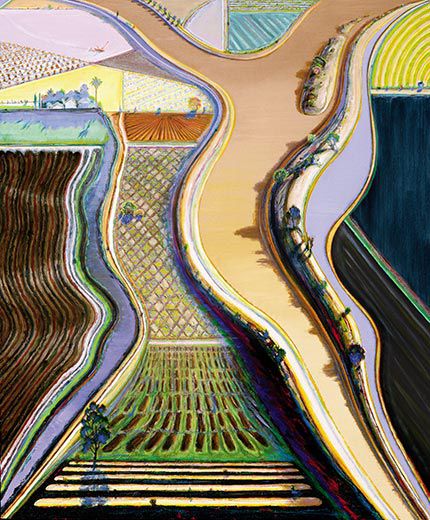
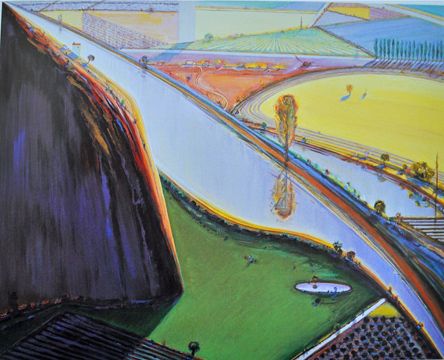
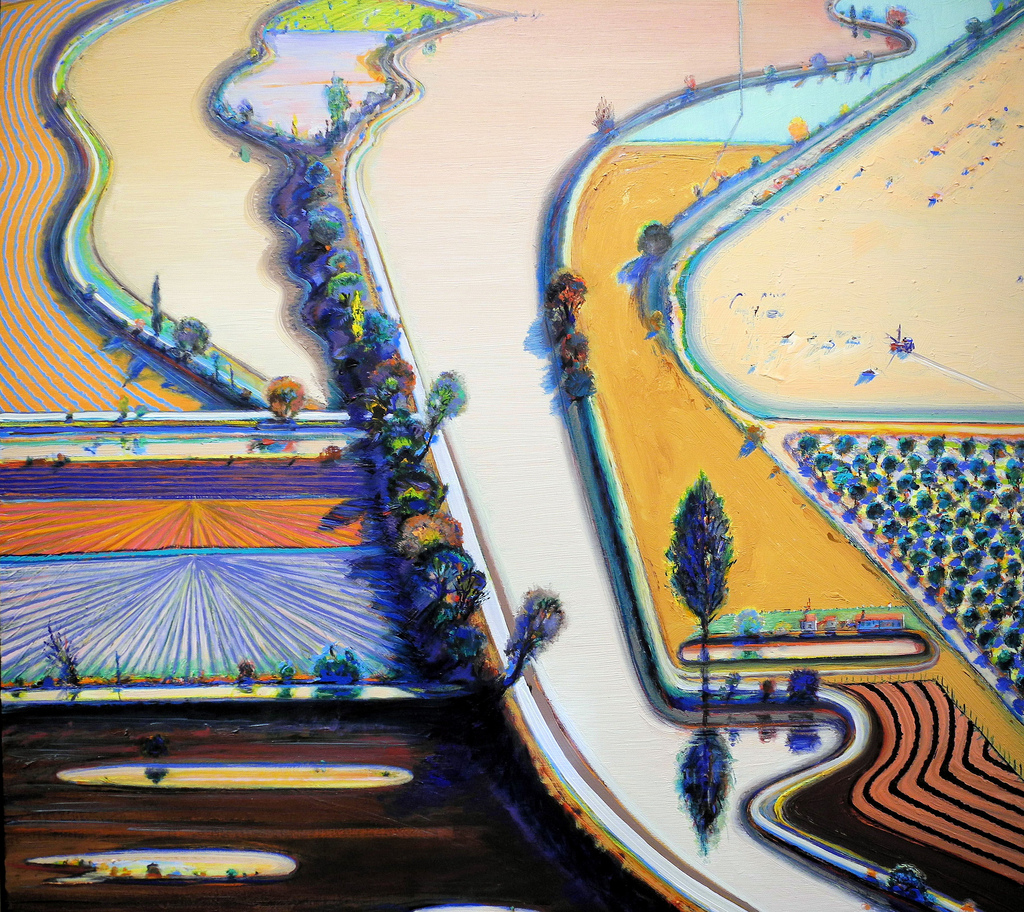
Wayne Thiebaud has long been a favorite of mine.  Most people associate his name with his paintings of  cakes, ice cream and confections with their bold colors and beautiful thick brushstrokes. They are wonderful but for me, his most striking work are his landscapes, often set from a high perspective.  They have such great color and their compositions feel as much like abstraction as they do realism.

Just plain good stuff.

I always feel inspired by this work, moving me to try to find that same balance in my own work.

Here’s a video of his confectionery works, which is, as I said, his more popular work. I haven’t found video with his landscapes but this is still a good intro to his best known work.

At the Cap Rep

I currently have a small group of my work on display in the public gallery space at the Capital Repertory Theatre in downtown Albany, accompanying the current show Blithe Spirit, which opened last Friday. The demand for the show was so high that they added another week with its run ending May 6.  The Cap Rep is a highly respected repertory company with a resident cast of professional actors with impressive resumes so every show is performed at a very high level. They are in the midst of creating a new state of the art facility which should open in 2019.

I normally don’t do these kind of exhibits and, to be honest, didn’t have the time to dedicate to it. But a longtime friend, Jennifer Duke Anstey, who is the Head of Operations and House Manager at Cap Rep as well as a talented photographer with who I once shared an exhibit about 20 years back, convinced me that I could easily put together a group of work and she would take care of all the details. I trust Jennifer’s judgement and decided to put together the exhibit.

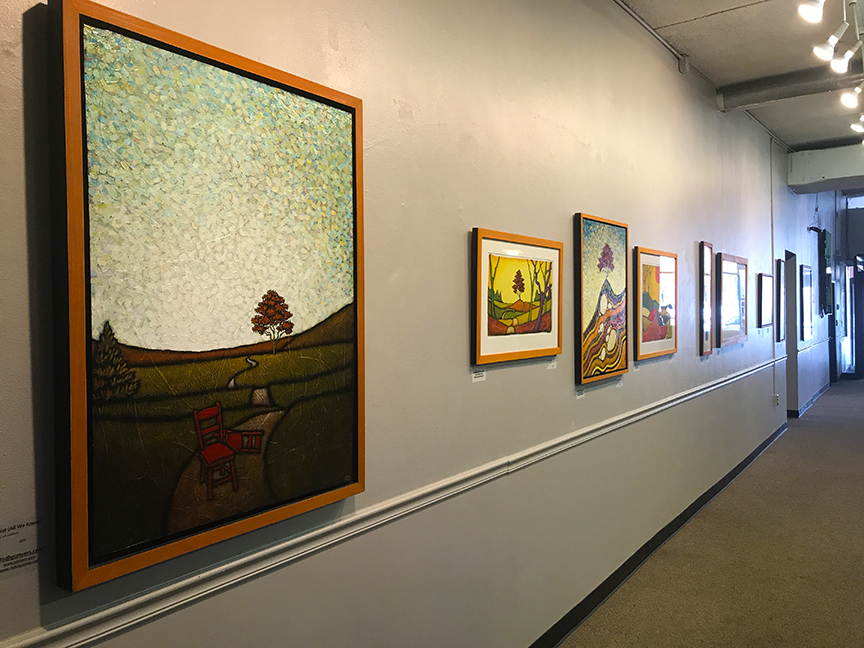
It turned out to be a mini-retrospective comprised of older work that are my personal paintings along with other pieces from several periods from the past two decades. There are paintings from that range from 1998 up to the present day. While an abridged show, it gives a representative glimpse of the progression of my work over the years.

So if you’re in the Capital District, stop in for a look — the space is open during the day– and stay for a great bit of theater.

There a new piece on the easel right now that is at a point in it’s progress that has me chomping at the bit to get to work this morning. I thought, in the name of expediency, I would share a post from a few years back about trusting yourself when it comes to something like art. I know a lot of people who won’t go into galleries or museums because they think they don’t know anything about art and feel intimidated. That’s a shame because you don’t need to know anything about art except how you react to it. Have a look:

*********************

He knows all about art, but he doesn’t know what he likes.

–James Thurber

******************

James Thurber Cartoon Art CriticThis may not technically qualify as a quote but who cares?  The message in this cartoon from the great James Thurber is so simply put and true and that’s what I am looking for in a good quote.

 And art.

That’s what I like.

In the past I’ve talked about how many people are intimidated by the idea of art, feeling that they don’t know anything about art.  This leaves them not trusting their own eyes and their own reactions to any given piece of art.

And that is a pity because art is mainly about the reaction to it.  Art is a reactive agent, reaching out and stirring something in the viewer.  All of the knowledge in the world about a piece of art cannot make you like that piece of work if it doesn’t first strike that chord that raises some sort of emotional response within you.

And I think most of us know within a few moments whether a work of art speaks to us or leaves us cold.  The trick comes in recognizing this realization and feeling okay with it.

I’ll admit that there are many celebrated works of art out there that do absolutely nothing for me.  They may have historical importance or elements of beauty or great craftsmanship in them but they simply don’t raise any emotional response within me.

I might be able to appreciate them but the bottom line is that I don’t like them, plain and simple.  That doesn’t mean I’m right or wrong.  It just means I know what I like.

And I accept that criteria from anybody, even with my own work.  While it would be nice to think that it speaks to everyone, I know this is an impossibility.  I’ve had people tell me that they didn’t like my work– in polite and respectful terms, thankfully– and I’m okay with that.

They know what they like.  And that’s good enough for me.

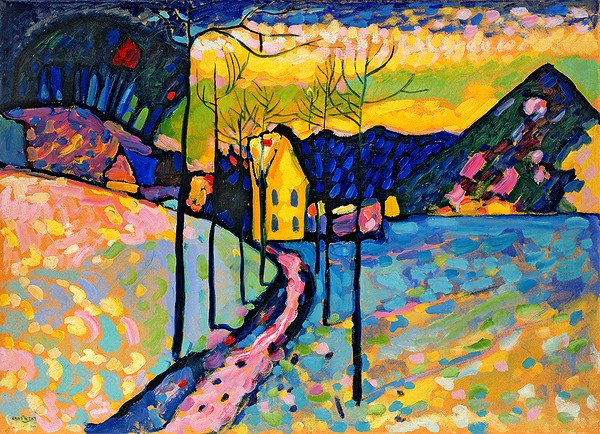
“… lend your ears to music, open your eyes to painting, and … stop thinking! Just ask yourself whether the work has enabled you to “walk about” into a hitherto unknown world. If the answer is yes, what more do you want?”

― Wassily Kandinsky

+++++++++++++++++++

A busy day but with enough time to consider this early Kandinsky painting and his words. Having learned to stop thinking some time ago, I do feel enabled to walk about in his created world. And, yes, I want and need no more this morning.

Etude No. 14

While searching for a piece of music to feature here this morning, I found myself looking over at this new painting shown here as I listened to the music. As usual, the search had me running down rabbit holes that sent me in all different directions, none that satisfied me enough to want to share it.

Then I somehow ended up on this modern classical piano piece from composer Phillip Glass, Etude No. 14, played by pianist Vikingur Olafsson. There’s a part in it, starting at about 1:15, that the sound and this painting just seemed to mesh for me, filling out the feeling that I was experiencing as I was taking it in.

It is a painting that is still on the easel, near completion or so I think. I am in that part of the process where I am still examining it, absorbing it to see what it has for me, what it’s trying to say to and for me. And here, the music created a narrative line that pulled me and the image together.

It’s hard to explain. Everybody sees art differently, having different expectations of what they hope to extract from it, if anything. I think a lot of folks don’t even think about those expectations and just react to what is before them. I do that as well and it is generally gives a true response.

But more often I see art as an existential puzzle with pieces that provide clues as to our meaning and purpose. There are works that attract me and I search them for these clues, trying to figure out if there are answers or where it will send me next in my search. In this painting, the Glass music helped me see what I had only sensed before.

As I said, it’s hard to explain.

Anyway, give a listen and have yourself a good Sunday. By the way, I am calling this painting Etude No. 14.

Final Portrait

Once the object has been constructed, I have a tendency to discover in it, transformed and displaced, images, impressions, facts which have deeply moved me.

–Alberto Giacometti

+++++++++++

There is a film out currently called Final Portrait which is about the writer James Lord, played in this film by Armie Hammer, sitting for a portrait with artist Alberto Giacometti, played in the film by Geoffrey Rush.

Taking place in 1964, a couple of years before Giacometti’s death, the sitting is initially supposed to last for a few hours but stretches for weeks as Giacometti agonizes and constantly alters the painting. The movie is based on Lord’s perspective, one that has him confused and frustrated until at last seeing how Giacometti has transformed his image into something beyond what he himself saw in it.

I haven’t seen it but imagine it to be a quiet but intense film. I’ve had some fascination for Giacometti’s work and writings for many years, intrigued by the singularity of his vision and his dedication to bringing it to light. I find myself often nodding in agreement, as I did with the quote here at the top, when reading his words from interviews and his writings.

Here’s a short film that the Christie’s auction house put together several years ago about the painting of this portrait when it came to auction, selling for nearly $21 million. It’s provides the basis for Final Portrait.