Feeds:
Posts
Comments
Caspar David Frederich- Abbey Among Oak Trees

Caspar David Frederich- Abbey Among Oak Trees

A picture must not be devised but perceived. Close your bodily eye, that you may see your picture first with the eye of the spirit. Then bring to light what you have seen in the darkness, that its effect may work back,  from without to within.

–Caspar David Frederich

***********************

I find myself identifying strongly with the words and work of the 19th century German painter Caspar David Frederich (1774-1840).  His work often takes a symbolic stance with expansive landscapes that overwhelm the human presence in them and much of it moves toward the metaphysical.  He , along with his British contemporary JMW Turner, were at the forefront of the movement from Classicism  to  work that reflected the inner emotional reaction of the individual to the world around them.

It was said of Frederich that he was “a man who has discovered the tragedy of Landscape.”  I see this in his often moody and contemplative work.  It is not painting of only a place or scene– it is more a painting of emotion, of some inner vibration triggered by what is before the painter.  His brilliance is in capturing that inner element and revealing it to the viewer.  It’s a rare thing, one that I think most painters aspire to obtain in their own work.  I know that I do.
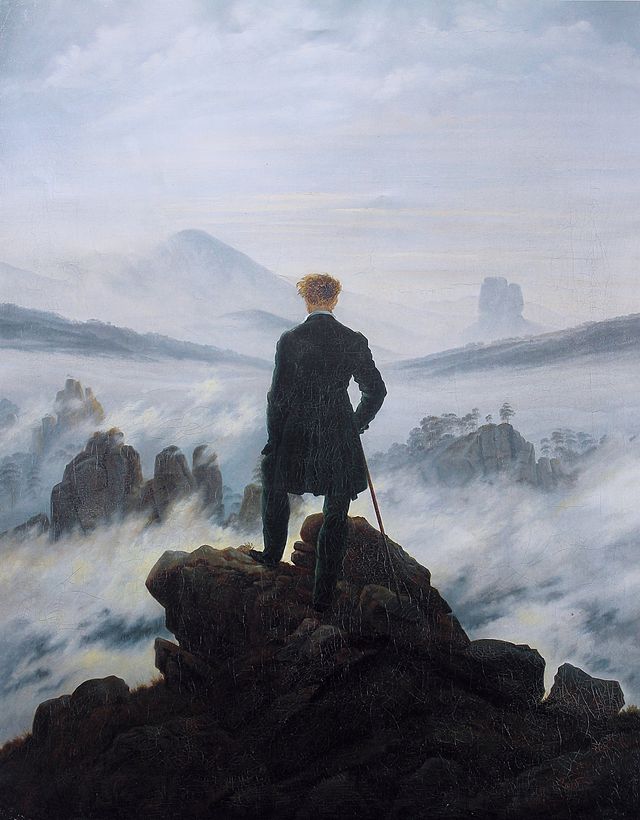
Caspar_David_Friedrich_-_Wanderer_above_the_sea_of_fogFrederich’s work fell from favor in the latter stages of his life but the coming of modern art movement whose many painters were greatly influenced by Frederich,  brought him back to great recognition through the first few decades of the 20th century.   Unfortunately for Frederich, in the 1930’s, his work was associated with the Nazis who mistakenly saw his work as being nationalistic in its symbolism. I know that the piece shown here on the right, Wanderer Above the Sea of Fog,  is often associated with Friedrich Nietzsche‘s idea of the Übermensch or Superman.  Even though Frederich died years before Nietzsche was born and almost a century  before the Nazis usurped his art, it took several decades before his work regained the stature it lost due to this association.

But the inner message of his landscapes persevered and his paintings still resonate with their timeless qualities today.  As they should.
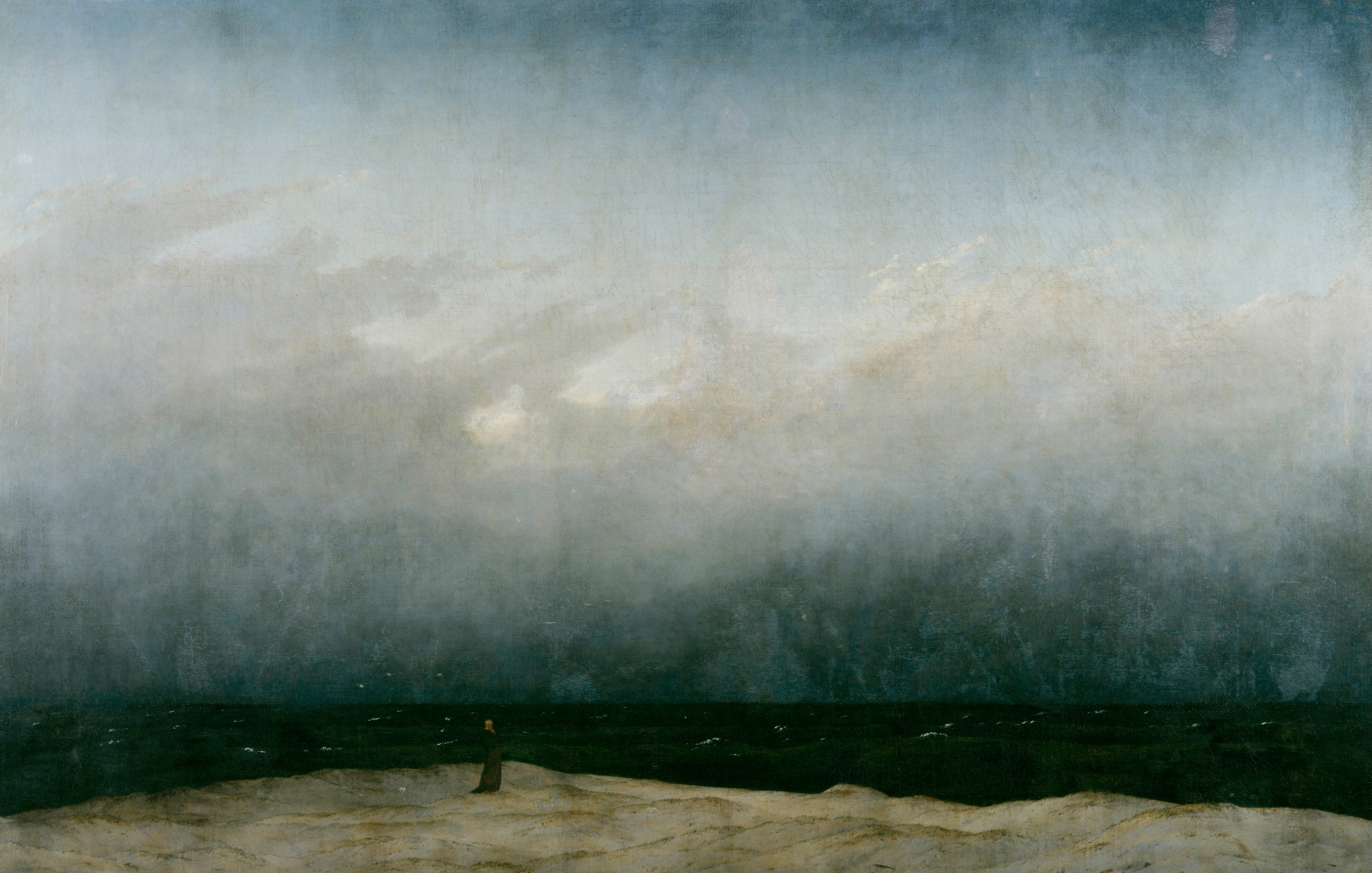
Caspar David Friedrich- Monk by the Sea

Caspar David Friedrich- Monk by the Sea
Salar de Uyuni- Enrique Pacheco FilmI came across a terrific video from travel cinematographer and time-lapse specialist Enrique Pacheco called Reflections From Uyuni.  It is a film that has time-lapse views of Salar de Uyuni, the world’s largest salt flats located in the Andean highlands of Bolivia.  The flats cover an area over 4000 square miles in size ( much larger than Yellowstone, more than twice as large as the Grand Canyon and about 90 times larger than our Bonneville Salt Flats) at an altitude of over 11,000 feet, with only a few feet of variance over the entire area.  Very flat indeed.  With its crust of salt, it is obviously a great source of salt as well as lithium, of which it is estimated to hold well over 50% of the world’s reserve.

But all that said, for me, these strikingly beautiful images are filled with a sense of silence that I find so intriguing and often find myself trying to embed in my own work. The Big Quiet as I call it. Take a few moments to judge for yourself.  Also, please check out Enrique Pacheco’s other films at his Vimeo page or his website.  Truly stunning work.


Reflections from Uyuni from Enrique Pacheco on Vimeo.

Rooted

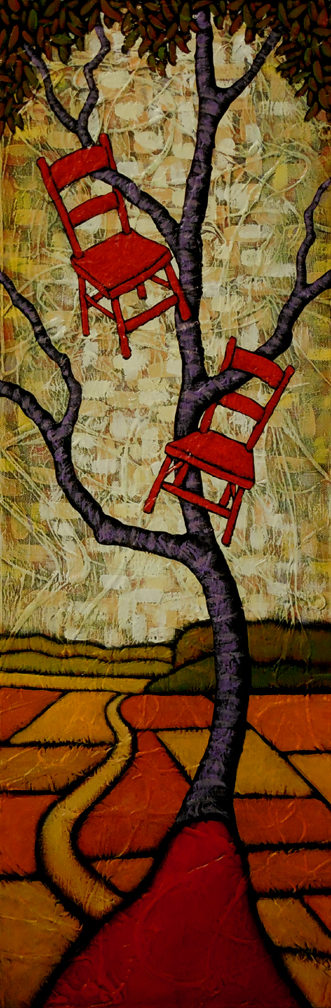
GC Myers- RootedIn this new painting, a 10″ by 30″ canvas that I am calling Rooted, the Red Tree steps aside and allows the Red Chair to take centerstage.

The title is an obvious reference to the Red Chair’s most frequent interpretation as a symbol of family and ancestry, with the dark tree that holding them looking in a way like a pedigree chart with branches coming off the main root and branching out.  The path that disappears in the distance could be  referring to the journey that the family tree took at an earlier time, perhaps emigrating from a distant land.

But for all its symbolism, I feel the strength of this piece is more from a visual fulfillment in the way the tree’s trunk and branches break up the picture plane into little islands of light, as though I am looking down on it from above and the tree transforms into a river with the branches becoming smaller streams feeding into it.  Thus, the Red Chairs are not growing away from the earth but are flowing back toward it.

There are a lot of things happening in this modest piece. Even now, looking up at it as it rests on the fireplace here in the studio, I find myself taking in different aspects of it that send my mind in new directions. And I like the fact that it can be simply what it is or can move me into a completely different realm of thought.

Rooted will be part of my show, Native Voice, opening June 5 at the Principle Gallery in Alexandria, VA.

Heroes

Arthur Ashe HeroismKeeping up the theme that was the subject of an earlier post this week, I decided that for this Sunday morning’s musical selection I would play a lovely version of Heroes from David Bowie.  It’s an acoustic version (with Gail Ann Dorsey accompanying him on vocals and bass) from a 1996 performance at the Bridge School Benefit, an annual concert began by Neil Young to benefit the Bay Area school that helps kids with severe speech and physical impairments.  In that context, the song takes on additional layers of meaning as you see the many parents in the audience with their children, many cradling them.

Heroism.

Looking for an image to illustrate this post, I did an image search by punching in the word hero.  It was all superheroes and warriors which saddened me because I know that heroism is something far more than that.  It’s about doing those things that need to be done, about taking responsibility  in  order to serve a purpose beyond your own needs.  We think of it as a rare thing but it is evident every day in the actions of those people who give so much of themselves to others.

For me, an example of this came to me in a very personal way.  When my mother was struggling in the last months of her battle with cancer, I visited her for  last time.  Her and my father had been together for about 46 years at that point, years which could be described as turbulent at best.  For such a long married couple, they had an odd love/hate relationship which had them always on the edge of huge screaming  battles that were fraught with violence.  They were terrible things to see and even as a child I often wondered why they remained together.  But they did and as she neared the end of her life, Dad became her cook, her maid, her nurse,  and her driver to the many treatments that made up the last months of her life.  Her everything.

When I made my last visit, I noticed a photo on her bedside table.  It was photo of the two of them together from several years before, standing at some Florida site drenched in sun.  On the cheap little frame, underneath my father was a word formed in simple block letters, those type of things that you rub on from a sheet.

It was the word Hero.

Now, at that point in my life I didn’t see my father in heroic terms.  Far from it.  No, he was and is a very flawed human being with many traits that are far from any definition of heroism.  But in this case, he took on the form of a hero for my mother and in that moment, looking at that photo, for  myself as well. I realized that the word was not about great accomplishment but rather about following that need to serve another.

So it can be for everyone, as the song says :

I, I will be king
And you, you will be queen
Though nothing will drive them away
We can beat them, just for one day
We can be heroes, just for one day

I finally came across the  quote at the top from the late Arthur Ashe that seemed to best fit the thought .

Have a great Sunday. Be a hero to someone today.

Smarter Every Day Backwards Brain BikeCame across an interesting video from Smarter Every Day, a science based website from aerospace engineer Destin Sandlin that, in his words, attempts to find the unexpected.  This video concerns a bicycle made  with a gear that turns the wheel in the opposite direction.  That sounds simple enough and I am sure most of you who have rode a bike think that you could master riding this bike fairly quickly.  Just a little concentration and a push of the pedals and you would be off, maybe a little shakily at first but on your way.

Not so quick.  

It turns out that there are so many factors at play in riding a bike that are hardwired into our brains once we learn how to ride one that dramatically altering any one of them makes riding a bike almost impossible, as you will see in this video.  A very interesting example of the way our brain learns and adapts. Or not.

Take a look for yourself:

Joseph Campbell quoteI’ve been a fan of the late mythologist Joseph Campbell for many, many years.  In his many books on myth, including his classic The Hero With a Thousand Faces, as well as a great PBS series, The Power of Myth,  with Bill Moyers , Campbell documented myths from around the world but more importantly showed how intimately they related to our individual lives.  Campbell showed us that we all had lives that very much followed the patterns that ran through the classic myths of all cultures.

In short, we are all, in our own way, heroes.  We may not slay dragons or find great treasures, but we all at a point experience some form of the hero’s journey.

There’s a wonderful animated short film called What Makes a Hero?  from TED Ed and educator Matthew Winkler that succinctly illustrates Campbell’s premise, including the eleven stages of the hero’s journey.  It’s a delightful short that will hopefully help you to begin to see the mythic elements that make up your own life.

Theodore Rousseau- Under The Birches  1842

Theodore Rousseau- Under The Birches 1842

It is better in art to be honest than clever.

–Theodore Rousseau

*************************

Theodore Rousseau (1812-1867) was part of the Barbizon school of painters, an art movement in 19th century France that was instrumental in moving away from from formalism and towards naturalism and artistic expression of emotion.  It was very influential on many of the painters who later created the Impressionist movement.

Rousseau and Jean-Francois Millet, best known for his peasant scenes, were the two artists from this school whose work really spoke to me, seeming to have honest emotional content in them.  Perhaps that is why his short quote resonated so strongly with me.  That and the fact that I have found myself less impressed with cleverness than honest expression through the years.  I have always believed that art comes from tapping into the subconscious, something other than the part of our brain that produces conscious thought.

I guess I just don’t think we are that smart.  Or clever.

I know I am not.  My work is at its best when it comes from a place of honesty and real emotion, when it is made with more intuition than forethought.  When it is too thought out and directed it begins to feel stilted and contrived, losing its naturalness and rhythm and becoming heavy-handed.

That is probably the reason I tell young or beginning painters to focus not so much on the actual idea of a painting but more on things like paint handling and color quality, those things that make up the surface of a painting and convey the real meaning of the painting. And I think that is what Rousseau was probably getting at in his terse quote.

But maybe not.  Like I said, I am not that clever.

Reflecting

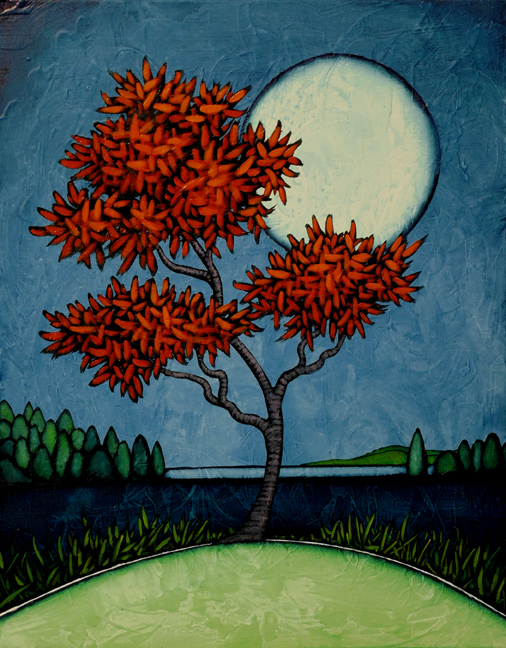
GC Myers- ReflectingThis is a new painting that has been grabbing my eye here in the studio lately.  It’s a 16″ by 20″ canvas that I am calling Reflecting for now.  It will be included in my solo show, Native Voice, at the Principle Gallery in Alexandria which opens June 5.

The title comes from the light and form of the arc of the foreground that seems to be reflecting the light and form of the moon above.  But it is also refers to the posture of the Red Tree as it seems to be gazing  into the sky.  For me, it has a feeling of  great pondering, of both looking outward and inward.

Reflection is, after all,  the act of turning one’s thought on itself to discover its true reality, like looking in the mirror and wondering who the hell that person is who is looking back at us.  The Red Tree here is a reflection of the moon which itself reflects the greater power of the sun which, in a way, might reflect the ultimate power of the universe. And maybe that is what this is ultimately about–  looking for traces of that universal power in our  earthly self.

I will have to reflect on that for a bit…

Nepal

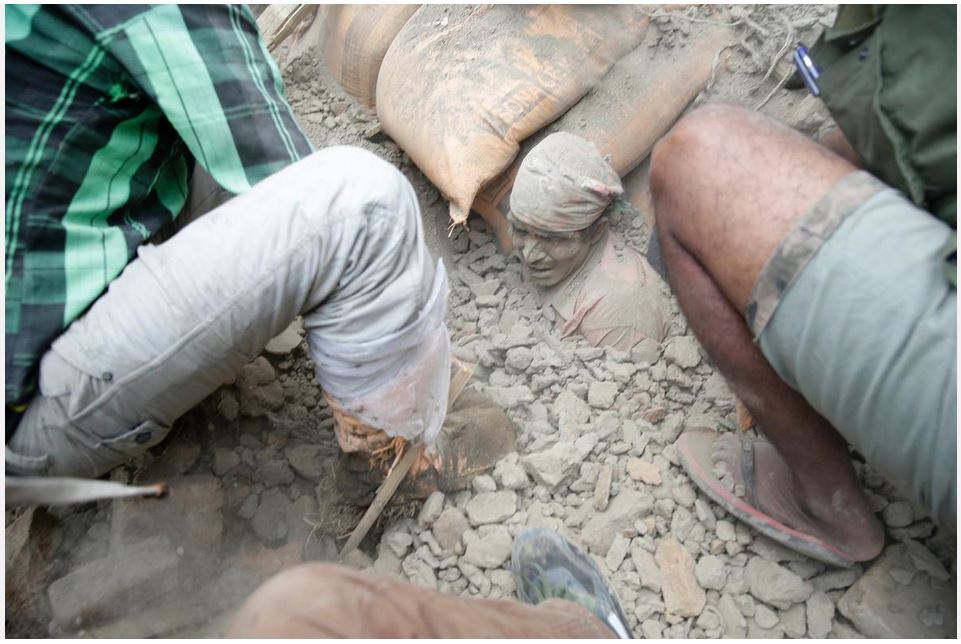
Nepalese man Trapped in Rubble Photo by Narandra ShrestaIt’s been heartbreaking to see the tragedy taking place in Nepal as a result of a massive 7.8 earthquake and subsequent huge aftershocks that rocked this Himalayan nation over the weekend. I’ve never been to Nepal and there is a good chance that I may never see it but I feel a small connection to this distant nation through my work, which hung in the American Embassy in Kathmandu for several years.  Plus, I have met a number of folks who have been there and they always speak of their experiences there in glowing terms.

It’s hard to even imagine the destruction caused when a chunk of the planet about 35 miles wide and 75 miles long is suddenly shifted 10 feet.  But the images coming from Kathmandu fill in the blanks– tremendous physical damage, horrible injuries and mounting loss of lives– over 3700 as of this morning and sure to keep rising.  Rescue efforts continue but it is a hard slog given the lack of resources and the remoteness and relative inaccessibility of Nepal.

Maju Deval Temple, Kathmandu- Before and After  Earthquake

Maju Deval Temple, Kathmandu- Before and After Earthquake

There were also cultural tragedies, including the total destruction of the Maju Deval Temple in Kathmandu.  It was built in 1690 and had survived beautifully through the previous 325 years until the quake reduced it to a pile of rubble as seen in the photo above. On Mt. Everest, there is still no true accounting of the total number of climbers and guides lost when the quake caused massive avalanches in the high peaks.

It can be frustrating, watching a tragedy such as this from such a long distance.  We want to help but there seems to be so little that we can do from half a world away.  But there are reputable charities that are geared up just to help in situations such as these, having resources ready to go in a very short time and their people on the ground in the devastated areas within hours.

And they need your help in order to help others.

There is a local Nepalese charity called the Soarway Foundation, that was created in part by the honorable Scott DeLisi, our former ambassador to Nepal and a man who I have had the honor of corresponding with over the past several years. They have an infrastructure in place in that nation and any money donated will have an immediate impact on the earthquake’s victims.

Two other of my personal favorites are Oxfam and Americares, both of which take very little from your donations for things like administration and fundraising.  Both are very quick to action also.. And of course, there is the Red Cross, although most donations go into a general fund to help around the world.

So give if you can to this nation that needs a helping hand at this time.

Black Coffee

black coffeeTime for some Sunday morning music and since I was up extra early this morning the idea of something to pick me up seems like a good idea.  Something like some black coffee.

Not the drink, though I am sipping my coffee as I write. I mean the song.

The sultry Black Coffee was written in 1948 by Sonny Burke and originally recorded by Sarah Vaughan and a few years later by Peggy Lee. There have been many, many covers of this song and most are very good. But there are four versions that really stick out for me, all very distinctly different. They are Vaughan’s original, the one from Peggy Lee, k.d. lang‘s darkly twangy version and the one I am featuring this morning from the great and grand Ella Fitzgerald.

Her version is elegantly spare with her voice and piano interweaving beautifully. It is darkly tinged but there is such strength in her phrasing that it keeps the song feeling surprisingly upbeat. Just a great, great song.

A little bit of trivia about this version: It was the favorite song of Nobel Prize winning poetess Wislawa Szymborska , who requested it be performed at her funeral. You might remember Szymborska from a blog entry here last month that featured her poem Possibilities.

So,give a listen as you sip the morning beverage of your choice.  Maybe a little black coffee…