Feeds:
Posts
Comments

Posts Tagged ‘Quote’

Paul Gauguin- Where Do We Come From? What Are We? Where Are We Going?What still concerns me the most is: am I on the right track, am I making progress, am I making mistakes in art?

Paul Gauguin

******************

At one of my gallery talks a year or two ago, I was asked about confidence in my work.  I can’t remember the exact wording but the questioner seemed to imply that at a certain point in an artist’s evolution doubts fade away and one is absolutely certain and confident in their work.

I think I laughed a bit then tried to let them know that even though I stood up there and seemed confident in that moment, it was mere illusion, that I was often filled with raging doubts about my voice or direction or my ability.   I wanted them to know that there were often periods when I lost all confidence in what I was doing, that there were days that turned into weeks where I bounced around in my studio, paralyzed with a giant knot in my gut because it seemed like everything I had done before was suddenly worthless and without content in my mind.

I don’t know that I explained myself well that day or if I can right now.  There are moments (and days and weeks) of clarity where the doubts do ease up and I no longer pelt myself with questions that I can’t answer.  Kind of like the painting at the top, Where Do We Come From? What Are We? Where Are We Going?, the masterpiece from Paul Gauguin.  Those are tough questions to answer, especially for a person who has little religious belief.

And maybe that’s the answer.  Maybe my work has always served as a type of surrogate belief system, expressing instinctual reactions to these great questions.  I don’t really know and I doubt that I ever will.  I only hope that the doubts take a break once in a while.

There was another quote I was considering using for this subject from critic Robert Hughes:

The greater the artist, the greater the doubt. Perfect confidence is given to the less talented as a consolation prize.

I liked that but it felt kind of self-serving, like saying that being aware aware of your own stupidity is actually a sign of your intelligence.  I would really like to believe that all those times when I realized I was dumb as a stump were actually evidence of my brilliance. I think many of us can  claim that one.

Likewise, if Hughes is correct  then I may be one of the the greatest artists of all time.

And at the moment, I have my doubts…


Read Full Post »

Three-Musicians-By-Pablo-PicassoFor those who know how to read, I have painted my autobiography. 

-Pablo Picasso

***************

True.  Enough said.

Read Full Post »

Odilon Redon- The Cyclops 1914I am certain about what I will never do – but not about what my art will render.

–Odilon Redon

***************

When I came across this quote from the great French Symbolist painter/printmaker Odilon Redon, I found myself nodding in agreement.  There are many things I know that I will never do with my work mainly because these things don’t inspire me to take the time to make the effort.  But about those things where I do make the the effort,  I am never quite sure where they will take me or how they will surprise me or how they will reach out to others in ways I never imagined.

And that is the thing, the driving force, that keeps me coming back to this studio each morning: the hope that this will be the day that brings that next surprise, that next thing that remains a wonder to myself.

By the way, you should really take a few moments and check out the work of Odilon Redilon.  He was one of the most influential painters around the turn of the 20th century and set the groundwork for a lot of modern movements.  Plus, his prints and paintings are just plain interesting to take in, with a mysterious twist and symbolism that feels both psychological and spiritual.  The eye in the sky is a recurring form in his work as you see in the painting at the top, The Cyclops.  His one-eyed creature has a different feel than that of the more terrifying one in Homer’s Odyssey.  Redon’s has an almost protective, paternal feel.  It feels odd but inviting.

Here is a site ( click here)with most of his known paintings although not much if any  of his print work.  It’s worth a look.

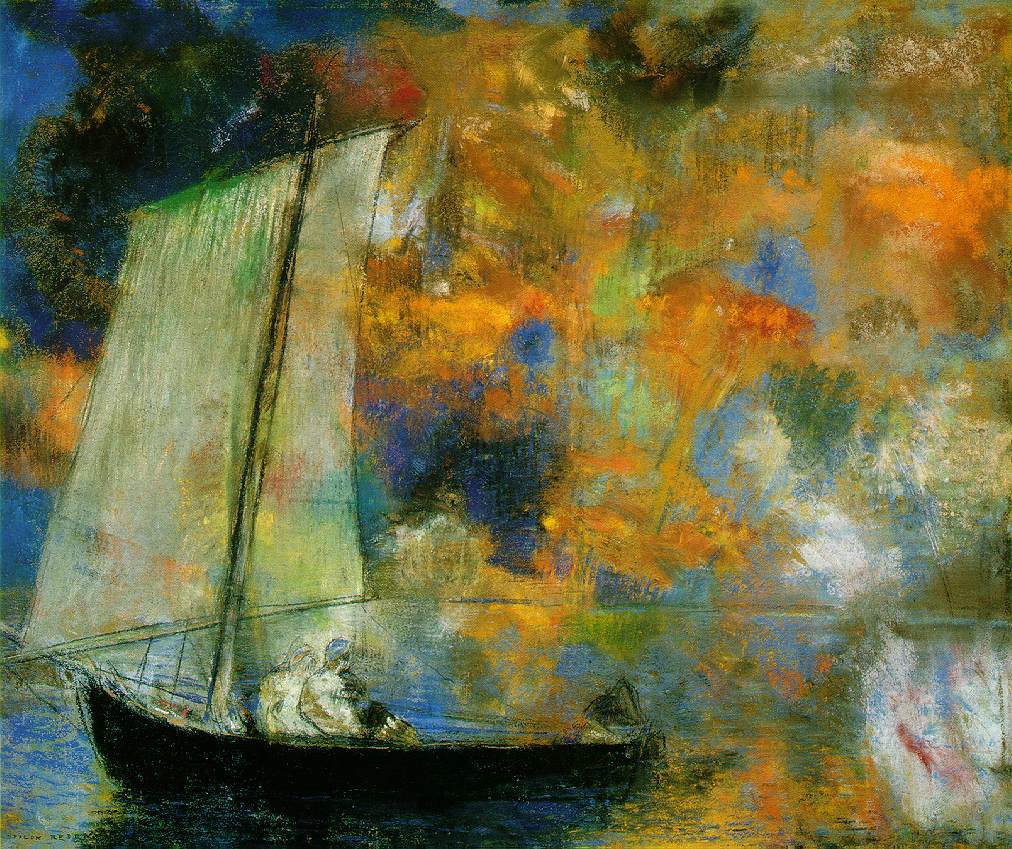
Odilon Redon - Eye  Balloon-1898 Odilon Redon Flower Clouds 1903

Read Full Post »

mark_rothkoIt is a widely accepted notion among painters that it does not matter what one paints as long as it is well painted […] There is no such thing as good painting about nothing.

Mark Rothko

**************

I have often said, often without much grace, that the subject for a painting is secondary, not really that important so long as the painting says something, expresses feeling and evokes emotion within the viewer.  I think the work of Mark Rothko is a good example of this sentiment. They are simple of blocks of opposing colors set one over the other or, as in the case of the piece above, one alongside another.

Seemingly without subject.

Seemingly about nothing.

But as Rothko states, there is no such thing as a good painting about nothing.  And this is a good painting.  It allows the viewer’s own emotions into its space, lets their own story become the story and subject of this work.  That space is the subject and purpose of this work.

So, every picture does tell a story.  Some dictate the story, forcing the viewer to follow a set storyline through the picture as though they were the plot of a murder-mystery novel.  Others do so like a song or poetry, evoking feeling with a suggestion or a gentle nudge.  The viewer here is complicit in the fulfillment of the art.

For myself, I prefer the latter but have enjoyed works with more obvious subjects.  Perhaps not as deeply felt but enjoyable nonetheless.  I still question where my work falls on this scale.  I am sure it has been both and I know I am much more satisfied when it appears more poetic.  But being able to dictate the nature of the work is often beyond me.  It sometimes appears in the poetic form seemingly on its own, without my direction.

And that is most satisfying.  And elusive.

All this being said is mere pretense for this week’s Sunday Morning Music.  It’s a cover of Rod Stewart‘s classic song, Every Picture Tells a Story, done by the Georgia Satellites back in 1986.  I always liked their version of this song and hope it’ll kick off your Sunday on a high note.  Have a great day!

Read Full Post »

Dorothea Lange Next Time Try the TrainTo know ahead of time what you’re looking for means you’re then only photographing your own preconceptions, which is very limiting, and often false.

Dorothea Lange

*****************

As a fan of Dorothea Lange’s photography, I was very open to her take on what an artist–  in her case, a photographer– is seeking.  I’ve written a lot here over the years about searching for something  in my work but what that thing is, quite honestly, I do not know.  I know that it is not something I can find without releasing a lot of myself including my fears and preconceptions.

Lange’s idea of preconceptions being limiting is one that rings very true to me, coinciding with my constant chorus that  painting is best done without thought, without having an idea of where it might end up.  Preconceptions create expectations and these too are limiting.  The best work often comes when there are no expectations and no idea of what I am trying to accomplish.  Well, it holds true for my painting, at least.

Her idea ( and mine, I suppose) of searching is so devoid of planning or purpose that it actually reminds me of Picasso‘s thoughts on searching:  I have never had time for the idea of searching. Whenever I wanted to express something, I did so without thinking of the past or the future.

They both very much say the same thing but in differing ways.

And I agree with both.

dorothea-lange-depression-inspiration-tractored-out-childress-county-texas

Read Full Post »

GC Myers- In the Window- Dream Away smIn my picture of the world there is a vast outer realm and an equally vast inner realm; between these two stands man, facing now one and now the other, and, according to temperament and disposition, taking the one for the absolute truth by denying or sacrificing the other.

~Carl Jung

*********************

I came across this passage from the writings of ground-breaking psychoanalyst Carl Jung recently and it very much summed up what I have been saying for several years about the manner in which I view my work.  I often call  them internal landscapes, which I see as my inner response or alternative to the outer world.  Perhaps, as Jung says, I am accepting my internal view for absolute truth–as I see it–  by sacrificing the reality of the outer realm.

I don’t know.  To me, both worlds exist fully and have equal validity and I split my existence moving between the two.  Actually, my time spent in that internal land make my time in the outer realm more tolerable.  It’s when I struggle to find my way into that inner world that the outer world becomes more difficult to bear

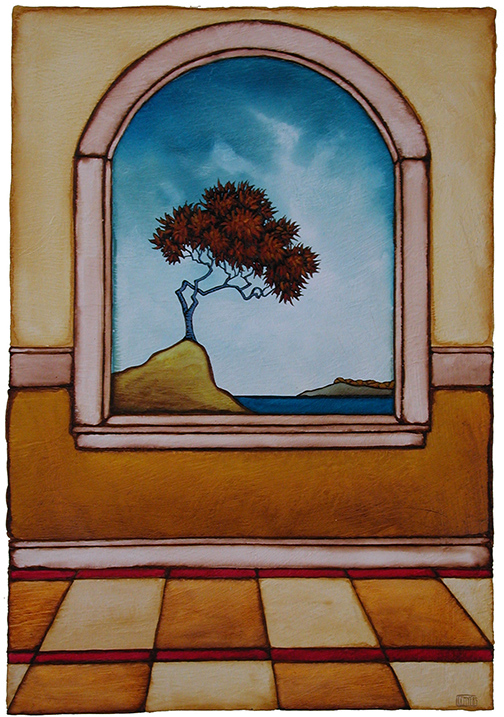
GC Myers-  Inthe Window- The Searcher smThis idea of inward and outward perspective made me think of a series called In the Window that I had painted a decade ago of views of my landscapes as seen through windows.  The piece at the top, In the Window: Dream Away,  was the first from this series.  It’s an inversion of Jung’s analogy with my internal Red Tree landscape existing here in the outer realm and the external reality occupying the inner space, the window serving as a real and symbolic portal  between the two worlds, one through which I can move back and forth easily.

I had never really thought of this series in those terms.  Initially, this series was meant as a way to present my landscapes in a different manner.  Like a fine piece of jewelry, the landscapes would act as a precious stone and the window and internal space would act as a setting for that stone.  But it really comes down to a perspective on reality and I think at that point I was just beginning to see that these landscape were as much internal as they seemed external while looking out that window.

Hmm, something to think about on a thankfully rainy day…

Read Full Post »

GC Myers- Floating Melody smSunday morning.

It’s been a strange week spent trying to get some chores done around the studio and our home but not actually achieving as much as I had hoped.  Most of my time has been spent thinking about some concepts that I am trying to move forward with in my work.  A lot of this has to do with using different materials in a way that seems organic and not forced– one of the differences between art and craft.

Sometimes I will form an idea that seems like the perfect direction to head but once I extend my thinking through it I find that the result that I imagine is so much less that I had originally foresaw.  I begin to see the idea becoming too crafty and just that thought puts a serious damper on my enthusiasm for the concept.

So I continue to roll things around in my mind, trying to find that elusive edge which I can grab on to and run with.  This is a bigger part of what I do than one might imagine.  It’s never just a matter of physically placing yourself in the studio and mechanically moving materials through a process to produce paintings.  The mental aspect is the hardest part of the process, hard to describe and even harder to master.

It was put best by iconic painter L.S. Lowry when asked what he was doing when he wasn’t painting.  His response: “Thinking about painting.”

So I am here this morning, thinking about painting.  But I am my own master, my own boss, which makes a nice intro to this week’s selection for some Sunday Morning Music.  It’s a song from nuevo flamenco guitarist Jesse Cook and friends called La Rumba D’el JefeThe Boss’ Rumba.  So, give a listen, maybe move your feet a little bit and have a great Sunday.  Me? I’ll be thinking…

Read Full Post »

Henry Moore SculptureIt is a mistake for a sculptor or a painter to speak or write very often about his job. It releases tension needed for his work.

Henry Moore

*************

Came across this quote from the great British sculptor Henry Moore and it struck me on two accounts, both in the words about an artist talking too much about his job and the other in the need for tension.  I am aware and worry about both things quite often.

Talking and writing about my work has been a normal thing for me for years now and, while I think it has helped me express myself in many ways especially in the way it acts as a confessional in which I can air out my anxieties, I have often feared that my willingness to be transparent will detract from my work in some way.  In times when I am less than confident, I fear that my words will somehow expose me as a fraud or, at least, point out the more obvious flaws in my character.

Even as I write this, I am questioning the very act of doing so.

But I do it.  And will probably continue to do so.  It’s become part of who I am at this point, even on those days when I find myself questioning the wisdom in it.

As for tension being needed for the work, that is something I have believed for myself for a long time.  Tension pushes me, makes me stretch forward out of my comfort zone.  Tension has been the igniter for every personal breakthrough in my work, creating an absolute need to find new imagery or new ways to use materials.

There are times when I feel that I have become too comfortable in the materials and processes that I use and that people have become too accustomed to seeing my work.  I feel stagnant, stalled at a plateau.  It is in these times when tension, even fear, begins to build in me and I begin to scan in all directions for a new way of seeing or a new material in which to work.  The tension becomes a burning need to prove myself.

This tension is not a comfortable thing.  But I know it is a necessary condition in order for my work to continue to grow, which is what I want and need.  To the casual observer it would seem to be a good thing to reach a point where you are comfortable and satisfied in what you do but when I don’t feel that tension I begin to worry.

Odd as it may seem, I see that anxiety as a path forward or an open door to be found.  It ultimately shows something.

Read Full Post »

GC Myers- SunbeamThe aim of art is to represent not the outward appearance of things, but their inward significance, and this, and not the external manner and detail, is true reality.
Aristotle
***************

This new painting, a small 6″ by 12″ canvas that will going with me to Alexandria this coming Sunday for my Gallery Talk at the Principle Gallery,  intrigues me on many levels but mainly in the way in which it challenges my own perception of reality.

I wondered how light would appear in a world that gave it different properties.  For instance, what if instead of a sun, that ever-burning orb in the sky, our light was provided by a ring of light that cut across the sky?  And what if the source of light was darker than the light it provided?  How would it affect how we looked at our world?

The odd thing is that my mind accepts the reality that was created.  And that speaks to the words of Aristotle at the top of the page.  The significance of a piece of art is in how our mind interprets the reality of it, in how it connects  with our inner needs and perceptions.

For me, this small painting works on those terms.  It is warm and inviting and familiar even though the reality of the setting is alien to me.  I feel as comfortable–  perhaps even more– in this environment as I would in a perfectly represented image of the real world in which we live.

And that is all I ask of it…

Read Full Post »

GC Myers- CandleThere are two ways of spreading light… To be the candle, or the mirror that reflects it.

–Edith Wharton

***************

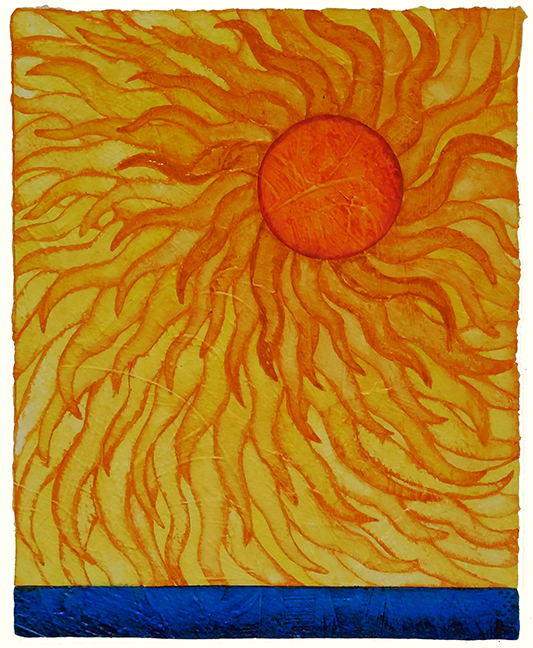
This is a new piece,  8″ by 10″ on paper, that I am calling Candle.  Working on this painting, I determined that I wanted to keep the composition very simple and stark.  There was so much energy in the radiating forms that adding anything beyond the blue panel at the bottom would change the whole feel of the piece as I was seeing it.  The blue provides contrast and forms a horizon line that gives the whole image a measure of inward depth without detracting from the simplicity of the image, which I see as being essential to the strength of this painting.

Simplicity, as is often the case, translates as grace.  And grace of some form was what began to show in this piece as it unfolded.  I was reminded as I worked on this of the great (in my mind, the greatest British artist) JMW Turner‘s reputed dying words: The sun is God.  There is a spiritual element in how the sun is depicted in his work and I often feel that I am representing something more than a source of physical light and energy when I paint these sun orbs in my work.

Perhaps that something more is a presence beyond the physical.

I don’t know.  But for a moment, my uncertainty is relieved and I feel connected with the warmth and light from the presence that is the sun in this piece.

Read Full Post »

« Newer Posts - Older Posts »