
Fist by Frank Cieciorka
On the television show History Detectives on PBS, there was a story investigating a protest poster that was made around the time of the famous protests surrounding the Democratic Convention in Chicago in 1968. It featured two images, one a glowering police officer in helmet and sunglasses and the other this fist. The segment went on to examine further how the image of the fist evolved and became one of the most powerful symbols of the protest movement of the time, used by the Black Panthers and multitudes of Labor movements as well.
They gave the name of the artist who was responsible for this iconic image, Frank Ciecorka, but gave little information on the man or his life. I wondered what became of him or what his work was like after the 60’s. Looking him up, I found out that Ciecorka was raised just down the highway from here, in Johnson City, NY, leaving after high school to head to California to go to college. He became involved with the Civil Rights Movement , organizing African American voter registration in Mississippi at the time of of the infamous murder of the three student organizers that was later portrayed in the film Mississippi Burning. It was this time spent in Mississippi that sparked Ciecorka to produce the famed fist.
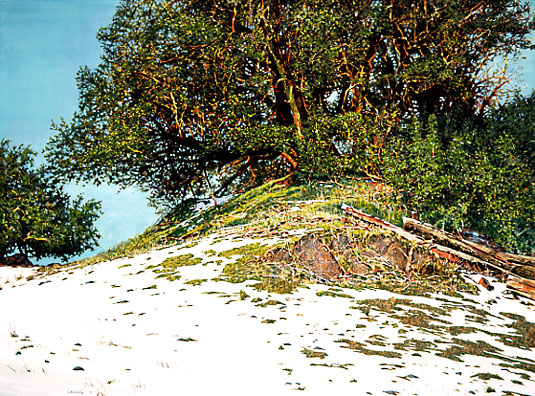
Pepperwoods, Snow-- Frank Ciecorka
The interesting thing to me was seeing his other work after that era. It turns out Ciecorka became a modestly well known watercolorist living in a rural area of California. The work was very traditional and well executed. Quiet in tone. Hardly radical at all. Looking at them said a lot to me. This was a man who was branded a radical at one time but was simply a person seeking peace and quiet for themself and others. Not an idealogue. Wanting to give others the same rights and freedoms he had experienced in his life put him at odds with those who sought to oppress or exploit others. Wanting to do the right thing became a radical idea.
Frank Ciecorka died in 2008 at the age of 69. His image of a fist raised in protest, however, lives on as a symbol of the power of the common people to fight oppression.
 Redtree Times
Though I understand it as a symbol of protest, I’ve always associated the clenched fist with a closed-minded ideological rigidity, a defining characteristic of the radical Left in the 60s (and beyond) and an increasingly defining characteristic of the new Right. The fist-bump vs. the handshake.
Perhaps you’re right in it being most associated with the more radical elements of the Left in the 60’s. I was more concerned with its origins and original intent in writing this, more interested in it as a symbol of resistance to oppression. Like many powerful symbols, it is often taken along to the furthest extremes.
The symbol of solidarity. I saw the History Detectives show. I remember the 1968 Democratic Convention. I watched it on TV. But I and others used the fist as a symbol of solidarity in 2011, during the uprising against Act 10, that Republicans used to attack unions. I was arrested for holding signs and chalking, as were many others. Ours was a peaceful protest. It was interesting, though, to see the show about the poster and the artists.