Feeds:
Posts
Comments

Archive for May, 2016

GC Myers- The Bridging

We want to be sure that it has that drama to it, that vividness to it, that focus, that cleanliness to it that is going to say something to you.

Thomas Keller

***************

The words above from chef Thomas Keller, owner of the fabled French Laundry restaurant  in Napa Valley, were in reference to food but I couldn’t help thinking that it was good advice for artists as well.

As an artist, you want your work to have a sense of drama that compels the viewer (or listener or reader or whoever it is that is taking in your work) to pause and ponder the work.  This sense of drama tells the viewer that there is something beyond the surface if they only take the time to fully appreciate it.

The vividness is in the uniqueness of it, how quickly it reaches out with its essence and reaches its intended audience.  I think of this as the work being a sort of beacon that is calling out.  Sometime, I will go in a gallery or museum and there are things on the wall that just call out to me from a great distance away.  It can be in the color or contrast or composition– something that just grabs my eye.

Focus is in the sense that all of the elements in the work come together in a harmony that pushes the central theme through.  I think there is a lot of work that is quite well done but never fully comes together in a single message that comes through to the audience.  I’m sure you’ve experienced work that you know is well done but just doesn’t seem to have much to say to you.  It kind of leaves you cold.  Focus, I believe, brings the work to life.

And there’s cleanliness.  I don’t think Keller was speaking about the cleanliness of a sanitized kitchen in his quote.  I think he was referring to the execution of the work– in his case food– so that all the elements of it sparkle and there is no distraction from what it is meant to be.  There are no unnecessary flavors or embellishments.  All excess has been pared away and there is a lightness and brightness to it.

Taken all together these qualities make for a delicious dish.  But it doesn’t happen with every effort.  There are days when finding one of these is difficult.  Then there are days when they just emerge, seemingly without effort.

The example I’m putting forward that I think fulfills Keller’s requirements — you might not agree– is the painting at the top, a 10″ by 30″ canvas called The Bridging that is part of my show at the Principle Gallery, opening in a couple of weeks on June 3.

It was the first piece I looked at after reading Keller’s words and it just seemed to have that beacon effect on me.  It was vivid and focused in it’s communication and there was a sense of drama to it.  Plus, there was a sharpness in its look and finish that just made it very appetizing.  ‘

If this were food, I would gladly eat it.

As I said, you might disagree.  Our tastes in food and art may differ.

And that is just as it should be…

Read Full Post »

GC Myers- In the Inner PlaceShakespeare said that art is a mirror held up to nature. And that’s what it is. The nature is your nature, and all of these wonderful poetic images of mythology are referring to something in you. When your mind is simply trapped by the image out there so that you never make the reference to yourself, you have misread the image.
Joseph Campbell (with Bill Moyers), The Power of Myth

*****************************

I think that the words above that Joseph Campbell spoke during his conversation with Bill Moyers for  The Power of Myth speak beautifully for both mythology and art, at least in my view.  I believe that we truly connect with myth and art when we see it as personal to ourselves, as being somehow symbolic of our own experience and being.  Our emotions and reactions.

Of course, many myths and much in art may not speak to us on this personal level.  I certainly don’t expect my work to speak to everyone no matter how much I may wish that it could.  It simply can’t.  My work is a reflection of my journey, my limited knowledge and my flawed self.  Yours is completely different.  But occasionally, there is a moment when you will see something of yourself in my representation of my inner world and that to me is magical.

This new painting, an 8″ by 24″ canvas, is what I see as being a very personal piece that might well reflect for others.  I call it In the Inner Place and it is included in my upcoming show, Part of the Pattern, at the Principle Gallery which opens June 3.  Without being specific, I see many things in this painting that I think speak strongly to how I want to see my world and my place in it.

An inner perception.

You might simply see it as a pleasant piece.

Or not.

Or you may see it as something reflective of your own inner world, something that speaks to who you are.  I can’t say.  We can’t control what anyone sees in a mirror.

Read Full Post »

walt-whitmanI’ve worn facial hair of some sort for the past twenty years and am used to seeing many people with beards.  I might even end up with a big white beard like Uncle Walt Whitman, as seen above, when I finally accept that the white hair I have is a true indicator of my age.  So a guy wearing a beard seems like no big deal, right?

Joseph Palmer  1789-1873 Harvard Worcester MAWell, it wasn’t always that way.

There was an interesting entry on the Anonymous Works  (a great site and blog featuring unique Folk art and other neat stuff– check it out!) Facebook page yesterday about a fellow named Joseph Palmer who lived in Worcester County, an area just west of Boston , Massachusetts from 1789 until his death in 1873.

Looking at his photo here on the right, his beard raises no offense to our modern sensibilities and he looks like an alright fellow.  In fact we might even think that with his big beard he looks like a typical man of his times.

Palmer Beard GraveThat was not the case.  Palmer’s beard was a source of great conflict throughout his life, to the point that when he died, it was the central theme of his wonderful gravestone in Worcester County, shown here on the left, that bears the words: Persecuted for wearing the beard.

Below are two entries that were on his listing on the Find A Grave website, another wonderful source of information, that tell his story.  The first is from a person listed as New York Historian.

Despite the conception that the past was a hairy wonderland of bearded outdoorsmen, bushy facial hair was long considered the mark of lunatics or worse, heretics. Today there is a Massachusetts gravestone that still remembers one man’s heroic fight against the forces of anti-hirsute vigilantes and a whole town’s persecution against his epic mane.


A veteran of the War of 1812, Joseph Palmer began wearing a beard in the 1820s. Beards had gone out of style in the 1720s, and Palmer was considered by most all in his small town to be slovenly and ungodly. He was even criticized by his local preacher for communing with the devil, famously responding to the accusation, “…if I remember correctly, Jesus wore a beard not unlike mine.”


In May of 1830, Palmer was attacked by four men outside of a hotel in Fitchburg, Massachusetts. Armed with razors and scissors, the men attempted to forcibly shave Palmer’s face, but the bewhiskered man stabbed two of his attackers with a pocketknife, and was subsequently arrested for assault. He could have avoided jail by paying a fine and court fees, but Palmer refused, maintaining his innocence, and more importantly his right to a glorious beard. He was subsequently jailed for 15 months, including time in solitary confinement.


Upon leaving prison, Palmer joined the Fruitlands utopian community in nearby Harvard, Massachusetts after being influenced by his friendship with fellow Fruitlander, Louisa May Alcott. The character Moses White from Alcott’s “Transcendental Wild Oats” is later based on Palmer. Palmer died in 1865 and his tombstone displays a portrait of him with a long beard, and as a final act of rebellion, the inscription, “Persecuted for Wearing the Beard.

The other entry:

Joseph Palmer was a veteran of the War of 1812 who later joined the Fruitlands commune in Harvard, Mass. started by Amos Bronson Alcott, Charles Lane and other Transcendentalists in the 1840s.

Palmer wore a full beard, which was very much out of fashion since Colonial times. He was the only man in Fitchburg, Mass. with a full beard when he moved there in 1830. He was so reviled for doing so that people would throw stones at him and break the windows of his house. His pastor refused him Communion. In 1830 he was jumped by four men who threw down and attempted to forcibly shave him. In the process of defending himself, Palmer stabbed two of the men. Palmer was charged for committing an unprovoked assault and was fined, which he refused to pay on principle. He was jailed in the Worcester city jail for non-payment and the prison guards and other prisoners also attempted to shave off his beard by force. After much bad publicity in the press he was to be released, but Palmer refused to leave the prison unless he could receive a proclamation that it was perfectly acceptable to wear a beard. No such proclamation was forthcoming and Palmer was forcibly removed from the prison by being tied to a chair and carried out. Palmer became a celebrity and worked for the Temperance and Abolitionist movements. He appears as the character Moses White in Louisa May Alcott’s story “Transcendental Wild Oats.”

His grave in Evergreen Cemetery has a likeness of his bearded face with the inscription “Persecuted for wearing the beard.”

The intolerance we see today seems ridiculous but it seems that although we pride ourselves as a nation of freedom and crow constantly about our personal rights and liberties, we have always been pretty quick to tell others how they should look, act and live their lives.  Hats off to Joseph Palmer for holding fast to his wearing of the beard.


Read Full Post »

GC Myers- Ascending BirdI’ve been looking for a title for this new painting, an 18″ by 18″ canvas, for a week or so now.  A lot of things come to mind and I thought I had it for a while.  Then I was listening to some music and one of the songs just hit me.

It was Ascending Bird, a traditional Persian folk melody, played by the Silk Road Ensemble which is a large and loosely knit group ofmusicians, including the great Yo-Yo Ma, who hail from along that fabled route and play many of the traditional instruments. The Silk Road was the network of  ancient routes that traders used in linking the East and West over the centuries, from China through the Middle East to the Mediterranean. Both goods and ideas moved along the Silk Road.

This song is the Persian version of the Phoenix myth, of a bird who flies higher and higher toward the sun until it is engulfed in flames.  It then rises from the ashes as a new creature.

And that’s kind of how I see this painting.  The paths moving from dark to light signify a transformative journey and the Red Tree appears as a Phoenix-like figure emerging from a hillock bursting from a treed hillside.  The Red Tree almost seems to ready to take flight.  I see it as a moment of realization and redefinition.

Here is the Silk Road Ensemble with Y0-Yo Ma performing Ascending Bird.  The version here is a shorter one but has the dynamic punch that struck me.  You can hear a longer version here. Give a listen and have a great Sunday.

Read Full Post »

Jigsaw Planet- Early Riser GC MyersI was going through some older posts from this blog when I came across a couple that featured some of my paintings on the website Jigsaw Planet.  It’s a site that allows viewers to either choose from a large group of puzzles or to upload their own images and create jigsaw puzzles that they can assemble on their screens.  It’s an interesting diversion.

For me, the interest comes in seeing my colors and forms deconstructed, getting to see them in singular bits that allow me to examine their texture and depth away from their normal surroundings.  I am sometimes surprised, mostly pleasantly so, by what I see.  And, despite having an advantage in knowing these painting intimately, I still struggle at some points in putting them back together– mainly because I find myself just examining the individual pieces for an extended period of time

So this morning I went to a page on the Jigsaw Planet site from a regular reader of this blog who goes by the moniker TheWOL ( and who also writes a blog called The Owl Undergound) and has posted a number of my paintings there.  There were a couple of new paintings that are featured in my upcoming June show at the Principle Gallery so I thought I’d share one with you today.  It’s Early Riser which you can see in full at the bottom and in partial reconstruction above.

If you want to try your hand at figuring out the puzzle of this painting or any of the others TheWOL has posted, click here.

DSCN1667  sm 2

Read Full Post »

GC Myers- Highest GroundI’m so glad that he let me try it again
‘Cause my last time on earth I lived a whole world of sin
I’m so glad that I know more than I knew then
Gonna keep on tryin’
Till I reach my highest ground

Stevie Wonder, Higher Ground

********************

Another new painting headed for my show, Part of the Pattern, which opens June 3 at the Principle Gallery in Alexandria, VA.  This piece is 8″ by 14″ on paper and is titled Highest Ground, borrowed from the chorus of the great Stevie Wonder song.

This is an easy piece to absorb at first take with its mix of deep warm and cool colors and simplified composition.  But despite that, there’s a lot of going on in this piece. It both feels soothing as though it represents a sort of safe haven but it raises questions.  If this is a safe haven, what is it safe from? Is this an end of the world scenario?  There’s a boat but nobody seems to be present– where are they?

And the ladder is a new element here.  I see it as a symbol of a continual upward climb toward some sort of final personal fulfillment.  A spiritual endpoint.  As the song says– gonna keep on tryin’/ Till I reach my highest ground.

 Here’s Stevie Wonder’s song to help me along as I continue to look at this piece for a while.

Read Full Post »

GC Myers-  Prismatic Moment smThe soul becomes dyed with the colour of its thoughts.

–Marcus Aurelius, Meditations

*******************

When I was in the early stages of this piece, I wasn’t quite sure what I thought of it.  It just seemed too much.  Too much color.  Too much vibrancy.

But as I tweaked here and there, deepening some colors and inserting lighter segments, it seemed to coalesce into something that needed that vibrancy in order to express whatever it held within.  As the final marks were made and it was finished, that initial uncertainty was wiped away.  That thing that I had saw earlier as its weakness had become its strength.

I’ve spent a lot of time looking at this piece over the last week or so and there’s something about it  that keeps drawing me back to it.  Maybe it is simply the colors  or the meditative stillness between the Red Tree and the Moon.  I don’t know for sure.

I call this piece, which is a 12″ by 24″ canvas, Prismatic Moment.  I have spoke before of us all being prismatic beings, filled with many colors, dimensions and sides but seldom showing but only a few of these things to any other person.  I see this painting as being one of those rare moments when one is fully expressed, when one is seen for exactly who and what they truly are.

I don’t know if we have many of those moments in our lives.  I think they may be rare but I could be wrong.  Do we ever fully see another person for all their colors and sides?  And do we ever truly show all our own colors and sides?  This piece makes me consider that thought…

Read Full Post »

2200-year-old-Antakya TurkeyMosaics 2Be Cheerful, Live your life– that is the translation of the words on this mosaic.
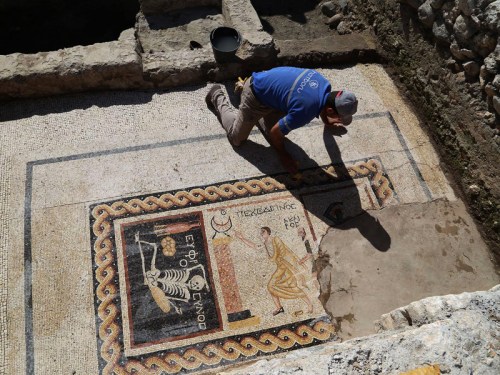
Archaeologists recently uncovered this wonderful mosaic floor with those words in Antakya, formerly the Greek-Roman city of Antiocheia, in Turkey that dates back over 2200 years, back to the third century BC.  This is an area that is famous for the discovery of a multitude of floor mosaics that once decorated the homes of the upper crust of society.

This particular mosaic feature three panels with the final panel being a reclining skeleton with bread and wine just chilling out.  The central panel shows a man with butler in tow heading anxiously toward his evening bath which was a communal event at the time.  9 PM was the time for bathing and to be late was frowned upon which  he obviously is as he is pointing to a sundial which indicates the time as being between 9 and 10 PM.  The first panel, which is damaged, is thought to have a figure throwing fire which is symbolic of the preparation for a bath.

But it’s the skeleton with it’s message that kind of lines up with Bobby McFerrin‘s song from a number of years back, Don’t Worry Be Happy, that catches our modern eye.  I think we don’t give the people from the past,  both from the near past and the very distant past, with having  a sophisticated view of life or sense of humor.  To see something like this gives us a closer connection to how they saw their own world as well as allowing us to see that they were not so different than us even though 2200 years separate us.

So, if you’re fretting on this Monday, hurrying around to beat the clock (or sundial), just remember that partying skeleton and heed its advice–Be cheerful and live your life.  If you need an accompanying beat to start the week off on the right foot, there’s little dose of the Booby McFerrin song at the bottom.

2200-year-old-Antakya Turkey Mosaics 1

Read Full Post »

GC Myers- A Hard PastIt’s Mother’s Day again. You might think the image I am showing today is an odd selection for this day. It’s a small painting called A Hard Past that is from my 2008 Outlaws series.  It’s one of a few pieces that I deeply regret ever letting go as it holds personal meaning for me.  I just didn’t realize this at the time.

I know that this may not seem like a flattering thing to say but every time I look at this image I see my Mom’s face.  At least,  a certain look she had when she was sitting by herself in silence at the kitchen table, drinking a cup of tea and smoking her ever-present Camel cigarettes, those unfiltered beauties that no doubt contributed to the lung cancer that took her life at age 63.

She would sit in stillness for a long period time at that table with a distant and hardened gaze on her face.  I always wondered what she was thinking or where she was in that moment.  But when you’re a kid you just move through the kitchen without a word or a question.

More’s the pity…

The title, A Hard Past, came from this memory of her.  She had a pretty hard life- her mother died when she was three,  no school beyond ninth grade, years of toiling in a factory and a long, turbulent and angry marriage to my father.  It gave her a hard edge, a toughness that several people commented on after her death back in 1995.  But they also commented on her humor, generosity and willingness to help others who might need a hand– those qualities that I also saw in her.  Those qualities that I so miss.

So while it may not seem like a flattering tribute, just seeing my Mom in this piece means so much to me.

For today’s music, I’m going with her favorite, Eddy Arnold, and a song that she probably felt fit her like a glove, You Don’t Know Me.  It’s a classic song that Arnold is credited with co-writing along with songwriter Cindy Walker in 1955.

Have  great Mother’s Day…

Read Full Post »

Portrait of a Group of LumberjacksI’ve got a soft spot for pictures of lumbermen.  I’ve written here before about my great-grandfather, Gilbert Perry, who was a pioneer in the Adirondack logging of the late 1800’s.  It was in the days before chainsaws and gas-powered tractors when everything was done with axes, crosscut saws, teams of horses and the brute force of large crews of men.  My aunt once had a photo of him alongside a huge stack of logs atop a horse-drawn sled but it was lost before I able to see it.

But besides Gilbert, early loggers from the Eastern forests are pretty numerous in my family and in my wife’s family.  I am always surprised at how many turn up when I am doing research. Being a lumberjack was a rough and dangerous job, one that was romanticized in the late 1800’s in magazines such as Harper’s Weekly and the Atlantic as the Eastern equivalent of the Western cowboys of that time.

A number of those in our families lost their lives in the forests.  Among them, Cheri’s great-grandfather was crushed beneath a large log and died before he could be extracted.  I read an account of a great-uncle of mine in the Pennsylvania Black Forest whose leg was crushed between two logs in a sluice that was being used to move them.  The article tells how they  rushed him to a train and sped at breakneck speeds towards Williamsport trying to save him.  Unfortunately,  he passed away as they pulled into the city.

So whenever I run across a photo from of early lumberjacks I have to stop and take a look.  I don’t know anything about the photo at the top, when or where it was taken.  I suspect it’s from around the turn of the century but whether it is from the Eastern forests, the Northwest or the great forests of the upper Midwest is beyond me.  Regardless, it’s just a great photo on so many levels and is one of my new favorites.

Read Full Post »

« Newer Posts - Older Posts »