Feeds:
Posts
Comments

Archive for May, 2021

Vincent-van-Gogh-Whaet-Field-with-Cypresses.-Image-via-wikimedia.org_


A few days back, I shared a video from composer Barnaby Martin that concerned the work of Wassily Kandinsky and how color related to music. I thought I’d share another of Martin’s videos this morning, this one again about the role of music and its relationship to painting, this time focusing on the work of Vincent Van Gogh.

This interests me because I have thought many times about how painting is related to music and how I often view my paintings as musical compositions. Many are simple tunes but some take on the grander aspects of a concerto or symphony.

I notice this more in recent years as many of the paintings take longer and longer to finish. I would have finished many of these paintings much sooner in earlier years but they would have remained simple tunes. And that’s fine. Who doesn’t love a simple that stays with you long after hearing it?

But time has shown that the once simple tune can often expand and deepen, growing into something that speaks to larger universal concepts.  The extra time spent now on these paintings is used in deepening and expanding the range within itself. Finding extra rhythms and harmonies within the colors. Adding dissonance and consonance, small counterpoints and contrasts that may not even be noticed to the casual viewer.

It’s not something I intended to do with my work. It just evolved as I saw more and more room to grow within the work. A lot of that comes from working in the way this video describes the process of painter Eugene Delacroix who had an influence on Van Gogh. Much of Delacroix’s work dealt with repetitions of subject and form. This allowed him to focus on fully exploring color and its effects.

This is something that I understand very well. I have used similar compositions many times through the years and each is significantly different than the others. Differences in color, tone, shading, contrast, texture and other color qualities give each piece its own unique emotional feel and voice.

Every artist works a bit differently and has different aims for their work. They have their own reasons for doing what they do. To be honest, I don’t really know why I do things the way I do. Maybe I look at the works and writings of others with the hope of finding some illumination into my own motivation and rationale.

Maybe it’s just my way of making music in the only way I know. Who knows?

Anyway, hope you’ll take look at this video from Barnaby Martin. It’s worth a few minutes of your time.


Read Full Post »

GC Myers- Harmonia Aeternam


There are seconds, they come only five or six at a time, and you suddenly feel the presence of eternal harmony, fully achieved. It is nothing earthly; not that it’s heavenly, but man cannot endure it in his earthly state. One must change physically or die. The feeling is clear and indisputable. As if you suddenly sense the whole of nature and suddenly say: yes, this is true. God, when he was creating the world, said at the end of each day of creation: ‘Yes, this is true, this is good.’ This . . . this is not tenderheartedness, but simply joy. You don’t forgive anything, because there is no longer anything to forgive. You don’t really love — oh, what is here is higher than love! What’s most frightening is that it’s so terribly clear, and there’s such joy. If it were longer than five seconds — the soul couldn’t endure it and would vanish. In those five seconds I live my life through, and for them I would give my whole life, because it’s worth it. To endure ten seconds one would have to change physically . . . .

― Fyodor Dostoyevsky, Demons


I think I understand what Dostoyevsky was describing in the words above. I imagine –well, hope– that most of you have experienced those fleeting seconds where the harmony of everything suddenly becomes evident to you.

All the things that make up the world, the universe, all the planes of existence, and yourself in that rare moment seem to be just where they should be in relation to all other things. It is as though everything is comprised of floating, constantly shifting plates that periodically find themselves in a position where the perfection of eternity is achieved and revealed to the watchful few.

For a few glorious seconds.

Then the plates resume their shifting and harmony seems, at best, just out of reach. Or, in the case of the other extreme, nowhere to be found as the plates shift to a point of chaos and dangerous imbalance.

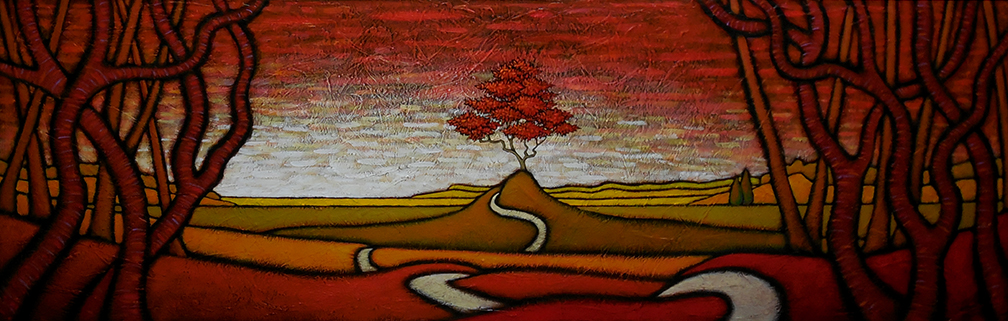
Maybe that rare moment of eternal harmony –as I know it– is what I am seeing in this new painting that is headed to the Principle Gallery for my annual solo show, Between Here and There, which opens June 4. It has a feeling of great harmony for me, of things being in alignment, in place. And of the Red Tree as a central figure being aware of the unity of time and place in which it finds itself.

I believe I have experienced episodes of those four or five seconds of clarity and I see it in this piece. I am calling this new 24″ by 36″ painting Harmonia Aeternam. I chose the Latin translation for Eternal Harmony because I felt this piece deserved a weightier title.

It’s strong enough to handle it.

Read Full Post »

gc-myers-mothers-day-1994-sm (1)


Art is the child of nature in whom we trace the features of the mothers face.

― Henry Wadsworth Longfellow


Hard to believe that 25 Mother’s Days have come and gone since my mom passed away. Seems like it was just a year or so back in time.

Longfellow was probably right about art being a product of the influence of our mothers, if I am understanding his words correctly. I know my mom played a role in me becoming an artist if only for the fact that she never discouraged me from following any particular path and always gave the encouragement she could.

I wish she had lived long enough to see that things worked out okay for me and my work. She only saw my earliest work, like the piece at the top that I gave to her on Mother’s Day in 1994 and which now hangs in my studio to remind me of her. She never saw it hanging in a gallery or museum nor would she know that I would end up making art as my livelihood.

Looking around the studio at the work assembled for my show in June, I think she would be really happy with it. I am not saying she would love the work itself. I will never really know that. But she would love the fact that I did it and I know that would be enough, that it would be a source of great pride for her.

And that makes me happy.

Maybe that’s what Longfellow was referring to with his words.

I don’t know. Just going to take some time today to remember my mom, though a day seldom goes by without some trace of her coming through to me. So glad I have those memories of her.

Like the song says: they can’t take those away from me.

For this Mother’s Day Sunday musical selection, here’s a recording of that classic George and Ira Gershwin tune done by Billie Holiday at a later stage of her career, in 1957. I like this performance a lot with Ben Webster on sax and Barney Kessel on guitar.


Read Full Post »

Kandinsky Sketch for Composition II

Wassily Kandinsky- Sketch for Composition II- 1923


Color is the keyboard, the eyes are the harmonies, the soul is the piano with many strings. The artist is the hand that plays, touching one key or another, to cause vibrations in the soul.

-Wassily Kandinsky


I came across a short film that I would like to share. It’s What Does Colour Sound Like? and was made by modern composer Barnaby Martin. This ten minute film discusses painter Wassily Kandinsky (1866-1944) as he tried to reconcile the connections between color, music, and emotion in his work throughout his career.

Kandinsky’s work and his writings have always struck chords with me. I know it influenced how I look at works of art, including my own. I often feel and describe paintings in terms of music and, like Kandinsky, view the colors and shapes within a painting as musical elements which are more vital to the work than the actual representation of any one object.

At this point in my preparation for a show, when there is an abundance of new work surrounding me in the studio, the importance of color and form as carriers of emotion becomes clear. Maybe that’s why this film and Kandinsky’s words speak so directly to me this morning.

If you have ten minutes to spare, I urge you to take a look. And a listen.


Read Full Post »

Ralph Fasanella Bread and Roses

Ralph Fasanella- Bread and Roses


This past week was the beginning of May and May Day, the first day of the month which is a holiday of several stripes, from a pagan celebration of the coming of summer to one that celebrates the rights of workers around the world. For me, it always reminds me of the late folk artist Ralph Fasanella. Before becoming a painter, he was a union organizer throughout his life and it is represented in much of his work. The painting at the top, Bread and Roses, for example, depicts the long and often violent 1912 labor strike against the textile mills in Lawrence, Massachusetts. The striker was called the Bread and Roses strike because the strikers demanded both better pay and benefits– the bread– as well as respect and recognition– the roses.

But when I think of Fasanella, beyond his labor and baseball paintings, I am also always reminded of a story about his response to a suggestion from someone about this painting. I have talked about it in posts here before but thought it would be a good story to share once more.

Anyone who does anything that people look at, listen to or read is always susceptible to a host of well-meaning folks who want to share ideas on how whatever it is that you do can be done better. It usually starts with some simple phrase: What you really need to do is… Or it could  be You should really try to… 

I generally listen politely and say something like I’ll look into that or Maybe I will try that sometime. Some of the suggestions are quite good and if I were so inclined might well be something I would do. But that is the key thing here: if I were so inclined.

If it’s not something that I want to do with great energy or excitement, if it’s not something that fits in with how I work and see things, then it ain’t getting done.

Another suggestion is that the artist or author should try to do something like other artists. That always hits a sour spot with me. It usually starts with Your work reminds me so much of… or Have you tried painting like….

I know when I was starting that a goal was to not have my work constantly compared to others so when I talk with young artists I try not to tell them that their work reminds me of another artist. There are exceptions to this, say when an artist is very new to the process and needs the affirmation that they are capturing something in the same way as a well known artist. But unless I know what the artist is trying to do and say with their work, it’s not my place to tell then how they should change their work or how it reminds me of other artists.

That brings me back to my Fasanella story. I am replaying a bit from when I first posted it here ten years ago. The portion with the Fasanella story is from a blog post from the Fenimore Art Museum which has a great folk art collection and whose president, Paul D’Ambrosio, was a friend and chronicler of  Fasanella’s work and life.

Here’s that post from 2011:


Over the years, I have been approached by several people who think they are doing me a great service by telling me that I should change the way I paint in some way or that I should try to paint more like some other artist. Early on, when I was first exhibiting my work, I had another more established artist tell me that I should change the way I paint my figures, that they should look the way other artists paint them. I responded to this artist and the others who offered me their advice with a smile and an “I’ll look into that.”

But that one time, I also mistakenly heeded the older painter’s words, being inexperienced and seeking a way as I was, and stopped painting figures for a while before realizing that this was not good advice at all. My style, after all, was my own and didn’t need to conform to what others thought were rules.

Here’s the post about Fasanella and his response to such advice.

Ralph Fasanella had trouble painting hands. A lot of trained artists do too, so it is not surprising that a union organizer who turned to drawing suddenly at the age of 40 would struggle with hands early in his career. But he did have something that proved better than years of formal training: he believed that he was an artist and that what he was doing – painting the lives of working people – was a calling that deserved his complete attention and all-consuming passion.

And that made him react when anyone suggested that his paintings weren’t up to snuff. He said that he was painting “felt space,” not real space. His people and the urban settings he placed them in were not realistic in the purest sense of the word, but they sang with spirit and emotion. As Ralph said, “I may paint flat, but I don’t think flat.”

Rembrandt Hands

His most memorable quote, and the one that says the most about him, occurred very early in his artistic career, when someone told him that his hands looked like sticks. He ought to study Rembrandt’s hands, they said, in order to get it right.

His response is priceless: “Fuck you and Rembrandt! My name is Ralph!”

I may not really adopt Ralph’s approach but you can bet his words will be echoing in my head the next time someone says “You should paint like…”


So, those are some of my thoughts on suggestions. Now I am going back to my work, doing it in the only way I know or can. If you have some suggestions for me, well… I’ll look into it.

Read Full Post »

GC Myers- Pillars of Wisdom- Wait and Hope sm


“There is neither happiness nor misery in the world; there is only the comparison of one state with another, nothing more. He who has felt the deepest grief is best able to experience supreme happiness. We must have felt what it is to die, Morrel, that we may appreciate the enjoyments of life.
” Live, then, and be happy, beloved children of my heart, and never forget, that until the day God will deign to reveal the future to man, all human wisdom is contained in these two words, ‘Wait and Hope.”

Alexandre Dumas, The Count of Monte Cristo


The painting above is another that is included in my show, Between Here and There, that opens June 4 at the Principle Gallery in Alexandria, VA. It is 12″ by 16″ and is also painted on an aluminum panel.

It is titled Pillars of Wisdom: Wait and Hope. This was inspired, in part, by the excerpt above from the classic The Count of Monte Cristo by Alexandre Dumas. As I was painting it, I began call this piece Pillars of Wisdom but after it was completed I came across this bit from Dumas. The idea of seeing these being trees named Hope and Wait and that they represent the totality of human wisdom seemed perfect.

So many of us live with a certainty and assurance that is beyond me. We have yet to learn all there is to know, all the answers to the infinite number of questions that hover over us like so many stars in the night sky. Perhaps one day we will fully be bathed in the light that is all wisdom, but until then all we have are those two words: Wait and Hope.

Hope waits for the light to come and Wait hopes for it.

Wait and Hope. What more do you need to know?


Read Full Post »


Fanny spoke her feelings. “Here’s harmony!” said she; “here’s repose! Here’s what may leave all painting and all music behind, and what may tranquillise every care, and lift the heart to rapture! When I look out on such a night as this, I feel as if there could be neither wickedness nor sorrow in the world; and there certainly would be less of both if the sublimity of Nature were more attended to, and people were carried more out of themselves by contemplating such a scene.

― Jane Austen, Mansfield Park


GC Myers- Tranquilium smThis is a new painting that is included in my new solo show, Between Here and There, which opens June 4 at the Principle Gallery. It is titled Tranquilium and is 10″ by 20″ painted on an aluminum panel.

I have recently started painting on aluminum composite panels which are two layers of aluminum sandwiched over a polyethylene core. They are rigid, acid-free and extremely durable which means that a painting done on one of these panels should be long-lasting.

The durability and  stability of my work is something I have thought about since my earliest days as an artist. While I have no control over how my work moves into the future after it leaves my hands, I can at least give it a chance to survive while maintaining the look and integrity of the original painting.

I don’t know if my work will live on but if so, I want it to look as good as possible. I believe work painted on these panels have the best chance at doing just that.

Plus, I like painting on them, Every surface– canvas, wood panel, or paper– has its own feel under the brush. A stretched canvas has an appeal for me in that there is often a drum-like feel and cadence as the brush bounces off the taut surface. It adds to the meditative quality of the process. Paper has a softness that comes through even when it is covered with multiple layers of gesso.

Much like wood or masonite panels but far more stable and unaffected by moisture, the aluminum panels have a unmoving solidity that lets me know how my brush will react as it meets the surface. That helps for my process. I know what is going to happen at that moment. And that’s a good thing.

This piece, Tranquilium, has satisfied something within me. It has a stillness and placidity that feels timeless so it’s natural that I would like to think that it will live a longer life than my own. Hopefully, it has something in it, perhaps that which Jane Austen’s Fanny described above, that will speak to someone in the future as it does to me in the present moment. Lifting the panel with this painting, feeling its weight and solidity and the way the image comes off the surface, it certainly seems like it might.

I will never know but at least I am giving it a chance.

Read Full Post »

Paul_Gauguin_-_D'ou_venons-nous


What still concerns me the most is: am I on the right track, am I making progress, am I making mistakes in art?

–Paul Gauguin


I run this post every few years, usually when I am at a low ebb, when self-doubt is really nagging at me. Right now, as I prep for my upcoming Principle Gallery show, I am bouncing from highs to lows each day which is normal for me in my process. It’s during these times that I ask myself questions like those above that Gauguin posed for himself. However, this morning I feel pretty good. Fairly confident, feeling that my work is very much progressing and evolving in a positive way. But time has taught that by this afternoon I may be racked with doubt about my abilities or my own judgement of them. 

So, I try not to dwell on it and attempt to simply work through it. That. usually provides the answer to my questions and doubts. That’s what I am going to do right now, thank you.


At one of my gallery talks a year or two ago, I was asked about confidence in my work. I can’t remember the exact wording but the questioner seemed to imply that at a certain point in an artist’s evolution doubts fade away and one is absolutely certain and confident in their work.

I think I laughed a bit then tried to let them know that even though I stood up there and seemed confident in that moment, it was mere illusion, that I was often filled with raging doubts about my voice or direction or my ability. I wanted them to know that there were often periods when I lost all confidence in what I was doing, that there were days that turned into weeks where I bounced around in my studio, paralyzed with a giant knot in my gut because it seemed like everything I had done before was suddenly worthless and without content in my mind.

I don’t know that I explained myself well that day or if I can right now. There are moments (and days and weeks) of clarity where the doubts do ease up and I no longer pelt myself with questions that I can’t answer. Kind of like the painting at the top, Where Do We Come From? What Are We? Where Are We Going?, the masterpiece from Paul Gauguin. Those are tough questions to answer, especially for a person who has little religious belief.

And maybe that’s the answer. Maybe my work has always served as a type of surrogate belief system, expressing instinctual reactions to these great questions. I don’t really know and I doubt that I ever will. I only hope that the doubts take a break once in a while.

There was another quote I was considering using for this subject from famed art critic Robert Hughes:

The greater the artist, the greater the doubt. Perfect confidence is given to the less talented as a consolation prize.

I liked the sentiment but it felt kind of self-serving, like saying that being aware aware of your own stupidity is actually a sign of your intelligence. While I would really like to believe that all those times when I realized I was dumb as a stump were actually evidence of my brilliance, I have real doubts about the logic. If it is true, there are a lot of geniuses out there operating under the guise of stupidity and overwhelming self-doubt.

However, if Hughes is correct then I may be one of the the greatest artists of all time and a genius to boot.

But, at the moment, I have grave doubts about that.


Read Full Post »

GC Myers- Show's Over, Folks


Everything is going to be fine in the end.
If it’s not fine it’s not the end.

― Oscar Wilde


My solo show, Between Here and There, which opens June 4th at the Principle Gallery, has a group of smaller paintings featuring Red Chairs in interior scenes are mostly scenes of the aftermath of prior proceedings. I’ve shown a few here already and thought I would share another today. The one above is titled Show’s Over, Folks.

Kind of like a cop at a crime scene saying, “Shows, Over, folks, Nothing more to see here. Move on.

I enjoy these pieces in many ways. I like composing and painting them. I enjoy looking at them because while they often make me smile, they often make me think as well. There’s usually a fair amount of atmosphere in them to take in and interpret. Sometimes my take on a piece like this will change from view to view. Perhaps it’s dependent on my own mood at the time that I am looking.

Right now, this one makes me smile. The show might be over for the night and that might be sad but it ain’t the end. Like Wilde’s words at the top– if it’s not fine it’s not the end.

Here’s song that kind of goes with this piece. It’s an old Kinks favorite, Till the End of the Day. With lyrics like: Yeah, I get up/And I see the sun up/And I feel good, yeah/’Cause my life has begun how can things not be fine?

Now, off to work.


Read Full Post »

GC Myers- The Animating Presence sm

“The Animating Presence”- At the West End Gallery, Corning


Running a little behind this morning but feel an obligation to at least share a song this morning. It’s Bodhissattva from an old favorite, Steely Dan.

Bodhissattva is a Buddhist term for a person who believes that their own enlightenment is not important as guiding and assisting others to reach enlightenment. They have put off reaching becoming arhats, which is the term given to those who reached enlightenment or nirvana, meaning that they have rid themselves completely of the Three Poisons of greed, hatred, and ignorance. Since an arhat is considered a “perfected person” they become free of the cycle of samsara or reincarnation.

On the other hand, a bodhissattva, which the Dalai Lama is considered, forgoes samsara in order to continually be reborn so that they can help many others free themselves from suffering and reach nirvana before ultimately reaching enlightenment themselves at some point in the distant future. To be a bodhissattva one must practice the Six Perfections which are:

  1. Be generous and give to others.
  2. Live a life in which you do the right thing.
  3. Have patience with all people.
  4. Sustain your energy so that you keep going through difficult times.
  5. Work on concentration by meditating.
  6. Gain wisdom

So, there’s a little knowledge this morning. I don’t know if you needed it. But I guess freeing ourselves from the Three Poisons of greed, hatred, and ignorance or practicing most or all of the Six Perfections can’t hurt any of us.

Here’s Bodhissattva from Steely Dan. Good tune to start off the morning.


Read Full Post »

« Newer Posts - Older Posts »