Everything is going to be fine in the end. If it’s not fine it’s not the end.
― Oscar Wilde
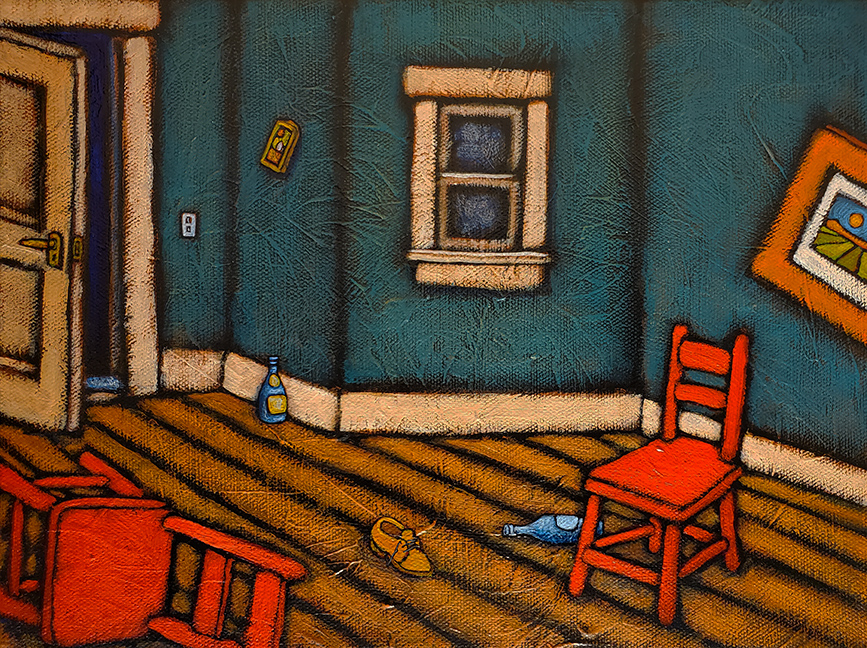
My solo show, Between Here and There, which opens June 4th at the Principle Gallery, has a group of smaller paintings featuring Red Chairs in interior scenes are mostly scenes of the aftermath of prior proceedings. I’ve shown a few here already and thought I would share another today. The one above is titled Show’s Over, Folks.
Kind of like a cop at a crime scene saying, “Shows, Over, folks, Nothing more to see here. Move on.”
I enjoy these pieces in many ways. I like composing and painting them. I enjoy looking at them because while they often make me smile, they often make me think as well. There’s usually a fair amount of atmosphere in them to take in and interpret. Sometimes my take on a piece like this will change from view to view. Perhaps it’s dependent on my own mood at the time that I am looking.
Right now, this one makes me smile. The show might be over for the night and that might be sad but it ain’t the end. Like Wilde’s words at the top– if it’s not fine it’s not the end.
Here’s song that kind of goes with this piece. It’s an old Kinks favorite, Till the End of the Day. With lyrics like: Yeah, I get up/And I see the sun up/And I feel good, yeah/’Cause my life has begun how can things not be fine?
“The Animating Presence”- At the West End Gallery, Corning
Running a little behind this morning but feel an obligation to at least share a song this morning. It’s Bodhissattva from an old favorite, Steely Dan.
Bodhissattva is a Buddhist term for a person who believes that their own enlightenment is not important as guiding and assisting others to reach enlightenment. They have put off reaching becoming arhats, which is the term given to those who reached enlightenment or nirvana, meaning that they have rid themselves completely of the Three Poisons of greed, hatred, and ignorance. Since an arhat is considered a “perfected person” they become free of the cycle of samsara or reincarnation.
On the other hand, a bodhissattva, which the Dalai Lama is considered, forgoes samsara in order to continually be reborn so that they can help many others free themselves from suffering and reach nirvana before ultimately reaching enlightenment themselves at some point in the distant future. To be a bodhissattva one must practice the Six Perfections which are:
Be generous and give to others.
Live a life in which you do the right thing.
Have patience with all people.
Sustain your energy so that you keep going through difficult times.
Work on concentration by meditating.
Gain wisdom
So, there’s a little knowledge this morning. I don’t know if you needed it. But I guess freeing ourselves from the Three Poisons of greed, hatred, and ignorance or practicing most or all of the Six Perfections can’t hurt any of us.
Here’s Bodhissattvafrom Steely Dan. Good tune to start off the morning.
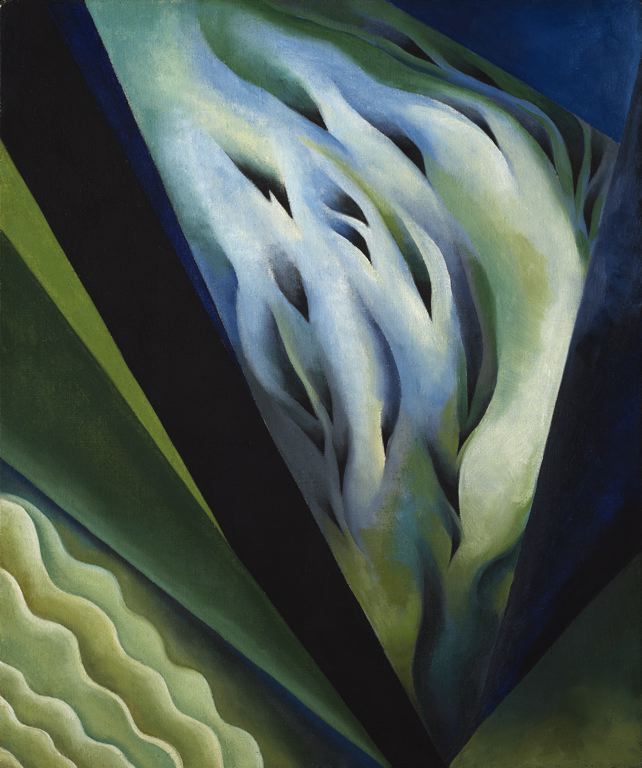
Lots to do this morning so I am just going to share a favorite painting from Georgia O’Keeffe and a piece of music whose composition was influenced by that same painting.
The painting is Blue and Green Music which was painted by O’Keeffe during her years in New York, somewhere around 1920. It is her attempt at translating music into visual form. I think it works on that level but even without knowing that this was her aim, I would be enthralled by this piece. The use of contrasts of colors, light and dark, and hard and soft edges along with the rhythmic curl of the bright organic form that occupies the center of the picture makes this an absolute feast for the eyes.
Or, maybe I should say, a symphony for the eyes.
I know that it sets off all sorts of sparks in me.
The piece of music is titled, of course, Blue and Green Music, and is a composition from the contemporary composer Samuel Hazo. I believe this piece is from somewhere around 2010 or 11. From the number of videos of this piece on YouTube, I would guess this has become a popular piece for high school and college concert bands and orchestras.
It’s a lovely piece of music. Taking a few minutes to listen while pondering Georgia O’Keeffe’s brilliant creation is not a bad way to kick off the morning.
I have a lot on my plate this morning so let’s just listen to the late Shel Silverstein sing his song/poem, Ickle Me, Pickle Me, Tickle Me too, from his marvelous book of children’s verse, Where the Sidewalk Ends. Like most of Silverstein’s stuff for kids, it’s a blend of word rhythms and nonsense that just works. I have probably watched this short video a dozen or more times over the years and it always holds my interest
I love kids songs and literature. Don’t know what that says about my mental development but I am not going to worry about it. When I was putting this together I thought of another really simple kids song from Woody Guthrie that I am going to stick on here. It’s his Grassy Grass Grass. My thinking is that with our spring weather finally taking hold that anything that urges the grass to grow and things to green more is a good thing. Plus it has a nice drum rhythm to start the weekend.
So, give a listen to a couple of simple ditties for the kiddies this morning. What can it hurt? In the meantime, I’ll get to my day. Some new work coming in the next few days so check back in.
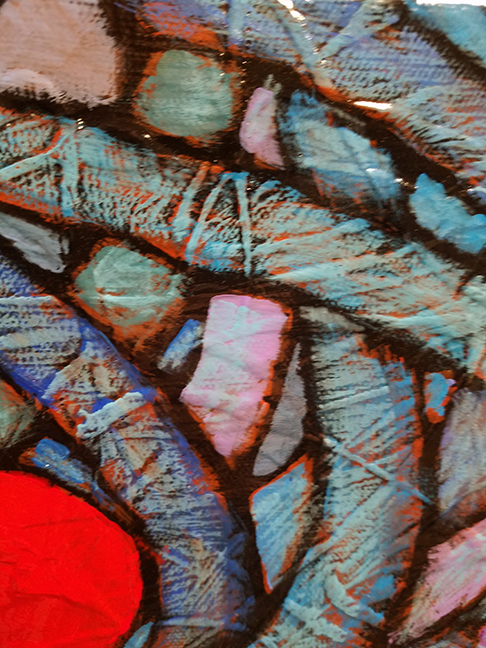
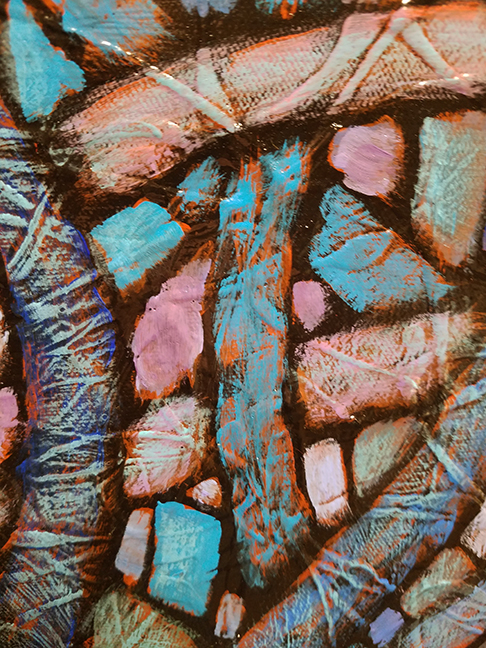
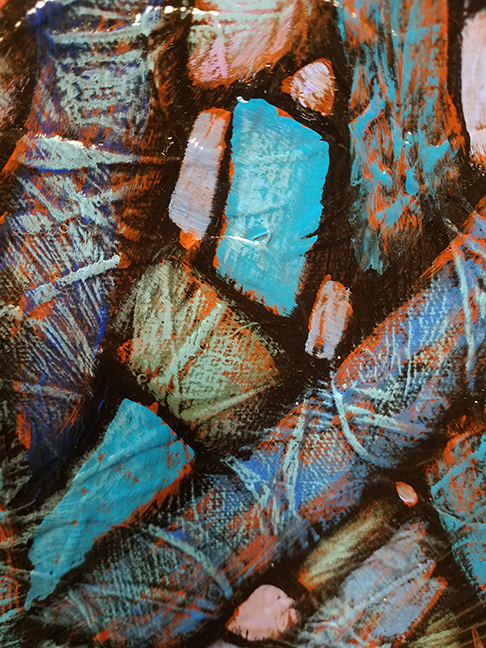
I am currently in the midst of painting for my annual June show at the Principle Gallery and am in what I believe is a pretty good groove at the moment. I was thinking about how I view my work at these times, about how it is about how I am painting rather than what I am painting. It reminded me of this post from a few years ago that shows closeup details of the painting’s surface. These details are actually how I see my work most of the time, especially when in a groove. And probably as much as I see them as a whole. Made me think this post was worth revisiting.
I was looking for something to play this morning and put on this album, Blues Twilight, from jazz trumpet player Richard Boulger. I’ve played a couple of tracks from this album here over the years.
While the title track was playing I went over to over to a painting that hangs in my studio, the one shown above. It’s an experiment titled October Sky from a few years back that is a real favorite of mine. I showed it for only a short time before deciding that I wanted it hanging in the studio. I never really worked any further in the direction this piece was taking me. Part of that decision to not go further was purely selfish, wanting to keep something solely for myself, something that wasn’t subject to other people’s opinions.
A strictly personal piece. A part of the prism that doesn’t show.
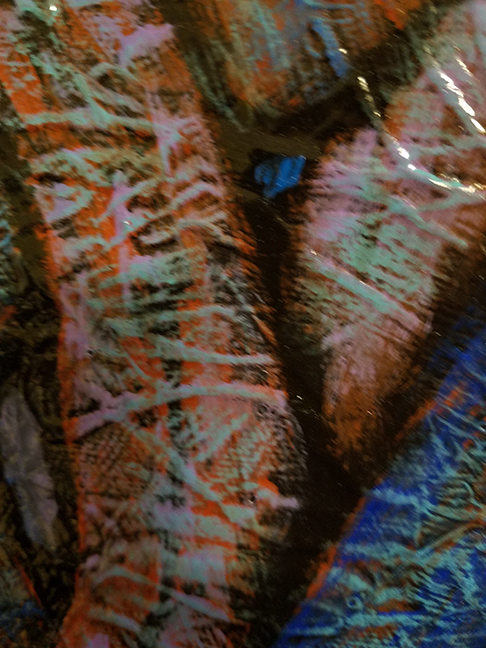
I look at it every day but generally it is from a distance, taking it in as a whole. But his morning, while the album’s title track played I went and really looked hard at it, up close so that every bump and smear was obvious. And I liked what I was seeing, so much so that I grabbed my phone and began snapping little up close chunks of it.
It all very much felt like the music, like captured phrases or verses. Each had their own nuance, color and texture and they somehow blended into a harmonic coherence that made the piece feel complete.
It’s funny but sometimes when I am working hard and in a groove that takes over from conscious thought, I almost forget about those things that I myself like in my work because I don’t have to think about them in the process of creating the work. Looking at this painting this close made me appreciate the painting even more, made me think about it in a different way than the manner in which I now used to seeing it.
Guess it’s a good thing to stop every now and then and look at what you’ve done, up close and personal.
Here’s Blues Twilight from Richard Boulger. Enjoy the music and take a look at the snips, if you so wish. But definitely have a good day.
Been working lately on a group of interior scenes that are part of my June show at the Principle Gallery in Alexandria, VA. I showed one this past week called After Party and it set the tone for this group with the sloppy disheveled look of a room after the party is over.
There are many things I like about these pieces. One is the fact that they can seem humorous while still seming quietly mysterious and even pensive or somber. I like that dichotomy. Maybe that’s because I have often seen humor in some of the more serious moments of my life.
It’s often a short ride from crying to laughing.
Another of the things I like about painting these pieces is their rough edges and slightly askew perspectives. I paint these pieces with slightly larger brushes than needed which gives them the softly sloppy look that appeals to me.
Like much of my work, these pieces are not planned out. I just start in one spot and see what builds out from that first mark on the surface. I make a mark then reassess and add another then reassess again, weighing the balance of the composition as well as the balance of the colors and contrasts.
It’s like juggling where you are always readjusting with each toss of the ball and with each new additional ball thrown into the mix. Maybe that is what I should call myself–paint juggler.
This piece is a small 9′ by 12″ canvas and is called Kick Off a Shoe ( Stay a Little Longer) which is a tip of the hat, in a way, to the old Bob Wills Western swing classic, Stay All Night ( Stay a Little Longer). Below is a version of that song from Ray Benson and Asleep at the Wheel, who have for many decades kept the spirit of Bob Wills’ music alive with their own brand of Western swing. Always sure to get your toes tapping.
Give a listen and get up and dance a little. Maybe kick off a shoe and stay a little longer. What’s stopping you?
There is one spectacle grander than the sea, that is the sky; there is one spectacle grander than the sky, that is the interior of the soul.
― Victor Hugo, Les Misérables
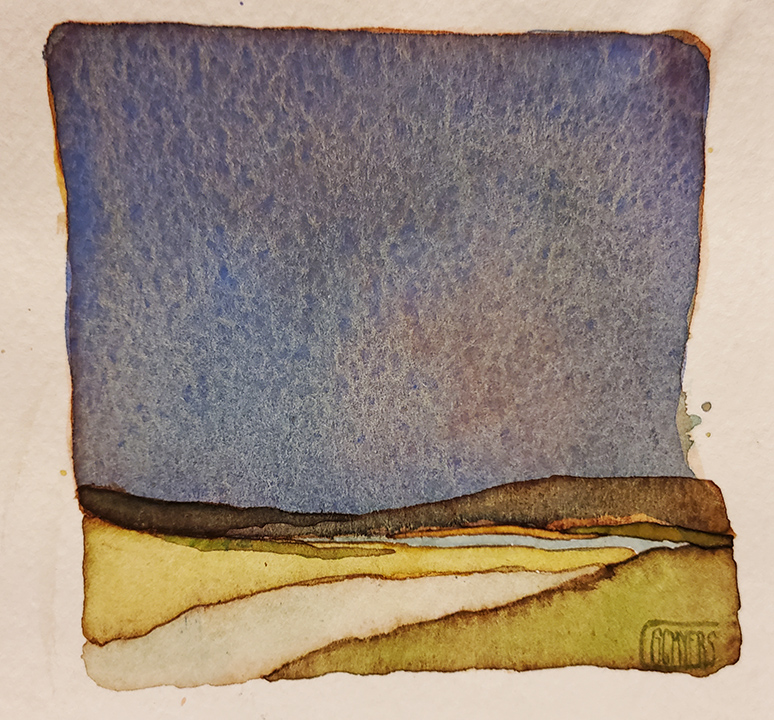
Thought I’d share another older piece, one that also never found its way out of the studio. Some times the reason they stay with me is obvious and other times not so much. This small piece falls in the not so much category.
It’s from mid 1995, not long after I first started showing my work publicly. Across the bottom of the piece of watercolor paper on which it is painted is the title The Sky Is Always the Sky along with the date it was painted in 1995.
Looking at it now, I can’t figure out why I felt it wasn’t worthy to show at that time. I am actually pretty pleased to be able to show it now. It has much in it that I wish would show up in my work now, twenty five years later.
For example, its utter simplicity and the gracefulness of its linework. Well, my definition of gracefulness, anyway. There’s also the way the layers of color go together so well with the grainy pigments of the cobalt blue settling into the shallow pits of the paper above a sepia underlayer.
Looking at it, I realize that many of the changes that took place in the following years in my work were material related. A few years after this I went from employing traditional watercolors in my work to acrylic inks. The difference is that the inks have a more and finer pigments which make their colors more explosive, more impactful. There is a difference in the more subtle aspects of the watercolors that is hard to replicate with the inks. This piece is an example, at least by my analysis.
Another difference was that I also began using a gessoed surface a few years later which also brought dramatic changes to the work. The positives of using gesso outweigh not using it for me but the beauty of cotton watercolor paper and its tactile appearance is undeniable.
The other difference was that the brushes I was using at the time were wonderful Winsor & Newton round brushes that have long since been discontinued. These round brushes had a different brush profile than almost any other round brush I have been able to find since that time. I use a round brush almost all the time in my wet work even when a flat brush might sometimes be a more obvious choice. I like the organic quality it gives the work and the linework it produces. Brush choice has a big impact on how the work appears and I am still trying to find brushes that have the same qualities as those old W&N brushes.
Anyway, looking at this old piece again so closely gives me inspiration, makes me want to revisit those elements that make it work so well for me. We’ll see
Here’s an old Chris Isaak song, a favorite that is centered around a particular blue sky. It’s the tone I would like for this piece. Here’s Blue Spanish Sky.
I was looking at some more old small paintings, stuff from before I ever showed my work in public. This piece from late 1994 always jumps out at me. It has a title written below the image (cropped out in the photo above) that says Lester’s Place. I don’t really know why I called it Lester’s or to who or what the name might refer.
There’s something about this little piece that I really like. Maybe it’s as simple as its colors. Maybe it’s the sense of place it evokes for me. Or the mystery of its narrative.
I don’t know.
And I don’t think I need to really know. I just like it for whatever reason. The funny thing is that I often think of this old John Lee Hooker song, Rock House Boogie, from the mid 1950’s when I look at this piece. This shack has the same sort of roughness and emotional coloration of this song. I can imagine someone in 1954 stumbling upon this after hearing years of music from groups like the Four Freshmen and the Modernaires on the radio.
It’s hard driving beat and sharp snapping guitar riffs would most likely create a sense of revelation or one of bewilderment and maybe even terror.
For me, even twenty years later, it was revelation.
Now, that beat has me wanting to get to it for the day. Give a listen and get to your own day.
Sometimes the horizon is defined by a wall behind which rises the noise of a disappearing train. The whole nostalgia of the infinite is revealed to us behind the geometrical precision of the square. We experience the most unforgettable movements when certain aspects of the world, whose existence we completely ignore, suddenly confront us with the revelation of mysteries lying all the time within our reach and which we cannot see because we are too short-sighted, and cannot feel because our senses are inadequately developed. Their dead voices speak to us from nearby, but they sound like voices from another planet.
–Giorgio de Chirico
***************
I am busy this morning but wanted to share a post from several years ago about painter Giorgio de Chirico. I thought I’d run it again today with the addition at the bottom of one of his more famous paintings and a short MoMA video about it. The idea that is presented about the metaphysics contained in dealing not with “perceived reality” but a “reality imagined” and of creating “a plausible representation of a believable and negotiable space” rang a bell for me as that is the space where I try to operate. Take a look.
A turning point for me when I was first stumbling around with my own painting was when I encountered the work of Giorgio de Chirico, an Italian painter of darkly toned metaphorical works. He lived from 1888 until 1978 but was primarily known for his early work from 1909-1919 which is called his Metaphysical Period. Metaphysics is devoted to the exploration of what is behind visible reality without relying on measurable data.
His work from this defining ten year period is very mystical.
De Chirico’s work after 1919 became much more based in reality and far more traditional. This later work was less colorful, less symbolic, less powerful and way more mundane. It is definitely the work from the earlier Metaphysical period that defines him as the artist as we know him today.
I was immediately drawn to that early work. It was full of high contrast, with sharp light and dark. The colors were bold, bright and vibrant, yet there was darkness implied in them. The compositions were full of interesting juxtapositions of forms and perspectives, all evoking a sense of mystery. It was a visual feast for me.
At that time in my own painting, I was still painting in a fairly traditional manner, especially with watercolors. That is to say that I was achieving light through the transparency of my paint, letting the underlying paper show through. It was pretty clean which was fine. But it wasn’t what I was looking for in my work.
Seeing de Chirico’s paintings made me realize what I wanted. It was that underlying darkness that his work possessed. It was a grittiness, a dark dose of the reality of our existence. I immediately began to experiment with different methods that would introduce a base of darkness that the light and color could play off. Plus, his ability to create a reality that seemed possible and recognizable but seemed filled with mystery was something aspired for in my own pieces.
Working with this in mind, my work began to change in short order and strides forward came much quicker as a result of simply sensing something in de Chirico’s work that wasn’t there in my own.
And she bare him a son, and he called his name Gershom: for he said, I have been a stranger in a strange land.
–Exodus 2:22
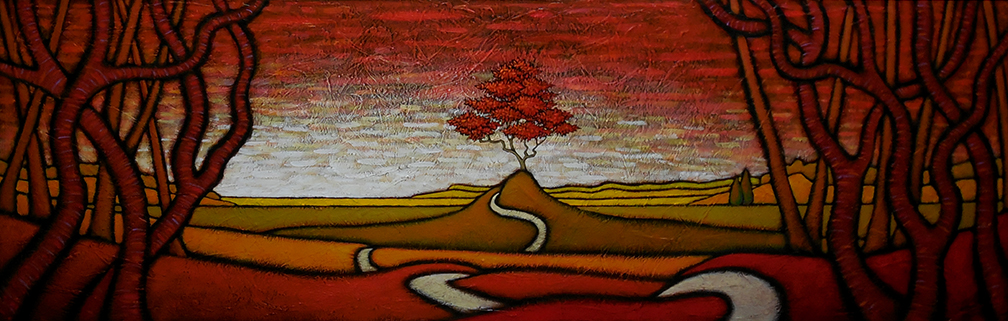
I was looking at the piece above early this morning. It’s been with me for a long time, since 2002. I sometimes take it for granted and don’t take the time to engage with it. But this morning I looked at it longer than I had in some time, reconnecting with what it has meant to me. Maybe it was because it’s near that time of the year when I get to indulge a guilty pleasure with my annual viewing of The Ten Commandments, the campy biblical epic from Cecil B. DeMille that always runs on ABC during the week before Easter. Or maybe it’s that the pronunciation of the Hebrew word ger which means stranger sounds the same as the shortened version of my name that my family often used for me growing up. I don’t really know but thought that it would be appropriate to share a post about it that has ran a couple of times during the many years this blog has been around.
I have been writing recently about some of the orphans, those paintings that make the rounds of the galleries and finally come back to me. The piece above is one of these orphans but it really isn’t. It’s mine alone, one of the rare pieces that I don’t think I would ever give up. Like many parents when looking at their children, I see much of myself in this painting.
Over the years I have periodically written about a group of paintings that were considered my Dark Work that were painted in the year or so after 9/11. The piece shown above is one of these paintings, painted sometime in early 2002. I very seldom consider a painting being for myself only but this one has always felt, from the very minute it was completed, as though it should stay with me.
It is titled Stranger (In a Strange Land) which is derived from the title of Robert Heinlein’s famous sci-fi novel which in turn was derived from the words of Moses in Exodus 2:22, shown here at the top. The name Gershom is derived from the Hebrew words ger which means stranger or temporary resident and sham which means there. Together Gershom means a stranger there. It is defined now as either exile or sojourner.
The landscape in this piece has an eerie, alien feel to it under that ominous sky. When I look at it I am instantly reminded of the feeling of that sense of not belonging that I have often felt throughout my life, as though I was that stranger in that strange land. The rolling field rows in the foreground remind me just a bit of the Levite cloth that adorned Moses when he was discovered in the Nile as an infant, a symbol of origin and heritage that acts as a comforting element here, almost like a swaddling blanket for the stranger as he views the landscape before him.
As I said, it is one of those rare pieces that I feel is for me alone, that has only personal meaning, even though I am sure there are others who will recognize that same feeling in this. For me this painting symbolizes so much that feeling of alienation that I have experienced for much of my life, that same feeling from which my other more optimistic and hopeful work sprung as a reaction to it. Perhaps this is where I saw myself as being and the more hopeful work was where I aspired to be.
Anyway, that’s enough for my five-cent psychology lesson for today. In short, this is a piece that I see as elemental to who I am and where I am going. This one stays put.
Here’s a little of the great (and I think underappreciated) Leon Russell from way back in 1971 singing, appropriately, Stranger in a Stranger Land…






 Redtree Times