Feeds:
Posts
Comments

Mantra

******************

The mantra becomes one’s staff of life, and carries one through every ordeal. It is no empty repetition. For each repetition has a new meaning, carrying you nearer and nearer to God.”

–Mahatma Gandhi

*****************

I wanted part of my upcoming June show at the Principle Gallery to feature not only new growth, as the show’s title implies, but a few nods of acknowledgement back to my older work. The new painting above, one that I finished just yesterday and am calling Mantra, is such a nod.

I have periodically used multiple images in my work through the years. Some were quite large back in my earlier days, some having as many as 60+ images making up the piece. I am attracted by the look of these piece but also by the mindset required when painting them, one with a blank concentration, one that produces a repetition of thought and form.

This repetition of thought and form produces small incremental changes in each cell. Each is the same but slightly different.

That could be the mantra for my work.

Over the past twenty years of these shows, the work has always changed in small increments. Changes in colors and tones. Changes in strokes and textures. Additions and subtractions in elements and forms. Each is the same but slightly different.

Again, the mantra.

I guess that is why I chose that word mantra for the title. As Gandhi points out above, it is no empty repetition.

Each repetition is new and has its own meaning even though it is seemingly the same. Each is its own moment in time, its own coordinate on the grid of time and space.

Whether this repetition takes one closer to god, as Gandhi adds, I cannot say. I don’t know what that even means. But if it means that it brings one closer to understanding and a sense of unity with this world, then I agree heartily and this painting, this mantra, says everything I need to know.

***********************

My new solo exhibit at the Principle Gallery , my 20th annual show there, is titled Red Tree: New Growth and opens June 7, 2019 at their Alexandria, VA gallery.  The painting above, Mantra, will be included in this show.

****************

Do not try to paint the grandiose thing. Paint the commonplace so that it will be distinguished.

William Merritt Chase (1849-1916)

****************

Love these words from the great American painter William Merritt Chase. I echo the sentiment whenever I get a chance to speak with art students, telling them to focus less on subject and more on how they render whatever they choose to depict. Most of the greatest paintings are of very common things, people and places. It is how they are painted that lifts and distinguishes them.

Chase was one of the dominant figures of American art in the late 1800’s. He was a prolific and renowned painter and among the first American Impressionists as well as an influential teacher who established a progressive art academy in NYC, The Chase School, that today is the Parsons School of Design.

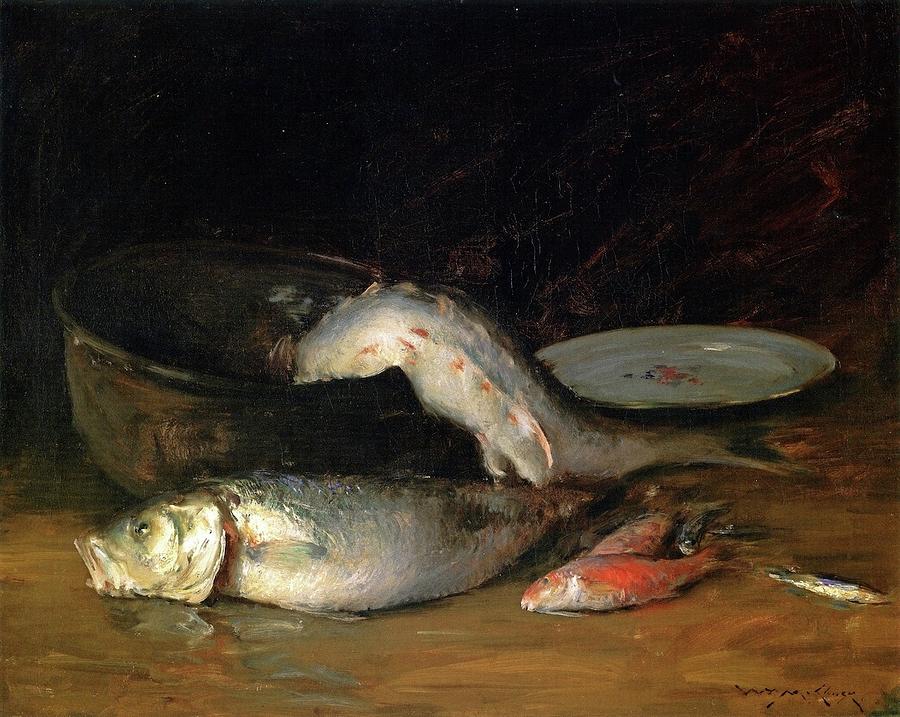
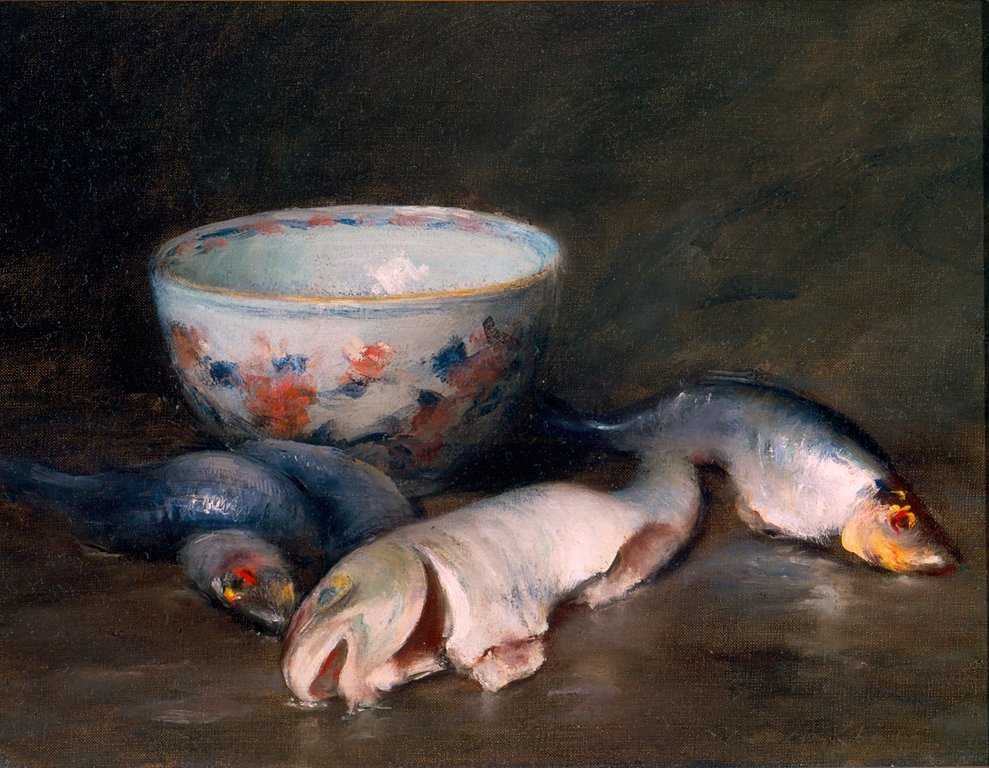
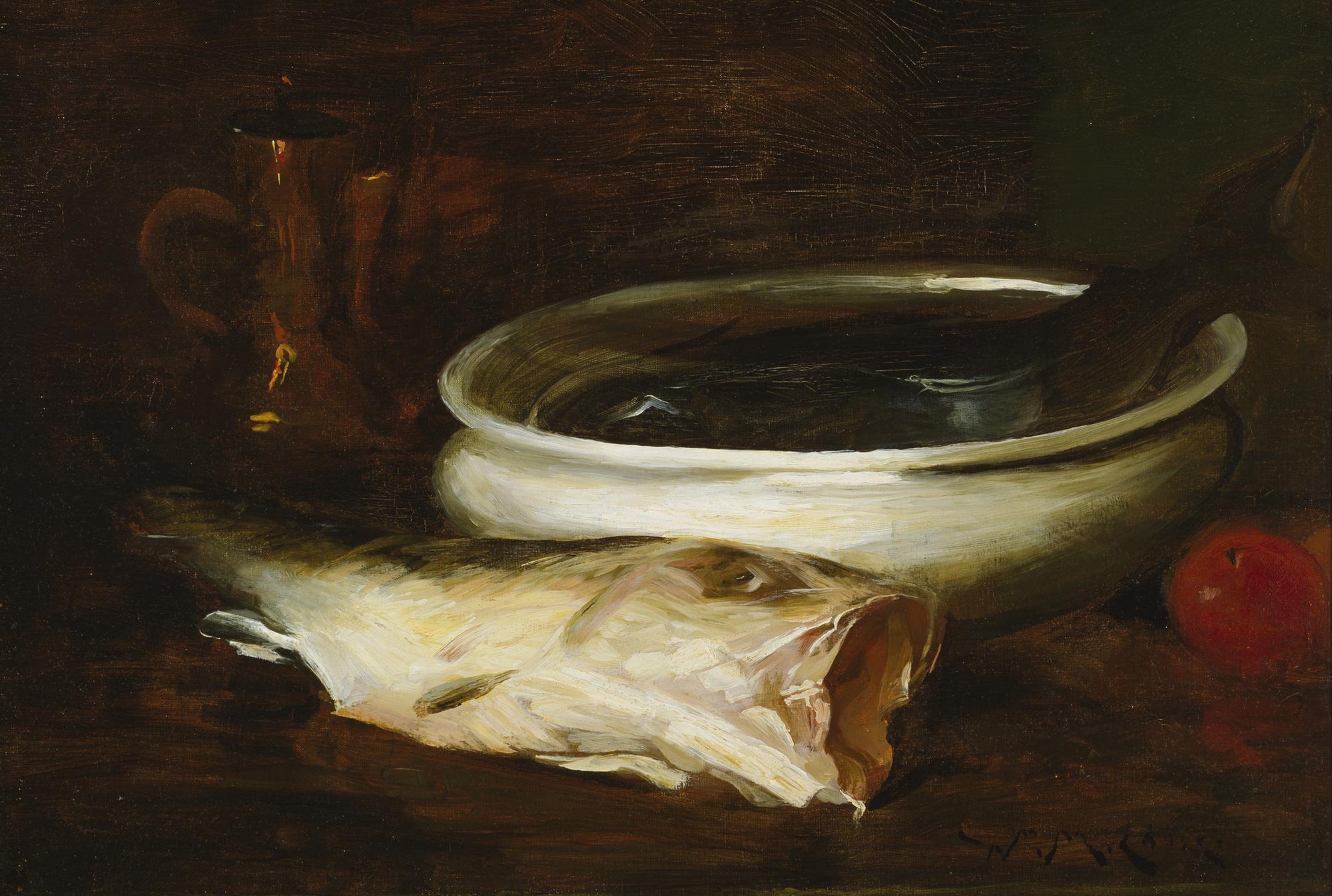
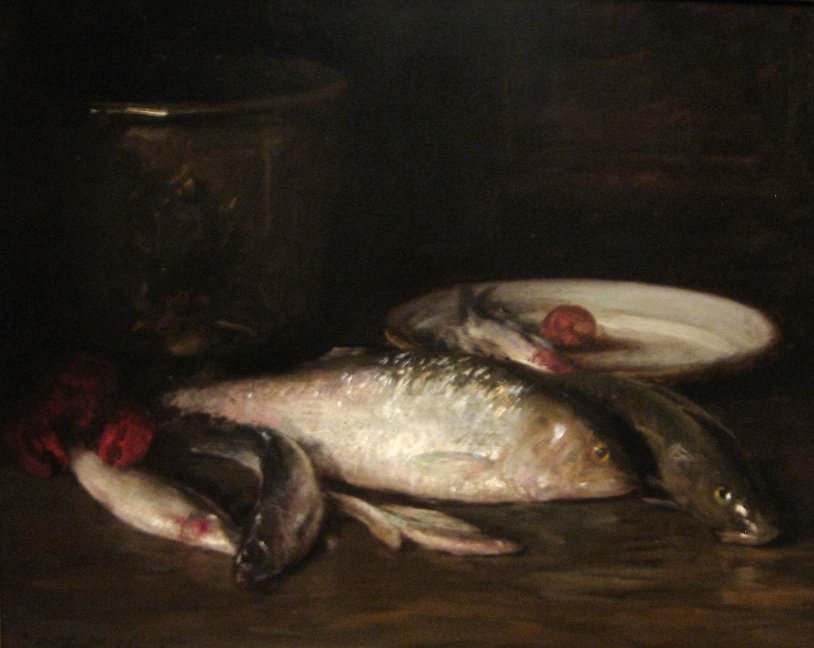
Some of Chase’s best known work is a great example of his words above. He painted the gamut of subjects– landscapes, portraits and still lifes– and is well known for each of these fields. His still life paintings with fish were among his favorite subjects, one that he often employed for painting demonstrations for his students. These pieces were done in a fast, wet into wet technique that relied on extreme contrasts of dark and light , setting aside detail for gesture and impression.

I don’t know how many of these fish pieces Chase painted but it appears to be quite a large figure. A number of years back, the Principle Gallery had one of his fish pieces in the gallery for sale and I remember being very impressed because whenever I thought of Chase his fish paintings always came to my mind.

Here are just a few examples.

********************

“There is a pleasure in the pathless woods,

There is a rapture on the lonely shore,

There is society, where none intrudes,

By the deep sea, and music in its roar:

I love not man the less, but Nature more”

Lord Byron, Childe Harold’s Pilgrimage

********************

This another new painting, coming in at 24″ by 24″ on canvas, that is headed to the Principle Gallery for my annual solo show there. The show,my 20th solo effort at the Alexandria gallery, is titled Redtree: New Growth and opens on June 7. This painting is titled Solitude’s Rapture.

I don’t know if solitude is for everybody. Some people might look at this painting with a little discomfort, seeing in it isolation and loneliness. But for myself, it represents a total freedom of the self, one that allows one’s absolute truth to emerge. A freedom that allows one to experience clear glimpses of our connection with all being.

The lines above from Byron’s Childe Harold’s Pilgrimage express this feeling well. Alone on a shore, one can begin to hear and converse with nature. The lap and roar of the sea becomes language as does the light of the sun and moon as it sifts through clouds above. It is in these conversations that we come to better understand that we are both small and large, insignificant yet integral.

Of  course, this is not a practical matter for most of us. I have my own little island of solitude here in my studio but I am not isolated. My regular life has me out in the world, interacting with people on a regular basis. But knowing that I will soon be back on my island where the only conversation taking place is in myself.

Hermann Hesse put it well in the excerpt below from his book, Reflections. He mentions it as being a way of bitter suffering. I suppose initially, for those who have been always in the society of others and seldom alone, this may be the case when faced with solitude. But, as he points out, when you get past that discomfort, the rewards of solitude are rapturous.

*********************

“We must become so alone, so utterly alone, that we withdraw into our innermost self. It is a way of bitter suffering. But then our solitude is overcome, we are no longer alone, for we find that our innermost self is the spirit, that it is God, the indivisible. And suddenly we find ourselves in the midst of the world, yet undisturbed by its multiplicity, for our innermost soul we know ourselves to be one with all being.”

Hermann Hesse, Reflections

**********************

***************

I pursue no objectives, no systems, no tendency; I have no program, no style, no direction. I have no time for specialized concerns, working themes, or variations that lead to mastery. I steer clear of definitions. I don’t know what I want. I am inconsistent, non-committal, passive; I like the indefinite, the boundless; I like continual uncertainty.

-Gerhard Richter

***************

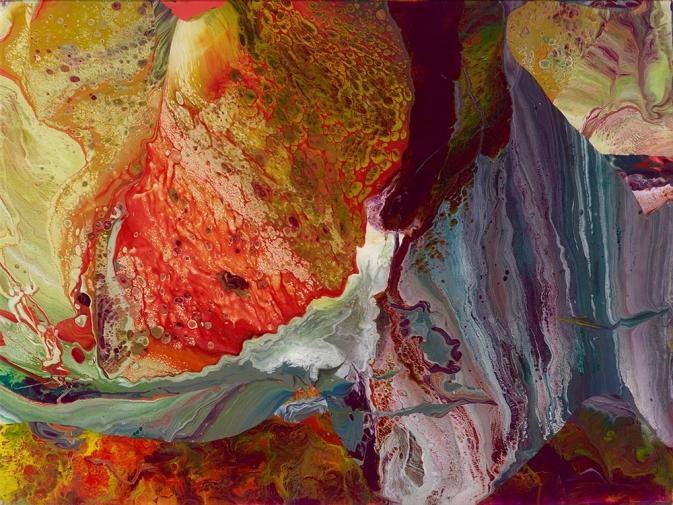
Gerhard Richter, the contemporary German artist born in 1932, is one of those artists whose thoughts about his work have made me appreciate to his work much more fully. He has a way of putting things in terms that are accessible, not just balloons filled with pompous artspeak that says very little.  More than that, much of what he says aligns with how I see art and the purpose of art, even though our work manifests itself in very different ways. I often come something he has said or written that very much echoes my own thoughts, often in a a very similar way. For example, he speaks about the rightness of art, something I to which I also often refer.

His work has moved around through the years through his iconic abstractions to photography and photorealism painting. I tend to gravitate and think of his work in terms of his abstract work, the Abstraktes Bild series from the 1980’s and the 2010’s. I thought I’d share a few of those pieces along with some his thoughts.

At the very bottom is a piece of music from guitarist Bill Frisell. It is from a project that combined Richter’s work, specifically a large book of his art, along with an album from Frisell titled Richter 858. Each track on the album correlates to a piece of Richter’s art. The piece of music below corresponds to the painting directly above it, Abstrakte Bild 858-3. Interesting concept.


***************

I believe that art has a kind of rightness, as in music, when we hear whether or not a note is false.

-Gerhard Richter

***************

My paintings are wiser than I am.

-Gerhard Richter

***************

****************

I would like to try to understand what is. We know very little, and I am trying to do it by creating analogies. Almost every work of art is an analogy.

-Gerhard Richter

***************

I believe that the quintessential task of every painter in any time has been to concentrate on the essential.

-Gerhard Richter

***************

The desire to please is maligned, unfairly. There are many sides to it. First of all, pictures have to arouse interest before people will even look at them, and then they have to show something that holds that interest – and naturally they have to be presentable, just as a song has to be sung well, otherwise people run away. One mustn’t underrate this quality, and I have always been delighted when my pieces have also appealed to the museum guards, the laymen.

-Gerhard Richter

***************

Gerhard Richter- Abstraktes Bild 858-3

****************************

Well I never pray,
But tonight I’m on my knees, yeah.
I need to hear some sounds that recognize the pain in me, yeah.
I let the melody shine, let it cleanse my mind, I feel free now.
But the airwaves are clean and there’s nobody singing to me now.

No change, I can’t change, I can’t change, I can’t change,
but I’m here in my mold, I am here in my mold.
But I’m a million different people from one day to the next
I can’t change my mold, no, no, no, no, no, no, no

The Verve, Bittersweet Symphony

****************************

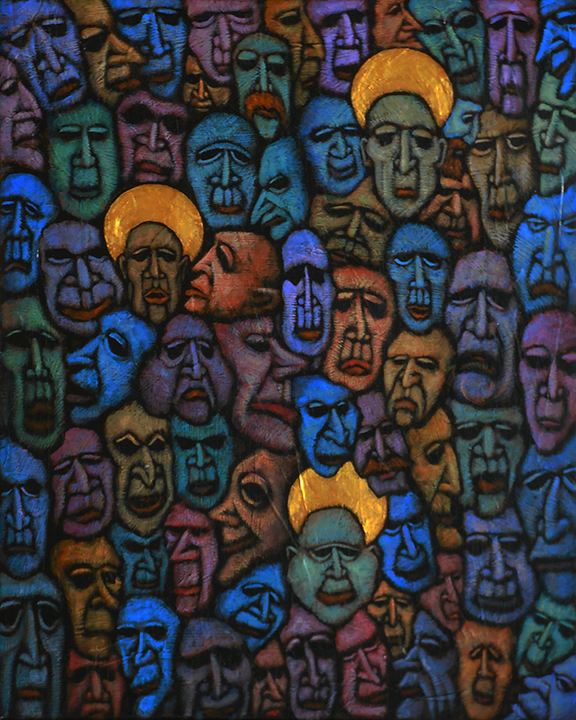
No rest for the wicked. Busy busy early this morning so for this week’s Sunday morning music, thought I’d pair up a new painting from my recent Multitudes series with a classic bit of Britpop, Bittersweet Symphony, from The Verve from back in 1997. Hard to believe it’s been twenty plus years. Many of you no doubt know the song and the video, which has about half a billion views on the YouTube on the interweb, but I think it works for myself this morning and as an accompaniment to the painting.

The painting is a darkly colored piece called Multitudes: Everyday Saints. I was prepared to give an explanation of this piece but the more I think about it– and I’ve already spent too much time doing just that this morning– I think I’ll just let it stand out there alone for awhile.

Take it as it is, okay?

Gotta run now. Give a look and a listen and have a good Sunday.

******************

To appreciate a work of art, is it okay to like what you like, and the heck with the art critics and experts? Absolutely.

–Thomas Hoving

*******************

I came across this quote from the late Thomas Hoving and thought it would be a good opportunity to show off an illustration of him done by the late David Levine, the famed illustrator/artist whose distinct caricatures adorned the New York Review of Books for many years, along with many other publications. The original drawing now hangs in a corner of my studio, obtained from the estate of Thomas Buechner who was friend to both Levine and Hoving.

Hoving was primarily a museum director. Now that sounds pretty blasé on its surface but among his peers he was a rock star,writing bestselling books and ushering the Metropolitan Museum into a renaissance of sorts as its director. He was big personality in what is often a low key position.

His words above definitely ring true as good advice to anyone who has ever felt anxious about purchasing or even sharing their opinion on a piece of art. Feel free to buy and admire work that speaks to you, regardless of what critics might say. Art is based on an emotional elicitation and nobody can dictate how anyone should respond to any one piece of work. A critic may have a response to a work of art and write effusively about that work, perhaps even making cogent points about the validity of the work. But if I don’t feel that same emotional response, all the eloquence in the world telling me why I should like it cannot make me suddenly adore that work.

In short, we like what we like.

I’ve seen people in high powered positions, people who normally ooze confidence, suddenly turn to jelly when trying to decide whether they should buy a piece of art. Art is such a nebulous and subjective thing that many of these folks feel a bit lost and out of their depth. They are afraid of making a mistake and lose all trust in their own opinion. They forget that they should simply like what they like and trust that feeling.

So, if you see something you like sometime, don’t be shy about showing your admiration for it. Maybe that means purchasing it or maybe it’s just letting the artist know that it moves you somehow.

Both are appreciated by every artist I have ever known.

Super busy day. Still feverishly painting away and mixing in beginning prep work on staining frames and varnishing paintings as the  clock ticks down. Only two weeks until I deliver this group of work to the Principle Gallery for my solo show there, opening June 7. There is always a sense of tension, panic and rush at this point in getting ready for a show, something I know from the fact that this year’s show is my 20th solo effort at the Principle. After all these years, I know the routine that has been formed.

But there is even a bit of added anxiety in it being the 20th show there. I guess this anxiety comes, putting it in the simplest terms, because I fear every show could be my last show, my last chance to prove myself, my final opportunity to demonstrate that I am deserving. This being the 20th just accentuates that point that there might not be a 21st.

Fear as a primary motivator doesn’t sounds right when pertaining to art but it seems to be the case with me. I don’t know if that’s good or bad and I really don’t care at this point. It keeps me from lulling myself into an attitude where I believe I am owed anything from anybody. Experience has taught me that I am entitled to nothing, that I have to treat every show as my first and possibly last show.

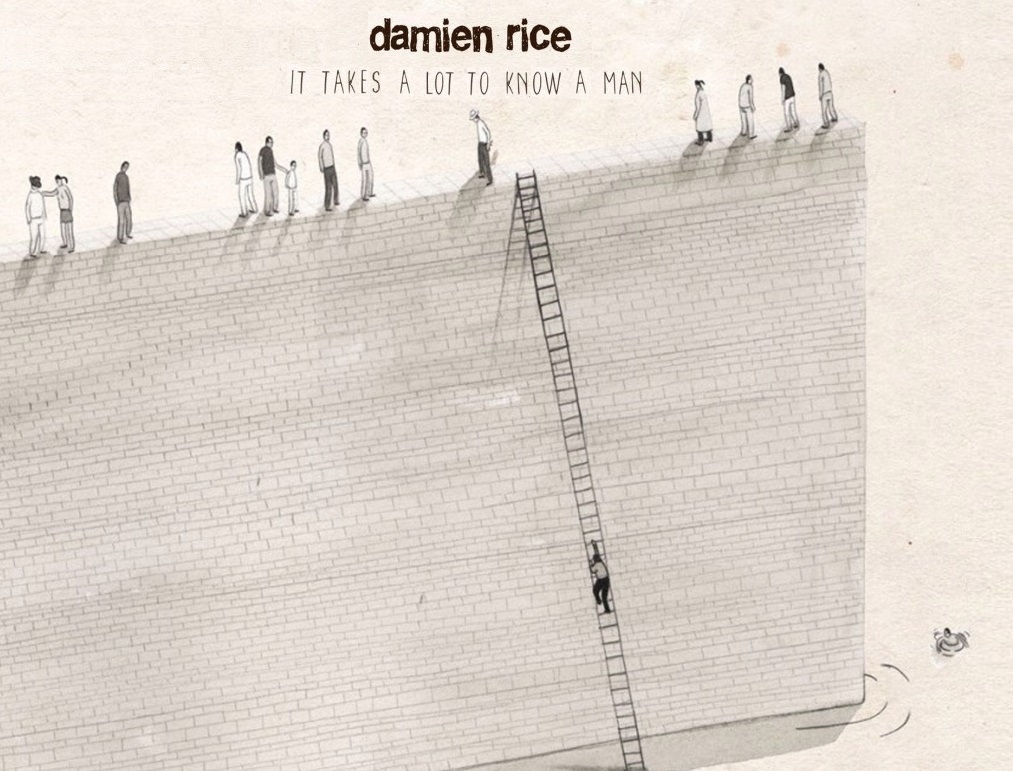
So, I am going to get to work in an early morning cold sweat. Just the way it should be, I guess. I thought I’d share a song, It Takes a Lot to Know a Man,  from Irish singer Damien Rice. There are two version below. One is the studio recorded song with instrumentation and accompanying lyrics.

The other is a live vocal performance that took place at a German music festival with Rice and the choral group Cantus Domus performing for an audience of one.  A single audience member at each show was kidnapped and taken to a hidden location. When the sack was removed from their heads they found that they were in what appears to be some sort of underground chamber surrounded by the group and Rice, who proceed to give them a one to one concert experience. I can only imagine being both incredibly uncomfortable and deeply moved. It’s an interesting film and a lovely song.

Have a great day.


*******************

“I learned this, at least, by my experiment: that if one advances confidently in the direction of his dreams, and endeavors to live the life which he has imagined, he will meet with a success unexpected in common hours.”

― Henry David Thoreau, Walden: Or, Life in the Woods

*******************

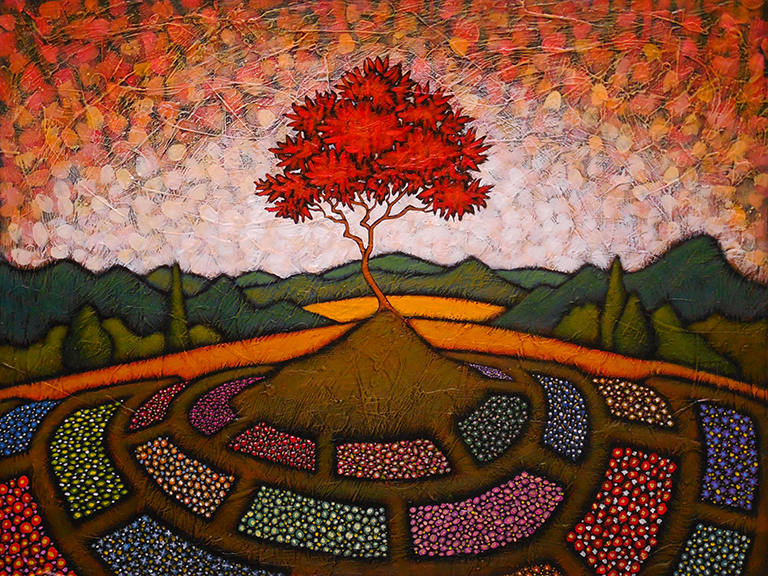
This is a new painting, 18″ by 24″ on panel, that is headed to the Principle Gallery for my upcoming show, Redtree: New Growth, that opens June 7. It’s been one of those pieces that keeps drawing my eye in its direction here in the studio. Maybe it’s the rings of colorful flowers– part of the New Growth from the show’s title–that encircle the Red Tree that attract my eye. They have a gem-like quality in the landscape.

I have mentioned in the past how I view many of my Red Tree paintings as being portraiture as much as they are landscapes, with the Red Tree and the foreground landscape often serving as the head and shoulders of a portrayed figure.  That certainly holds true for this piece, which I have titled  The Pharaoh’s Necklace.

In this piece, I see the Red Tree as a head held high with the colorful bands around the mound– the neck here– transforming from beds of flowers into a sort of necklace like those seen of the pharaohs of ancient Egypt. By the way, for your daily dose of useless facts, that type of necklace is called a usekh or wesekh.

Seeing this painting as a portrait, I see it as a portrayal of the strength and pride of someone who has, as Thoreau describes above, endeavored to live the life they have imagined in their dreams and have met with unexpected success.

More than that, it’s a painting of possibility, one that points out that we all have the potential to realize our hopes and aspirations, That is, if we can first formulate a dream. I sometimes get the feeling that many people have never given their dreams much thought.

As to those who have, I often wonder if many people actually maintain the dreams of their youth into their adulthood. If not, have they convinced themselves that these dreams were foolish and unattainable then finally ceased all pursuit? Or perhaps they had aspirations that didn’t match up with their actual strengths and abilities?

For example, I knew at an early age that my dream of being the ace of the St. Louis Cardinals pitching staff was off the table. And I never had the nerve to be a master thief. I knew my dreams had to focus on the few qualities I possessed and prized if they were ever going to come to fruition, if I was ever going to wear my own pharaoh’s necklace.

And, thankfully, there are some days when I do feel that I am sporting my own gem encrusted usekh. Those are the good days of this life and this painting is how those certain days feel to me.


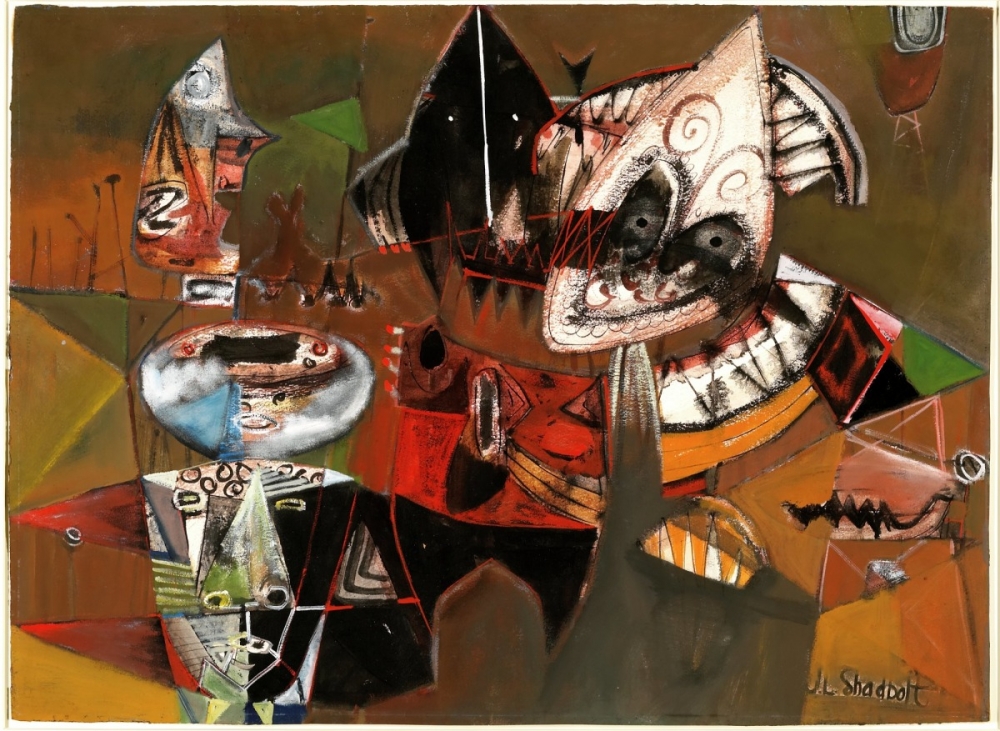
Jack Shadbolt- Presence After Fire – 1950

***********************

An artist is no bigger than the size of his mind.

–Jack Shadbolt (1909-1998)

***********************

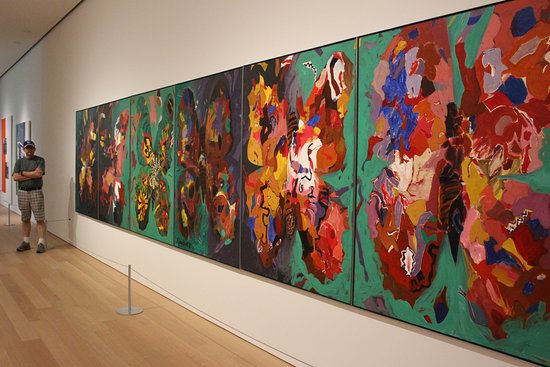
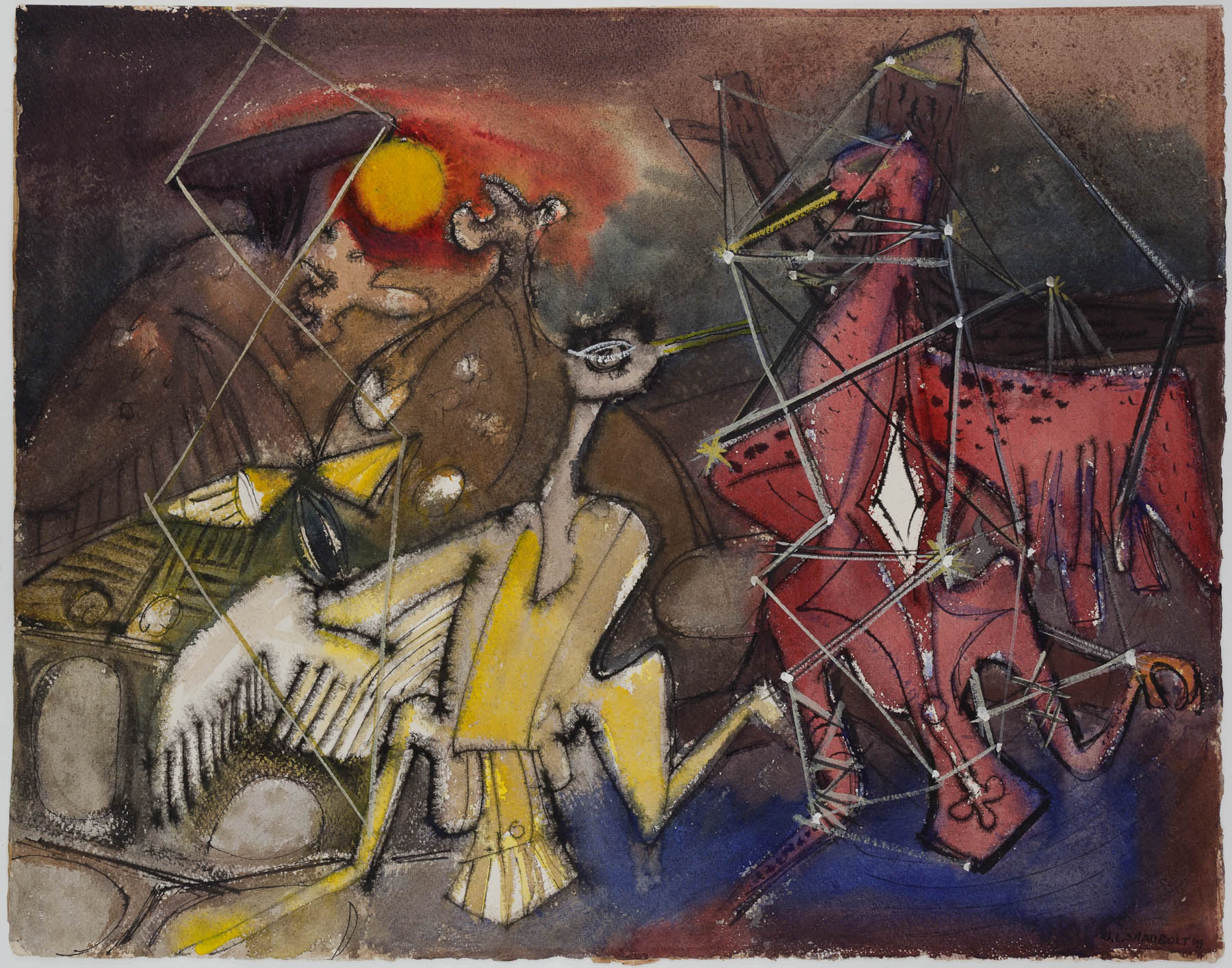
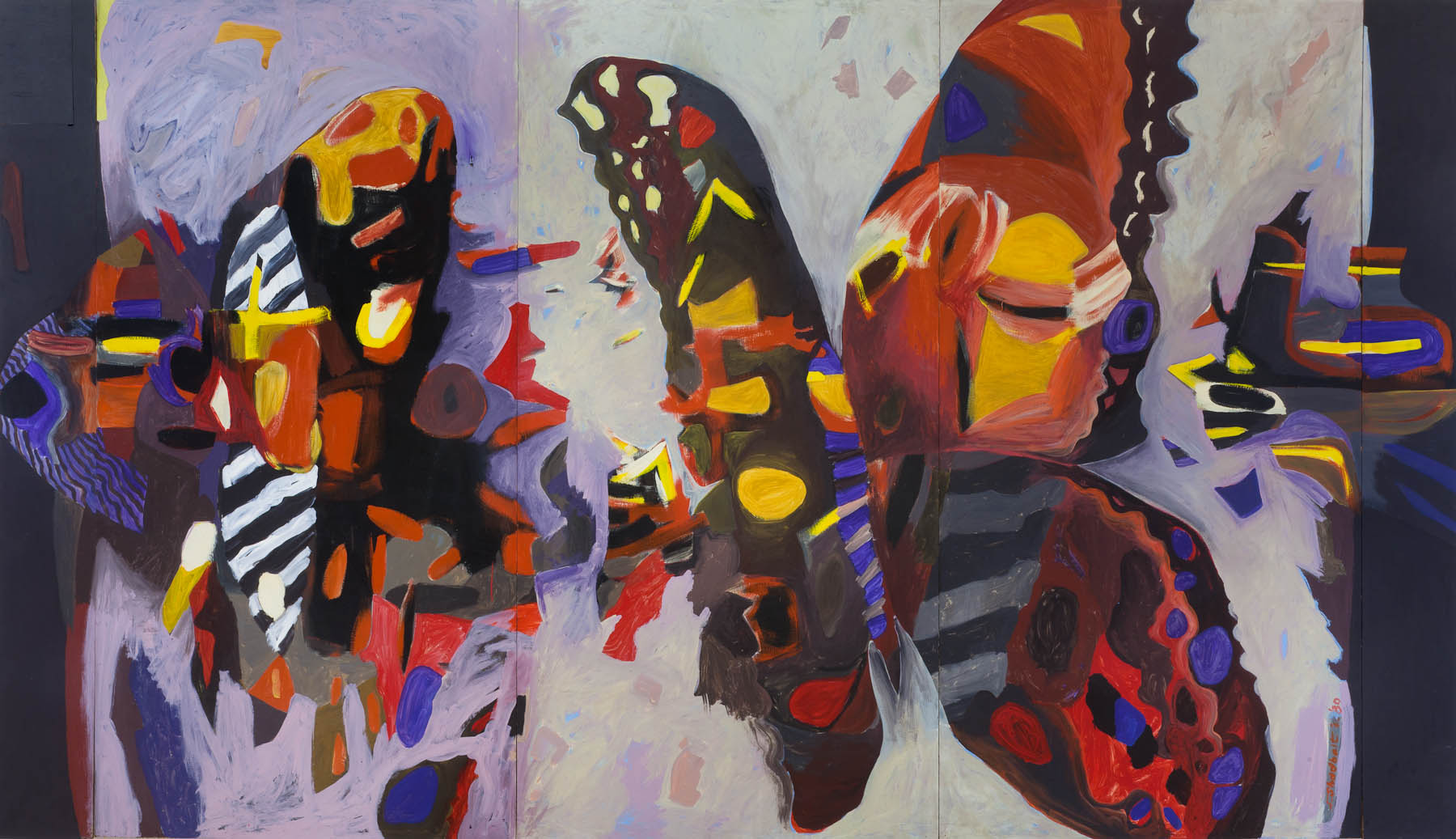
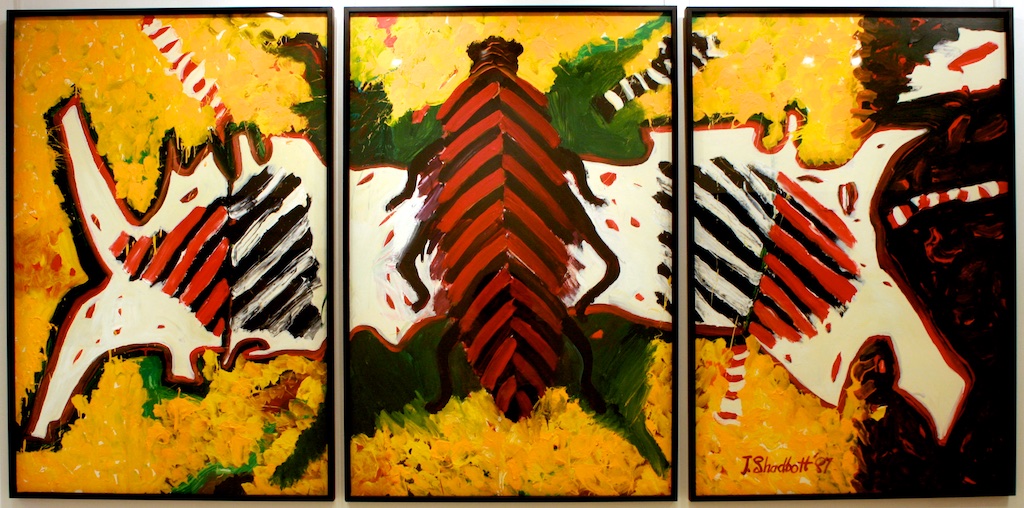
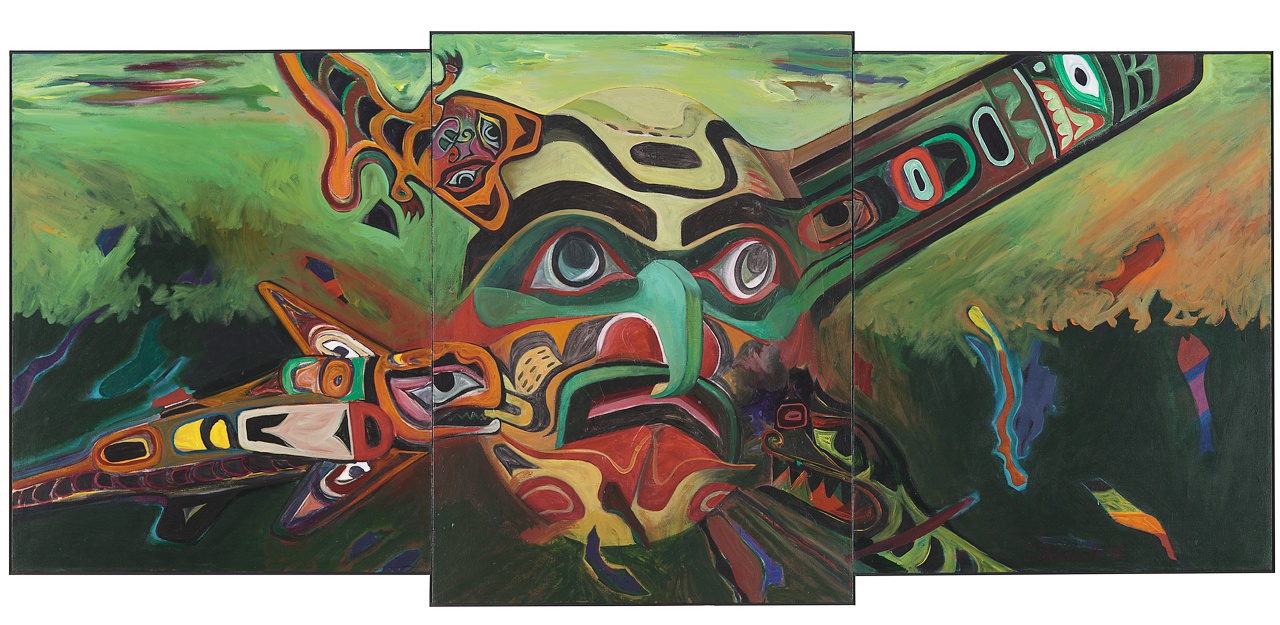
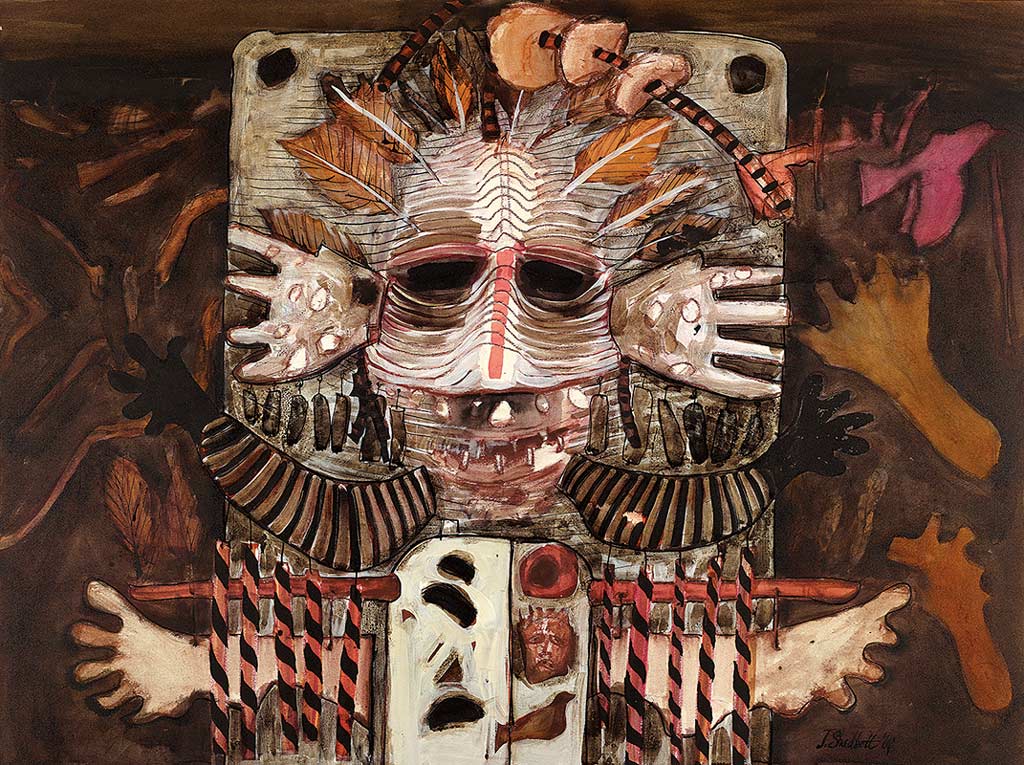
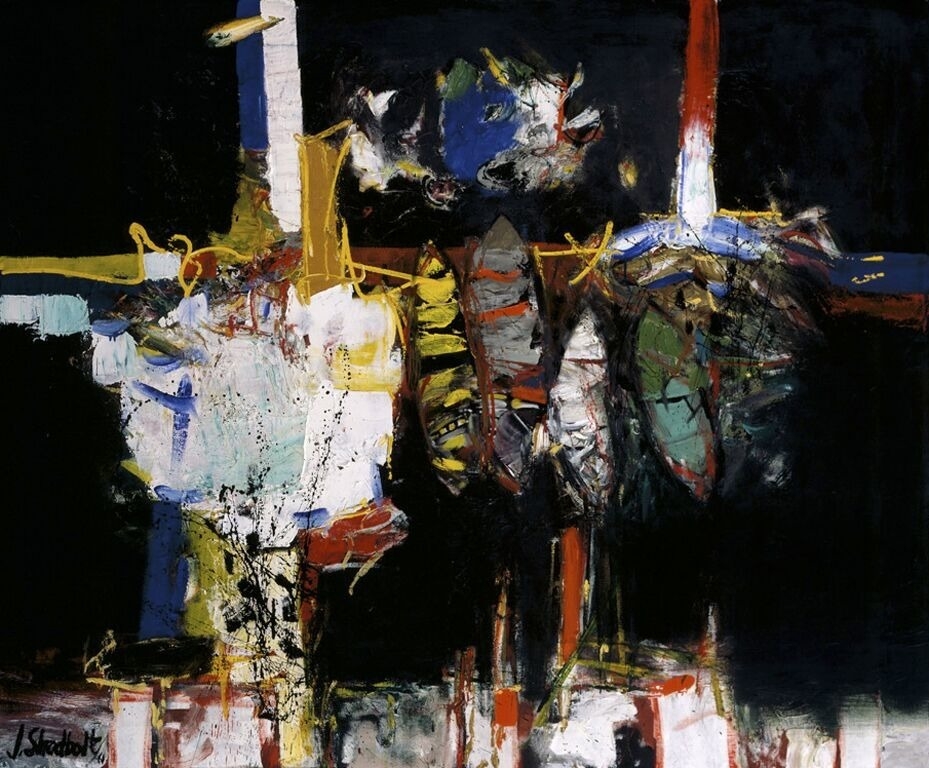
I have to admit that I knew little of the Canadian painter Jack Shadbolt before this morning. But I was immediately taken by his use of bold colors and forms along with an interesting use of symbolism depicted in a blend of representation and abstraction. I was also impressed with the scale of his many triptychs, their size giving the work greater weight. Just interesting work to put it simply.

There is a good short bio of Jack Shadbolt that you can read by clicking on this link. It gives you an idea of the forces, such as his World War II experiences, and people–his friendship with iconic Canadian painter Emily Carr, for example– that shaped his work. It also makes clear the influence his work has in his homeland.

One thing I discovered was that as Shadbolt was suffering at the age of 89 from congestive heart failure, his wife brought him home from the hospital. She set up a hospital bed in the center of his studio in British Columbia so that he might be surrounded by his paintings and be in that place where he had spent most of his time at his life’s work. He died there in his studio several days later.

I thought to myself that would not be a bad way to go. That is, if for some reason I decide to die someday.

But the focus today is on the short quote above, one with which I heartily agree. Whenever speaking to students I try to stress the need to grow their mind, to become an interesting person with something to say. To read more. To watch and listen more. To simply think and continue to learn.

Technique without an active mind behind it bears lifeless work.

At least, that’s my opinion. And Shadbolt said that beautifully and succinctly.

Now, take a look at some of the work of Jack Shadbolt.

Drumbeat

George Grosz- Explosion, 1917

**************************

In time of actual war, great discretionary powers are constantly given to the Executive Magistrate. Constant apprehension of War has the same tendency to render the head too large for the body. A standing military force, with an overgrown Executive will not long be safe companions to liberty. The means of defense against foreign danger, have been always the instruments of tyranny at home. Among the Romans it was a standing maxim to excite a war, whenever a revolt was apprehended. Throughout all Europe, the armies kept up under the pretext of defending, have enslaved the people.

-James Madison, speech at the Constitutional Convention, 1787

**************************

The drumbeat of war has started.

It’s all too predictable.

Here at home, the executive branch is under huge strain as it tries to deflect against any inspection or investigation of its actions. The president* has had historically low approval numbers while his actions seem designed to favor the wealthy few or his most ardent supporters at the expense of the majority of its citizens. He has shown a penchant for punishing those who stand against him and for spewing hateful, divisive rhetoric at rallies.

This same president* has shown a decided preference for foreign dictators and despots over our traditional friends and allies. He has attempted to follow their examples here at home, shattering the norms of democracy by trying to gain more and more power for the executive branch, unburdening himself from any sort of oversight by the other branches. His actions are uncompromising and unilateral, evidence of his desires for the same sort of unfettered power he sees in those autocrats he so admires and fawns over.

He desires unlimited executive power with little or no oversight.

So, as investigations roil around him, as his ambitions become more and more apparent (and attainable thanks to a craven GOP senate and a personal lawyer in the form of the Attorney General) what better way to deflect attention and gain support than use the ancient ruse, as Madison pointed out in his speech at the Constitutional Convention of 1787, of moving towards war against some foreign enemy?

We already have a historic foe in Iran. Our president* has been assisted by foreign autocrats, particularly the Russians and the Saudis, in reaching his lofty perch and appears to be in debt in some way to them now, willing to do their bidding on the world stage.  Iran is already an enemy to one of this president*’s greatest supporters, the Saudi Prince.

Recent unsubstantiated attacks of Saudi and UAE oil tankers (damage made by these unseen attacks was above the waterline, causing no spillage or injury nor made the ships less seaworthy) have the drums beating louder and louder. We have sent a carrier group to the Persian Gulf and plans are being prepared to send up to 120,000 US troops to the region. That is a force of about the same size as when we invaded Iraq. This would also be a unilateral move on the US’s part, with no involvement from our former traditional allies.

It is dangerous moment for us and the world.

A conflict  in this region could cost us dearly. The number of troops who would be sacrificed, and sacrificed is the term I knowing use, is unknown but even one or four or a hundred would be too many for such a misdirected ploy. There has even been talk that if this turned into a full blown war that we would not have sufficient numbers of troops and might need to reinstate the draft.

Or use private armies, an idea I find as reprehensible and financially irresponsible as the idea of private prisons.

Financially, it would cost our nation for decades to come as we know from the debt we still pay for the wars of the early 2000’s. Gas and oil prices would no doubt rise sharply with an ongoing war in that area of the world.

The repercussions throughout the world as far as trade are not known but past experience would point to a global downturn which in turn would strain those countries with already marginal economies. Would-be tyrants would be emboldened and there would be a surge in refugees fleeing such places.

It would be an existential test for a world already under stress.

And all because of a man* who has debts to those who would use him for the worst of reasons.

He is compromised and as a result, we, the people of this nation, are compromised as well. We will all be forced to pay for this compromise, some with money and some with their blood, their limbs, and their lives.

And for what? To divert attention? To change the narrative? To pay off some sort of debt?

And the drum beats on.