Feeds:
Posts
Comments

Archive for August, 2010

In the area where I live,  near the the NY/Pennsylvania border just south of the Finger Lakes, there is a great monthly magazine called Mountain Home.  It’s a beautifully produced and edited magazine that is free, distributed through grocery and convenience stores and a variety of other outlets throughout the Northern Tier of Pennsylvania and the Southern Tier of NY.  When it first came out several years ago, I was immediately taken with the quality of the writing about local stories.  The writers really focused on real storytelling, giving the stories of local people and places real depth and interest, exposing aspects of everyday life here that are often overlooked.  Just plain good writing.

A rare thing in modern journalism of any kind.

Turns out there’s good reason for this.  The publishers are a married couple, Theresa and Michael Capuzzo, who had both been journalists in the Philadelphia area and relocated back to Wellsboro in Tioga County, PA, where Theresa grew up.  Michael had been a police and crime writer for the Philadelphia Inquirer and the Miami Herald, nominated four times for the Pulitzer Prize and the winner of numerous other awards for his writing.  He is also the author of Close to Shore, the bestselling account of the summer of 1916 when Great White shark attacks along the northeast coast were epidemic, providing the inspiration for Jaws.

More recently, he has a new book out, The Murder Room, which has been garnering tremendous reviews and media coverage, including a recent ABC special cenetring on the book’s main character.  It is the real-life account of the Vidocq Society, a group of the best detectives and forensics experts from around the globe who meet monthly in Philadelphia where they go over and attempt to solve the most baffling cold cases, on a pro bono basis.  You can read an excerpt from the book as well as an interesting article on the main character of the book by clicking on the magazine cover above and going to the Mountain Home website.

The great writing and editing of the Capuzzos and their staff has been a real gift to this area.  They shine a flattering light on the places, people and history of this area and make me proud to call it home.

Read Full Post »

I try to keep up with pop culture but it spreads so far to the horizon that sometimes there are phenomenons that go unnoticed in my little world.  It took seeing a clue on Jeopardy ( a year old repeat, at that) to bring this YouTube sensation to my attention.

It’s called The Evolution of Dance and has been viewed  almost 150 million times in the past few years, making it the most viewed video ever on YouTube.  It features motivational speaker/dancer Judson Laipply going through quick takes on pop dancing and while it’s pretty clever and entertaining, and while hedoes have a knack for communicating with his movement, I still find myself baffled at the huge popularity of the video. 

Even more baffling, and startling, is the amount of time spent watching this video.  Doing some quick math, the time spent watching this 6 minute video 150 million times amounts to 15 million hours.

Wow.  15 million hours spent in front of the computer screen to see just this.  Taken out even further, it’s 625,000 days.  Talk about lost productivity!  It makes one wonder about how we spend our time.  I know I feel like I’ve lost hige chunks of my precious time on earth gazing at much too much goofy stuff.

Anyway, if you’re one of the last people to have not seen this or heard of it, here it is.  Sorry for the lost time.  I know it’s 6 minutes I’ll never get back.

Read Full Post »

A Cheerful Nature

There is one thing one has to have: either a soul that is cheerful by nature, or a soul made cheerful by work, love, art, and knowledge.

———Friedrich Nietzsche

***************************

Interesting quote.  I know that my life is made more cheerful from work, love and art. It’s the knowledge part that I find myself questioning.  Sometimes it feels that knowledge takes away cheerfulness, as thought the more we know the more dire the situation seems.  But I realize that I’m confusing knowledge with information.  Knowledge is taking information and having the ability to use and cope with it, to see how information fits into a larger framework.  A distinct difference there and one that most of us confuse. 

We’re bombarded with new information all the time, in an endless barrage of charts and numbers and words.  We are living in the world of information today, after all.  And after taking it all in feel as though we’ve obtained knowledge. 

 Information, yes.  Knowledge, no.

So, maybe Nietzsche is right after all.  Having true knowledge, an ability to cope with all this information in a coherent manner, would cheer me up. I guess I’ll keep trying to gain some.  I would so much more enjoy living in the world of knowledge than the world of information.

Read Full Post »

August

Skeleton- Pablo Picasso

This print from Picasso very much sums up my feelings for the month of August. 

I have never been a fan of August.  Memories of the so-called dog days of summer spent as a child.  Hot from a relentless sun.  Bored.  Burnt grass crunching underfoot.  The coming school year hanging overhead like the sword of Damocles.

August has always had a faint aura of death around it for me.  I remember the death of my grandfather in ’68.  My beloved dog Maggie years later.  Several friends over the years, from a variety of causes. Elvis.   The bright glare of the August sun seeming to taunt the grief of the moment.

August.

We were watching something on television the other night, perhaps Mad Men– I can’t really remember.  Anyway, the character in the scene that was on said , “I hate August.” 

It made my ears prick up and I couldn’t help but mutter, “I’m with you there, brother.”

August.

Well, I’ve got a lot to do this August  morning.  It takes a lot of work to keep busy to ward off the cruelty of  August…

Read Full Post »

The Raised Fist of Protest

Fist by Frank Cieciorka

On the television show History Detectives on PBS, there was a story investigating a protest poster that was made around the time of the famous protests surrounding the Democratic Convention in Chicago in 1968.  It featured two images, one a glowering police officer in helmet and sunglasses and the other this fist.  The segment went on to examine further how the image of the fist evolved and became one of the most powerful symbols of the protest movement of the time, used by the Black Panthers and multitudes of Labor movements as well.

They gave the name of the artist who was responsible for this iconic image, Frank Ciecorka, but gave little  information on the man or his life.  I wondered what became of him or what  his work was like after the 60’s. Looking him up, I found out that Ciecorka was raised just down the highway from here, in Johnson City, NY, leaving after high school to head to California to go to college.  He became involved with the Civil Rights Movement , organizing African American voter registration in Mississippi at the time of  of the infamous murder of the three student organizers that was later portrayed in the film Mississippi Burning.  It was this time spent in Mississippi that sparked Ciecorka to produce the famed fist.

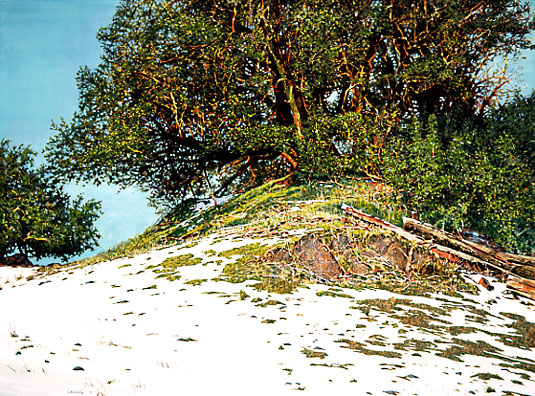
Pepperwoods, Snow-- Frank Ciecorka

The interesting thing to me was seeing his other work after that era.  It turns out Ciecorka became a modestly well known watercolorist living in a rural area of California.  The work was very traditional and well executed.  Quiet in tone. Hardly radical at all.  Looking at them said a lot to me.  This was a man who was branded a radical at one time but was simply a person seeking peace and quiet for themself and others.  Not an idealogue.  Wanting to give others the same rights and freedoms he had experienced in his life put him at odds with those who sought to oppress or exploit others.  Wanting to do the right thing became a radical idea.

Frank Ciecorka died in 2008 at the age of 69.  His  image of a fist raised in protest, however, lives on as a symbol of the power of the common people to fight oppression.

Read Full Post »

Gloria

Monday morning and I’ve got a lot to do this morning.  But I wanted to show some music and I realized I had never mentioned Van Morrison in my posts even though I have been a fan forever.  So much great music from the guy over the past 45 years or so.  Sounds funny to say that- 45 years or so.  But it’s true.  Consistently good if not great for all that time.  Songs like Brown Eyed Girl, Domino and Into the Mystic CaravanMoondance.  His night songs– Here Comes the Night and Wild Night.  So many great songs from the man from Belfast.

And then there’s Gloria.

Gloria became one of the icons of the rock era of the 60’s, being covered by scores of bands.  Performing with his band, Them, Morrison recorde this classic in 1965.  It was a B-side (we’re in the 45 RPM single era here, kids) to their hit single, a cover of the blues classic, Baby, Please Don’t Go.  The  sharp-edged marching rhythm  and Morrison’s snarling vocals on the song propelled it along to the chorus.

G-L-O-R-I-A!

Even illiterates could spell Gloria at the time.  Just plain, good stuff here.  Here’s a version I found that was perhaps produced for French television if the Les Them at the beginning is any indication.  It’s a curious video with a recurring image of a donkey throughout.  I have no idea what it means.  Anyway, here’s Van Morrison with Them…

Read Full Post »

Southern Gardens- Paul Klee

I was asked yesterday if I talked to my paintings.

  Interesting question.

I talk to animals.  I talk to trees and plants.  I talk to my car. I talk to my studio, which actually has a name. I talk to ghosts, present or not.   Whether any of these things or beings listens is another matter.

But talk to my paintings?

It immediately brought to mind a section of a famous lecture that I had been reading recently and had really resonated with me.  It was On Modern Art,  delivered in the 1920’s by Swiss artist and a personal favorite of mine Paul Klee :

May I use a simile, the simile of the tree? The artist has studied this world of variety and has, we may suppose, unobtrusively found his way in it. His sense of direction has brought order into the passing stream of image and experience. This sense of direction in nature and life, this branching and spreading array, I shall compare with the root of the tree.

……..From the root the sap flows to the artist, flows through him, flows to his eye. Thus he stands as the trunk of the tree. Battered and stirred by the strength of the flow, he guides the vision on into his work. As, in full view of the world, the crown of the tree unfolds and spreads in time and space, so with his work.
……..
Nobody would affirm that the tree grows its crown in the image of its root. Between above and below can be no mirrored reflection. It is obvious that different functions expanding in different elements must produce divergences. But it is just the artist who at times is denied those departures from nature which his art demands. He has even been charged with incompetence and deliberate distortion.
……..
And yet, standing at his appointed place, the trunk of the tree, he does nothing other than gather and pass on what comes to him from the depths. He neither serves nor rules–he transmits. His position is humble. And the beauty at the crown is not his own. He is merely a channel.

This very much sums up how I’ve always felt about art, especially my place as an artist.  A mere channel or transmitter.  And when I look at my paintings, it is not in the form of a conversation so much as listening  to what the painting has to tell me.  I paint because I question and, at best, the paintings provide some answers and insight that I might not find or see otherwise.

So, do I talk to my paintings?  Not so much.  But do they talk to me?  Yes.  And I do my best to listen…

.

Read Full Post »

Yesterday’s post about the 50th  anniversary of Green Eggs and Ham  by Dr. Seuss made me think about a piece that I’ve had hanging around my studio for the past decade.  It’s a painting that I did in 2001 that I call Red, Hot and Blue.  It’s an oil on panel piece that is pretty big, almost 5 1/2′ tall in its frame.  It could be a small door.  It showed in a few galleries after it was first painted and never found a home so it retired to my studio, to keep me company.

I mention it  because it was been called the “Dr. Seuss painting”  by several people who saw it when it was hanging in the galleries.  They saw something in the way the trees were shaped and colored  that gave them the appearance of a Seuss character.  I had no thought of Seuss when I painted the piece but when I heard these comments I began to see it. 

The expressive sway of the trees as though they were dancing.  The bright primary colors- the red of the foliage and the bright blue of the trunk.  Even the two trees in the background added to the Seuss-y feel.

The foliage actually looked like the endangered Truffala trees from Seuss’ cautionary fable about the environment, The Lorax

It was not intended but it made sense.  Seuss’ books were about communicating by giving strange creatures and things we often see as objects, such as trees and flowers, human qualities.  His characters moved  with a rhythm that made them feel alive. Just what I was trying to do with my painting.  I’ve often  felt that we best see and better understand things that possess human qualitities.  I remember being taught that the Native American tribes in the area where I grew up gave names to local hills based on the human qualities they had.  It made an impression and started me looking for the human form in all things. 

The curve of a tree trunk. The roll of the land.  The fingers of clouds in the sky.

To communicate.

So, while it was never intentional, this painting was very much a product of the influence of Dr. Seuss and others.  When I look at it today, I don’t see the name I gave it.  I see it as that “Dr. Seuss painting”.

Read Full Post »

Yesterday marked the 50th anniversary of the publication of the classic children’s book  Green Eggs and Ham from Theodor Geisel, better known as Dr. Seuss.

  I grew up in the heyday of  Dr. Seuss in the 1960’s and his strange characters and clever wordplay seem as familiar as breathing, so ingrained were they in the popular culture of the time.  Everyone knew the Grinch and the Cat in the Hat but the sheer simplicity and rhythm of Green Eggs and Ham always made it my favorite.

Using only fifty words with all but one being monosyllabic, Geisel created a book that is not really a story so much as a mantra of sound and rhythm.  There is some strange human element, an allure,  in it that I can’t put my finger on.  Whatever the case, I have a huge place in my heart for the simple words of this book.  Fifty years dosen’t seem like too long a time for the timeless.

Perhaps one of the best readings from the book came on Saturday Night Live in 1991.  It was the week after Dr. Seuss died and in tribute the Rev. Jesse Jackson did a dramatic reading .  It is a classic…

Read Full Post »

A few weeks back,  I wrote a post about a commission I was working on that was based on the Greek myth of Baucis and Philemon.  It was an interesting request and I hoped to be able to deliver a painting that captured somewhat the spirit of the tale of the humble couple who the gods ultimately favored with eternal lives together in the form of  a tree.  The painting shown here is the final product of the request.

My original conception of the painting was closer in detail to the myth with the two trees, sprouting from one trunk,  being located on a wide barren plain.  But the more I thought about it, the more I realized that it would be a cooler painting in feel than I think was requested.  I wanted to purvey more warmth, a sort of comfortable affection between the elements in the painting.  So I placed the tree on colorful rolls of land with a road that runs by.  I left out all other trees and vegetation, near and far, so that the tree and its relationship to the moon were the central focus.

This tree is very unique in my body of work.  Typically, when I have trees with separate trunks that intertwine together,  the crown of foliage  they form together becomes one solid unit of color, as though they had merged into one entity.  This piece was different.  The two trees were different but stemmed from the same trunk.  I chose to give their crowns separate colors to highlight the fact that, while they appeared to be one, they are two individual trees.   

For me, the moon here represents the watchful eye of the gods in the myth  (even though Zeus was not a lunar deity) and the horizon set by the water below represenst a feeling of eternity, of transcendent time.  The road leading to them represents the couple’s lives on Earth before they became part of eternity.

So, it may not be a literal translation of the myth, as many earlier classic artists have depicted, I think it carries the spirit of the story and the unity the couple feels together.  For me, it works…

Read Full Post »

« Newer Posts - Older Posts »